

 Comments
  Print
Print  Mail
Mail  Large Medium Small
"Its long-run effect, therefore, should be to help us all - both the public at large and the technical community - to face up objectively to our energy supply problems." Corey's report was published in the International Atomic Energy Agency (IAEA) bulletin.
"Three Mile Island has not changed our energy options. Oil is running out and, for the next 20 or 30 years, we must rely primarily upon coal and nuclear," he concluded.
|
 |
Moving from coal
Today, almost 32 years on, China's energy officials seem to be following that line of logic. A day after Japan's tremor and tsunami, the vice-minister of environmental protection, Zhang Lijun, said China "will not change its determination and plan to develop nuclear power. Some lessons we learn from Japan will be considered in the making of China's nuclear power plants."
China, the world's second largest energy consumer after the US, aims to boost nuclear capacity from about 11 gigawatts to 80 gigawatts by 2020. Even by then, only 6 percent of China's electricity will be produced by nuclear power (now it's just 1 percent). That number is about 20 percent in the US.
The drive is crucial to easing pressures to reduce China's reliance on coal. Coal, a sector in which 2,433 workers were killed in 2010, still accounts for at least 70 percent of the country's energy mix.
The move toward nuclear generation is also vital in curbing the growth of carbon emissions and combating climate change, authorities say. The country is committed to reduce its carbon intensity from 2005 levels by 40 to 45 percent by 2020.
New focus on safety
Japan's nuclear radiation crisis will prompt energy officials to review existing safety standards and raise entry barriers.
Chen Zhanghua, an expert from China National Committee on Nuclear Safety, wrote Sunday on his micro blog, the Chinese equivalent of Twitter: "The most direct consequence of the Japan incident . . . would be enhanced security standards for the nuclear power industry, to shore up defenses against even the most devastating natural disasters."
China adopted its nuclear power industry standards from the IAEA, said Bao Yunqiao, secretary-general of the China Energy Research Society.
"The safety standards for every nuclear project, whether in operation or still in the planning stage, are the same as those globally," he said. China has 13 operating reactors on the mainland and at least 25 under construction, according to the London-based World Nuclear Association.
Many Japanese nuclear plants, including those damaged by the quake and tsunami, were built in the early 1970s. Most Chinese plants in operation were started during or after the 1980s, and thus boast newer technology and are better prepared for catastrophes, Bao said.
|
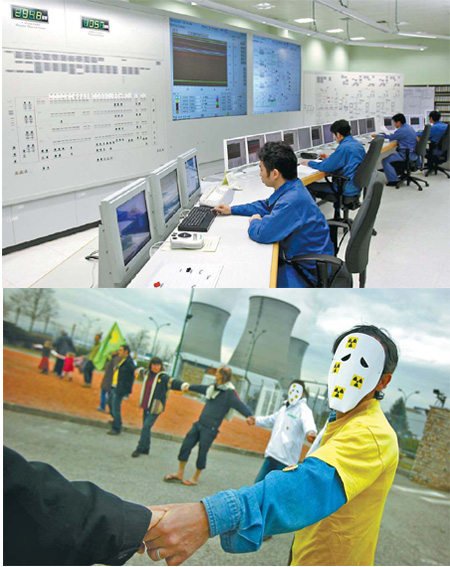 Top: Staff workers keep close eyes in the central control room monitoring Tianwan nuclear plant in Lianyungang, Jiangsu province, one of the biggest of its kind in China. Wang jianmin / for China Daily Above: People demonstrate in solidarity with Japan and to call for a halt in the production of nuclear energy outside Bugey Nuclear Power Station in Saint-Vulbas, near Lyon, central France, on Tuesday. [Photo/Agencies] |
Long prior to the latest crisis, scholars had claimed that problems with Japan's nuclear plants were deep-seated. While Chernobyl led to cutbacks in government funding on nuclear energy projects throughout the world, Japan's number of reactors snowballed from 32 in 1987 (the year after Chernobyl) to 55 today, according to radiation expert Leuren Moret.
Many of the reactors "have been negligently sited on active faults, particularly in the subduction zone along the Pacific Coast, where major earthquakes of magnitude 7-8 or more on the Richter scale occur frequently," she wrote in an article for The Japan Times in 2004.
"There is an extreme danger of an earthquake causing a loss of water coolant in the pools where spent fuel rods are kept If the heat-removing function of those pools is seriously compromised - by, for example, the water in them draining out - and the fuel rods heat up enough to combust, the radiation inside them will then be released into the atmosphere," Moret warned.
In the US, too, senior engineers in Northeast Utilities, which then operated five nuclear plants in New England, warned that fuel pools in plants across the country were risk-prone unless the rods could be submerged at all times.
"And if earthquake, human error or mechanical failure drained the pool, the result could be catastrophic: a meltdown of multiple cores taking place outside the reactor containment, releasing massive amounts of radiation and rendering hundreds of square miles uninhabitable," said an article in the March 4, 1996, Time magazine.

 Looted cultural relics displayed back in China
 Zhengzhou starts rail cargo service to Hamburg
 Jobless graduates swarm to grad school
 Fu becomes oldest living person at 116
 Peking University a hot tourist spot
 Building stands alone in East China
 Rain leads to bigger waterfall in C China
 Bruce Lee exhibition to open in Hong Kong
Copyright 1995 - . All rights reserved. The content (including but not limited to text, photo, multimedia information, etc) published in this site belongs to China Daily Information Co (CDIC). Without written authorization from CDIC, such content shall not be republished or used in any form. Note: Browsers with 1024*768 or higher resolution are suggested for this site.
License for publishing multimedia online 0108263 Registration Number: 20100000002731