|
 The wristband with a blue tag signifies this boy has been processed by the United Nations High Commissioner for Refugees to take shelter with his family at one of the Dadaab refugee camps in Kenya. [Photo by Zhang Wei/China Daily] |
After a 30-minute reception, health check and submitting a bio-fingerprint, Sahra Ali Mohamed and her seven children were given blue wristbands by the United Nations High Commissioner for Refugees (UNHCR).
They arrived at the refugee camp without any belongings, not even a cooking pot, after a five-day bus journey from Jilib in southern Somalia, where the Transitional Federal Government fought the Islamic Courts Union in 2006 and 2007.
Mother and children wait quietly and patiently to collect food from the United Nations World Food Program.
They will soon be officially registered as residents of Dadaab refugee camp in northeastern Kenya, the largest in the world.
The camp is home to nearly 463,000 refugees, 98 percent of them from Somalia. More than 1,000 refugees arrive daily. Monthly arrivals peaked at 40,434 in July. In January, it was 9,861.
Her husband is not with her. He was forced to stay behind as the bus was full. They promised to meet later in the camp.
"I couldn't stay at home any longer. My family would have all died because we didn't have any food at home," she said.
She didn't know that Dadaab also faces severe shortages, of food and space. It has been more than full for some time.
Dagahaley, Ifo and Hagadera camps were established in Dadaab in 1991 to accommodate about 90,000 refugees. Nearly 463,000 people live there now, so extensions were built in Kambioos, Ifo East and Ifo West.
|
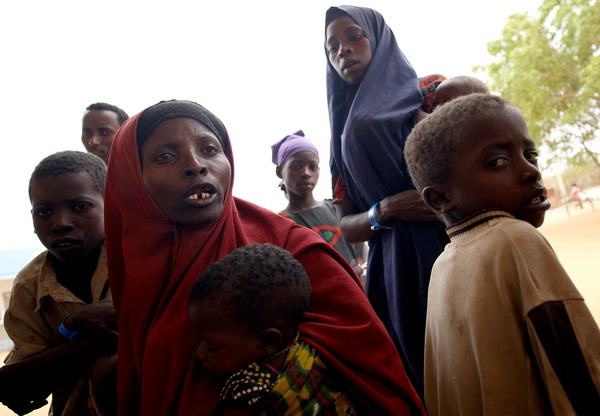 Sahra Ali Mohamed and her seven children arrive in Dadaab as refugees from Somalia. [Photo by Zhang Wei/China Daily]
|
Jam-packed
Dadaab used to be in the middle of nowhere. The town itself is just one street, a kilometer long, with some shops, garages and offices. But it has become the third most populous city in Kenya.
UNHCR's tents and wooden shelters are packed onto this land, and the quality and quantity of food distribution, healthcare and education in the camps have been heavily compromised by the sheer volume of new arrivals. For many residents, camp life is a struggle.
Kheyro Adan Abdi lives in a 3-square-meter shelter in Ifo, the largest of the camps. She tried hard to move out from the sitting mat to talk to visitors, but failed. She slouched back next to her small cooking pot, which held some spaghetti with sugar for her family of seven.
"I don't have any energy and my headache is really killing me," she said.
Abdi, her husband and five children arrived at the camp two months ago after walking for 30 days to the Kenyan border. If the UNHCR staff hadn't found them and given them food when they crossed the border, they may have died from starvation before arriving at the refugee camp.
Abdi felt ill a month ago. She went to the only hospital in Ifo camp and got some tablets, but not a diagnosis, she said.
"The tablets just didn't work and I am getting worse," she said. "Now I'm not even thinking about going back again, as there are very long queues and useless medicine."
She said life in the camp is tough and the food is insufficient for her family. Would she return to Somalia? She replied with six nos.
"Not enough here is much better than nothing at home."
Struggle for more
Don Owino, an employee at the local World Food Program office, said the program's ration is enough for families to receive the required minimum of 2,100 kilocalories a person a day. Groups at particular risk can receive fortified rations.
Still, malnutrition remains a great threat to many vulnerable people, particularly children and young mothers.
"From a comprehensive nutritional survey in Dadaab in August, the rates of acute malnutrition had reached between 17 percent and 22 percent, which was above the emergency threshold of 15 percent," Owino said. "New arrivals in Dagahaley, for example, registered global acute malnutrition rates of 38 percent and severe acute malnutrition of 20 percent."
The program also has blanket supplementary feeding for all children 6 months to 5 years old. Each gets a portion of Super Cereal, a fortified blend of maize and soy that is higher in protein and micronutrients than traditional cereals.
"Now we are providing Plumpy Sup to vulnerable groups," Owino said. "It is a specialized peanut-based paste enriched with essential vitamins and minerals and used in treating children diagnosed with moderate acute malnutrition. It does not require cooking, which makes it easier for refugee families to manage."
Abdi is worried about her children's future, not her own. The extreme crowding means only two of her five children can go to school.
The UNHCR said there is a conspicuous scarcity of infrastructure, teaching and learning materials such as classrooms, desks and books. As a result, only 47,358 out of the 140,605 children of school age can go to school in the camp.


Copyright 1995 - . All rights reserved. The content (including but not limited to text, photo, multimedia information, etc) published in this site belongs to China Daily Information Co (CDIC). Without written authorization from CDIC, such content shall not be republished or used in any form. Note: Browsers with 1024*768 or higher resolution are suggested for this site.
License for publishing multimedia online 0108263 Registration Number: 130349