
Fencing
Updated: 2012-05-14 16:49:29
(london2012.com)
|
|||||||||||


Although sword fighting dates back thousands of years, Fencing as we now understand it really came of age as a sport in the 19th century. A tense, compelling battle of wits and technique, the sport is one of the few to have featured at every modern Olympic Games.
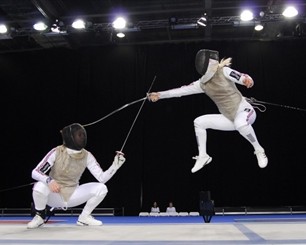
Competition dates:
July 28 - Aug 5
Competition venue:
ExCeL
Number of medal events
10 -?men's and women's Individual Epée Foil and Sabre, men's Team Foil and Team Sabre, women's Team Epée and Team Foil
Number of competitors
212 (102 men and 102 women), with the host nation places to be announced in May/June.
Each country is limited to eight men and eight women across all events, which equates to three athletes in men's and women's Individual and Team Foil, men's Individual and Team Sabre, and women's Individual and Team Epée, and two athletes in men's Individual Epée and women's Individual Sabre.
Field of play
Fencing takes place on a piste, 14 metres long and between 1.5m and 2m wide.
History of Fencing at the Olympic Games
At the first modern Olympic Games of 1896, the Fencing programme consisted of men's Foil and Sabre events, with Epée making its debut at Paris 1900. Women’s Foil first featured at the Paris 1924 Games, with Epée and Sabre added in 1996 and 2004 respectively.
The basics
Three types of weapon are used in Olympic Fencing. In bouts using the Foil and the slightly heavier Epée, hits are scored by hitting an opponent with the tip of the weapon. In Sabre, hits are more commonly scored with the edge of the weapon.
Epée allows both fencers to score at the same time, while Foil and Sabre have rules of right of way and timing that mean only one fencer can score a hit at a time.
Individual Fencing bouts last for three periods of three minutes each, or until one fencer has scored 15 hits against his/her opponent. In the Team events, teams of three fencers compete against their opponents over a series of nine three-minute bouts, with the aim of accumulating a maximum of 45 hits to win the match.
Hits are recorded electronically using wireless technology.
Competition format
All 10 medal events on the Fencing programme are run in a knockout format.
In Individual competition, men's and women's Foil, men's sabre and women's Epée start with a round of 64, although the fact that there are only 39-39 athletes in each event means that some athletes will receive byes into the round of 32. Men's Epée and women's Sabre begin with a round of 32, with a maximum of two athletes receiving byes into the round of 16. The draw is based on the existing FIE rankings.
All team events will feature eight teams except those in which Great Britain, as hosts, chooses to enter a team. The draw is based on the existing FIE rankings.
Players and teams progress through the draw until the finals, which decide the winners of the gold medals.
In the event of a tie in both the Individual and Team competitions, athletes fence for a further one minute, with one of the athletes randomly assigned 'priority'. The first to score a hit is the winner, but if no hits are made during this time, the 'priority' athlete wins the bout.
Officials
A referee oversees each Fencing bout. The referee is assisted by a video referee and, in the later stages of the competition, two assistant referees, who look for rule infringements.
Keys to success
Fencing is a fast, tense sport. Fencers must use all their wits and quick thinking to outmanoeuvre their opponent, judging the right time and the most effective way to attack.
Breaking the rules
While split-second decisions and reactions are needed, a wrong move can see valuable points taken away or awarded to the opposition. The referee will be looking out for infringements such as using the unarmed hand to cover the target, barging into your opponent or foot faults (when a fencer steps off the side or the end of the piste).
Jargon buster
Epée - the heaviest weapon and a true duelling sword: the whole body is a target, and opposing fencers can simultaneously score hits.
Foil - a light weapon derived from the court sword, the foil has very strict right-of-way and timing rules. The target area in foil bouts is the torso.
Sabre - in sabre, which is derived from the cavalry sword, fencers usually score hits with the edge of the weapon on a target area limited to anywhere above the waist - this is because it was once considered ungentlemanly to hit an opponent's horse!
Lunge - a fast, forward movement when attacking, with the back foot static but the front foot and body moving dynamically towards the opponent.
Parry - a defensive move, used to block your opponent's blade.
Riposte - scoring a hit after you've successfully executed a parry.
Piste - the field of play.



Medal Count |
||||
| 1 |  |
46 | 29 | 29 |
| 2 |  |
38 | 27 | 22 |
| 3 |  |
29 | 17 | 19 |
| 4 |  |
24 | 25 | 33 |
| 5 |  |
13 | 8 | 7 |
| 6 |  |
11 | 19 | 14 |


Most Viewed

Gold medal moments
Age not a problem for Olympic dreams
Olympic moments to remember
Beijing Olympics just keeps on giving
Against the Olympic spirit
Olympic fashion tips
Taking success overseas
Competition Schedule


