 |
|
A wind farm at Rudong in Jiangsu province. China's installed wind power capacity had reached almost 63 million kilowatts by the end of 2012. Xu Congjun / for China Daily |
Green development is facing a series of obstacles, as Jiang Xueqing reports in Changchun.
 |
The act was introduced with the aim of promoting the use of non-fossil fuel energy. However, the companies, which include wind farms and biomass energy plants, are also suffering huge financial losses.
From January to July, Huaneng Taobei Wind Farm in Baicheng, Jilin province, generated 134.75 million kilowatt-hours of wind power. During the same period, it lost 72.48 million kWh of unused wind power, resulting in a loss of almost 40 million yuan ($6.5 million).
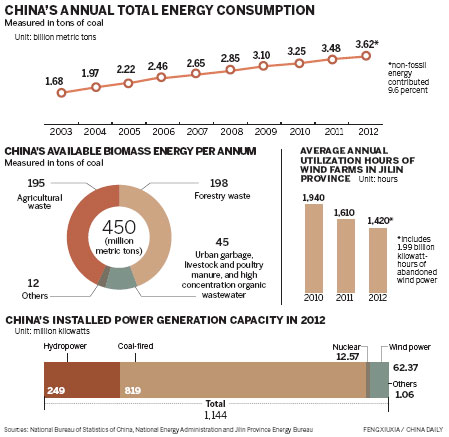
The wind farm's average annual utilization hours, the time during which it is running at full capacity, reached just 1,425 hours in 2012, but its break-even figure is about 1,560 hours.
During the first half of 2013, the farm averaged 813 utilization hours - the lowest in the country - and it is likely to continue to lose money, chief engineer Zhang Weilong says.
The farm's owner, China Huaneng Group, is debating whether to begin construction of the fourth phase. The previous three phases cost between 1.3 and 1.4 billion yuan.
Chen Xin, manager of the wind farm's pre-project department, speaking at a media event, said, "We'd rather put the project on hold, as the more wind turbines we build, the more money we lose."
The company's losses were caused by an oversupply of electricity in Jilin. Although the province had a total installed power capacity of 26 million kilowatts in 2012, the maximum demand for power was just 8.6 million kw.
"Several years ago, when the provincial government officials were making plans for the development of heating measures during winter, they didn't leave any room for the growth of new energy," said Zheng Jianlin, deputy director of the Jilin provincial energy bureau.
Jilin province's installed power capacity doubled in the period 2006 to 2010, from roughly 10 million kw to more than 20 million. During that period, the local government encouraged State-owned enterprises to build a large number of thermal power plants in the province to boost the growth of gross domestic product, but failed to take the provincial demand for electricity into account. It will take three to five years to adjust the discrepancy between supply and demand, said Zheng.
One solution would be to use long-distance transmission lines to deliver surplus wind power from the west of Jilin, where wind resources are rich, to regions where energy consumption is high.
|
Seeking to reduce air pollution, Beijing municipal government has decided to cut coal consumption to 15 million metric tons by 2015, from 23.3 million tons in 2012, and to less than 10 million tons by 2017. [Full story] |
Beijing plans gas-fired future to solve problem China will reduce its consumption of coal and gradually increase the use of natural gas during the next few years, according to the Airborne Pollution Prevention and Control Action Plan (2013-17), which was released by the State Council on Thursday. Total energy consumption is measured in tons of coal, irrespective of the method of generation. In 2011, China's total energy consumption was 3.48 billion metric tons of coal, out of which coal consumption contributed 68.4 percent, while natural gas contributed just 5 percent, according to the National Bureau of Statistics. [Full story] |
|
China's total energy consumption, measured in tons of coal, was 3.62 billion metric tons in 2012, rising from 1.7 billion tons in 2003. Meanwhile, non-fossil energy accounted for 9.6 percent of total primary energy consumption and will grow to 15 percent by 2020, according to the National Energy Administration. [Full story] |
 |
 |
Copyright 1995 - . All rights reserved. The content (including but not limited to text, photo, multimedia information, etc) published in this site belongs to China Daily Information Co (CDIC). Without written authorization from CDIC, such content shall not be republished or used in any form. Note: Browsers with 1024*768 or higher resolution are suggested for this site.
License for publishing multimedia online 0108263 Registration Number: 20100000002731 

