 |
|
About 330,000 visitors and media representatives attended the 798 Art Zone from August 1-24, 2008, including a record-breaking 30,000 in one day. More than 30 percent of the visitors were from overseas. [Illustration by Guillermo Munro] |
|
 |
|
 |
|
|
Huge fashion spreads cover brick walls. Shining steel adorns a maze of pipelines. Both are clear evidence that the days when cavernous concrete ceilings and obsolete machinery used to occupy the site of Beijing's 798 Art Zone have gone.
With the capital's urbanization, the Dashanzi area, which once stood on the outskirts, has become part of the city. Most of the old factories have disappeared.
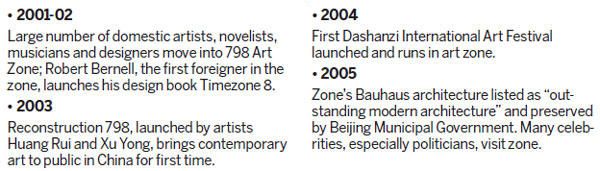
The zone was transformed with the arrival of artists around 10 years ago in what was billed as a "cradle of contemporary Chinese art".
Huang Rui, one of the pioneers of Chinese contemporary art who was once unofficial spokesman for the 798 arts district, said, "The artists' hub reflected the ebb and flow of the development process, similar to that in the SoHo district of New York, but it has ended up quite differently."
In 2002, Huang came across the factory area and, amazed by the Bauhaus-style space inside the warehouses, decided to stay.
Texan arts book publisher Robert Bernell was the first foreigner from the arts world to arrive at 798, full of passion and enthusiasm for contemporary Chinese art. With belief in his promising artist friends and dynamic works of art, he started his own publishing business, Timezone8, in 2002.
Before moving in, he worked at Lucky Tower on the Third Ring Road in a small, drab office with dismal gray carpet and cheap, gypsum walls. With the need for more space, but with little money, he started to explore factories around Beijing.
In 2000, the Beijing municipal authorities were moving factories out of the city fringes, leaving many industrial areas vacant. These factories had electricity, water and lots of space. They were on key transport routes and were cheap at the time.
After looking at a number of factories, Bernell settled on 798 in 2002. It used to have a Muslim canteen where they made steamed buns and halvah, a dense, nougat-like dessert. The walls were caked with grease, there was a hole in the ceiling to accommodate an emissions vent, but it was only 0.6 yuan per square meter, or 2,000 yuan ($325 a month at today's rates).
At the time, only 20 percent of the factory spaces were occupied. As artists started to work at 798, they also began to meet at Timezone8's coffee shop.
Zheng Kuo, director of 798 Station, an independent documentary about the progress of 798 in the past 10 years, said: "I always remember the atmosphere of freedom in the factory district when I went there for the first time. Factory workers and artists shared the same open space. Everything pointed to it being an ideal place in which to create art."
In many artists' eyes, 798 developed along similar lines as SoHo or Greenwich Village in New York.
|
|
|
|
|
|
|
|

Copyright 1995 - . All rights reserved. The content (including but not limited to text, photo, multimedia information, etc) published in this site belongs to China Daily Information Co (CDIC). Without written authorization from CDIC, such content shall not be republished or used in any form. Note: Browsers with 1024*768 or higher resolution are suggested for this site.
License for publishing multimedia online 0108263 Registration Number: 20100000002731 








 Op Rana
 Berlin Fang
 Zhu Yuan
 Huang Xiangyang
 Chen Weihua
 Liu Shinan