 |
|
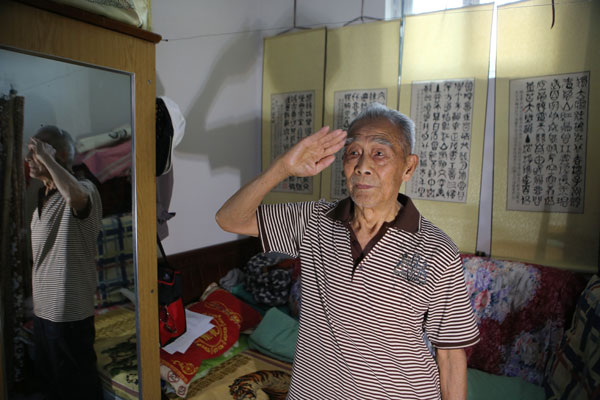
Fu Guoqian, 94, at his home in Beijing. Fu, who was born and raised in Thailand, was one of many ethnic Chinese admitted to Whampoa Military Academy during the Japanese occupation. Wang Jing / China Daily |
Many overseas Chinese returned for training at Whampoa academy, Zhao Xu reports in Beijing.
Fu Guoqian spends most of his time sitting in his 6-square-meter room in a traditional part of southern Beijing that is dominated by nondescript, age-old one-story buildings and narrow, well-trodden alleyways. Fu's room, the only space that belongs to the 94-year-old, is half-filled by a bed that faces directly toward the dilapidated wooden door.
The door had been swung open to allow some precious sunlight to enter the room, and outside, a couple of sparrows were hopping down the street, their loud chirps temporarily disturbing the stillness of a hot summer afternoon.
"See those sparrows? Back 70 years ago, I could have killed any of them with just one shot," said Fu, narrowing his eyes and slowly raising his right hand to imitate aiming a pistol. "I could shoot down any moving object within a range of 50 meters."
Fu's vision has long been cloudy and his bony hands shake involuntarily, but his memory is still crystal-clear, something he cherishes like nothing else.
"I came to China in 1939, against the will of my mother," said the elderly man, referring to the fateful decision that gave rise to all the pride and pathos in his life. "At the time, China was facing the most critical moment in its struggle against fascist Japan. As a young ethnic Chinese, born and raised in Thailand, I felt compelled to travel to my country of origin, and fight for her. The first thing I did was to enroll at the Whampoa Military Academy, which was the Chinese equivalent of West Point in the United States."
Young, red-blooded
Fu was one of thousands of ethnic Chinese who fought for the country, according to Chen Yuhuan, a renowned historian who has written several books about the academy's history. "Right from its foundation in 1924, Whampoa was a beacon for Chinese revolutionaries determined to restore strength and unity to a war-torn country that had only recently ceased to be a feudal empire. And when Japan began its full-scale invasion of China in 1937, the academy became the ultimate destination for many young, red-blooded Chinese, including those who spoke the language but had never before seen their motherland," said the 58-year-old.
Between 1937 and 1945, an estimated 2,000 expatriate Chinese from East and Southeast Asia enrolled at the academy. "The Communists and the Nationalists (also known as Kuomintang) had built a united front against the Japanese. Both parties were engaged in actively publicizing their concerted war efforts among the Chinese population overseas, organizing volunteer choral groups that toured neighboring countries, including Vietnam, Malaysia, Thailand, Singapore and Indonesia," said Chen. "They were undoubtedly successful in the minds of their listeners because young men started to depart for China while the singers were still in the middle of their tour."
Some shed blood before they even set foot on Chinese soil. In 1939, a group of Chinese-Singaporeans was headed for the southern Chinese coast aboard a British cargo ship that was spotted and shadowed by a Japanese warship on the Pacific Ocean. The situation turned critical when they arrived at Quanzhou Port in Fujian province.
"The British ship was grounded in the shallow water about 1,000 meters from land, and the Japanese ship was prowling in the vicinity," said Chen Yu, an army researcher who has made the study of the academy his life's work.
"The leader of the Chinese group arranged for local fisherman to pick everybody up in small rowboats under the cover of darkness. But despite the great caution shown, the enemy was alerted."
Under the Japanese warship's blinding searchlight, the men's escape, some by boat and some by swimming, was desperate and bloody. Twenty-three of the 143 men in the group were killed, but 30 of the survivors were accepted by the academy a year later.


Copyright 1995 - . All rights reserved. The content (including but not limited to text, photo, multimedia information, etc) published in this site belongs to China Daily Information Co (CDIC). Without written authorization from CDIC, such content shall not be republished or used in any form. Note: Browsers with 1024*768 or higher resolution are suggested for this site.
License for publishing multimedia online 0108263 Registration Number: 130349