|
|
Students from migrant worker families in Jinjiang take part in games designed to relieve stress on June 3 before the college entrance exam. ZHANG JIUQIANG / XINHUA |
A city in Fujian province steps up efforts to integrate valued migrant workers and balance urbanization with heart, report Sun Li and Hu Meidong in Jinjiang, Fujian.
|
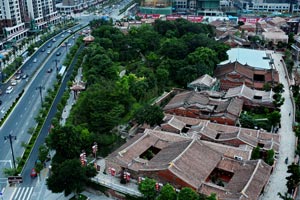 Wudianshi, an ancient building area in Jinjiang, has been preserved amid the city’s urbanization drive. There are more than 100 ancient buildings in the city. ZHANG GUOJUN / XINHUA
City keeps its distinctive culture alive
Jinjiang in Fujian province is balancing the preservation of its traditional culture and old residential buildings with urbanization. The city, which has a history of over 1,000 years, is home to many ancestral halls and traditional residential buildings. The structures are made of granite slabs mixed with red brick in a seemingly irregular pattern, a distinctive style of southern Fujian architecture. The city is known for its traditional art such as the Jinjiang glove puppet show and Gaojia Opera, a local traditional drama featuring clown characters. Huang Liang, director of the Jinjiang Bureau of Culture, Sports, Press and Publication, said the government is working with a group from Tsinghua University to conduct a full-scale survey of the city's traditional buildings. More than 6,500 traditional buildings are being planned for renovation and preservation, Huang said. Jinjiang Mayor Liu Wenru said every old building is highly valued in the city's push toward urbanization. "Traditional buildings are collective memories of generations of Jinjiang people. They will not be demolished unless necessary," Liu said. "Even if a traditional house has to be removed, considering the infrastructure needs, it will be transferred to a proper area and well protected," Liu said. In addition to protecting the old buildings, the local government also spotlights the preservation of the city's intangible cultural heritage. Thirty primary schools and middle schools have been selected as educational bases for the younger generation to learn Gaojia Opera and the glove puppet show. A research center of the southern Fujian dialect is also being set up to focus on protecting the regional language. Chen Rongfa, Party chief of Jinjiang, said the city's cultural roots have significantly contributed to its urban development. "The cultural elements set Jinjiang apart from many other cities speeding up their urbanization," Chen said. As cultural roots make the city lively and unique, protecting traditional houses and culture will always be on the city government's agenda, Chen said. |
In 2007, Zhao Xiaofang arrived in Jinjiang of Fujian province.
Zhao, who had worked in a shoe factory in Guangzhou of Guangdong province, wanted to try his luck in the small city famous for being the "footwear capital" of the country.
The 31-year-old quickly found work in a local footwear business and earned about 4,000 yuan ($650) a month, 1,000 yuan more than his monthly salary in Guangzhou.
He lived in a 20-square-meter room and was generally satisfied with his lot.
But in 2010, he suddenly felt a heavy burden on his shoulders when his wife brought their two daughters, aged 2 and 4, from his hometown of Nanyang in Henan province.
The footwear industry also experienced a slowdown following the global financial crisis, and Zhao's income froze. He could not afford to move to a bigger home.
"When I was alone in the city, housing wasn't a problem. But for a family of four, the tiny apartment seemed really shabby and cramped," Zhao said.
To make matters worse, they found the neighborhood increasingly unsafe. They lived on the first floor, and the area was full of jobless people.
"Once, when I left the window open, two cellphones on the table were stolen," Zhao said.
The Zhao family's problems were similarly experienced by many migrant workers nationwide.
These migrant workers usually found themselves left out of their adopted cities' household registration, or hukou, system. The system covers a Chinese citizen's legal residence in a city and provides access to various social services and benefits like housing, healthcare and education.
The migrant workers contributed to the growth of cities but had to settle for poor housing and inadequate benefits compared with their urban counterparts.
Recognizing the increasing need to address the issue, the country will take a series of steps to ensure the "orderly" migration of rural workers from their hometowns to cities, the State Council executive meeting chaired by Premier Li Keqiang decided in July.
Latest efforts to improve migrant workers' situations are already taking root.
Jinjiang Mayor Liu Wenru said the local government has been rolling out measures including low-rent housing programs and residence permits to help integrate the workers.
When Zhao got wind of a program offering low-rent housing and the Jinjiang authorities issuing new residence permits to migrant workers to replace their temporary passes, he immediately applied for them.
The permits gave holders access to more affordable social security and medical insurance. They are also needed to apply for low-rent housing.
With his permit, Zhao's daughters could also get full access to local schooling.
At the end of 2013, Zhao applied for low-rent housing near his community.
He recently collected the keys to his new home - a fully furnished, well-lit two-bedroom apartment. Covering more than 60 sq m, it includes a balcony and costs just 189 yuan a month to rent.
"You cannot imagine how excited I am to bid farewell to my shabby little dwelling and enter my new home," said Zhao, who is now self-employed and designs shoe molds for several companies.
Recognizing residents
Jinjiang has 1.09 million people covered under its household registration system and another 1.3 million migrant workers.
"Migrant workers are a valued part of the labor force and they make great contributions to the urban development of Jinjiang. The government must help them settle into local life," Liu said.
Cai Yiqing, director of the Jinjiang Bureau of Housing and Urban-Rural Development, said the city government has been gearing up support for the construction of low-rent housing projects.
According to Cai, the construction of 11,000 units of low-rent government-owned apartments has been completed, and 3,502 units have been offered to migrant workers.
In the residential compound where Zhao lives, there are 428 units like Zhao's and an additional 300 units have been arranged to settle more migrant workers, Cai said.
Wang Quanhe, from Jiangxi province, who recently registered his residence in Jinjiang, said he now considered the city his second hometown.
 |
|
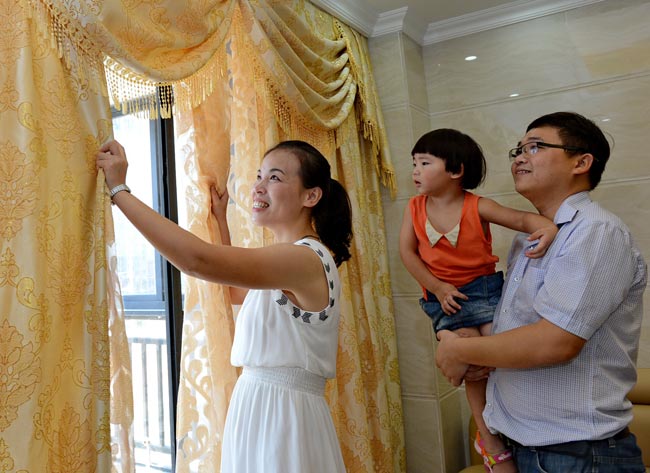
Bi Hongmei (left) with her family at their home on Aug 18. Jinjiang has given migrant workers the same housing benefi ts as local residents. ZHANG GUOJUN / XINHUA |


Copyright 1995 - . All rights reserved. The content (including but not limited to text, photo, multimedia information, etc) published in this site belongs to China Daily Information Co (CDIC). Without written authorization from CDIC, such content shall not be republished or used in any form. Note: Browsers with 1024*768 or higher resolution are suggested for this site.
License for publishing multimedia online 0108263 Registration Number: 130349