 |
|
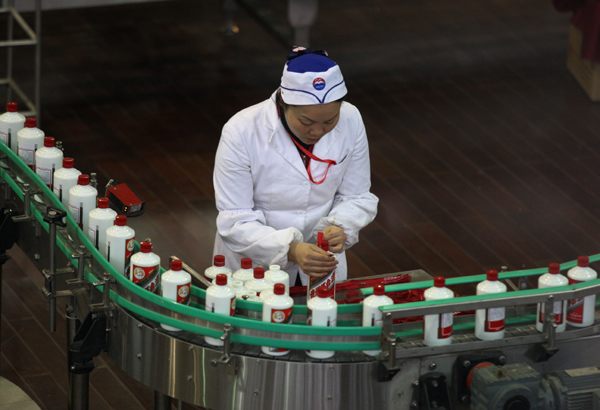
Moutai is distilled from fermented sorghum. Experts believe that the unique climate, water and vegetation in Maotai township make it the perfect place to distill the famously potent spirit, which is one of China's best-known exports. WANG ZHUANGFEI/CHINA DAILY |
Visible improvements
Chen Lin said he's proud the river is now so clean the water can be drunk untreated, and his village has founded a company to bottle and sell it.
"Now we use lees (organic waste generated during the liquor-making process) instead of manure and chemicals to fertilize the land where we grow sorghum. The lees are almost pollution-free and nurture the soil better than manure or chemical fertilizers. That's enabled us to raise our yields by 750 kg per hectare," he said. "The price of each bag of lees is 80 yuan ($13), and the government provides a subsidy of 40 yuan per bag to encourage its use. Thanks to the crystal-clear water and cleaner air, my family can earn at least 30,000 yuan from tourism every year."
Xiong Dewei, director of the Guizhou Provincial Environmental Protection Department, said that since 2013, the local authorities have invested more than 2 billion yuan in conservation projects on the river, and in the past two years processing facilities that can dispose of 120,000 tons of wastewater a day have come into operation.
Businesses are also now required to obtain licenses before they are allowed to draw water from the river, a move that's successfully reduced the amount of water used and slashed waste generation, he said.
Guizhou is actively collaborating with the neighboring provinces of Sichuan and Yunnan, which are also watered by the river, to share information, monitor conditions and conduct joint law enforcement operations.
In the past two years, combined environmental protection teams from the three provinces have inspected facilities and procedures at more than 800 companies along the river, he added.
The policies seem to have paid off; in September, Xiong's department raised the water quality status from level 3 to level 2, indicating that it is now potable without treatment.
Challenges remain
"Though we've achieved a lot, there are still many challenges to successful environmental protection," said a statement issued by the environmental protection bureau in Renhuai. "There are a great many sources of pollution across the city, but the bureau doesn't have enough personnel to oversee all of them," it continued.
In addition to those problems, some government departments regard environmental protection as solely the responsibility of the bureau, and have been reluctant to cooperate with pollution control and monitoring, which has hampered progress, the statement said.
For Liu, the biggest problems are a lack of funds and a shortage of workers. A wastewater disposal facility that can handle 1,200 tons each day costs about 700 million yuan to build, and requires huge investment from the cash-strapped local government, he said.
"As for inspections, the bureau has just 44 inspectors and seven cars, but we are responsible for conducting checks on nearly 1,000 companies, so the workload is very heavy," he said, adding that bureau has asked the city government to increase the headcount in the inspection unit.
Zhang Jiebo, deputy Party chief of Maotai township in Renhuai, said the local people have welcomed the measures to clean up the river and restore the area's natural beauty because the work has improved the quality of their lives and will attract tourists in greater numbers.
"The local people have been very cooperative and have supported our crackdown on illegal business operations that contaminate the river and their farmland, but they aren't only thinking of the financial benefits. They always say the river isn't their private property-it doesn't belong to them, it belongs to generations still to come," he said.
A snapshot of times long goneThe Chishui River, a tributary of the Yangtze River, is the last safe haven for a number of rare and endangered species of fish, so it should never be developed commercially, a senior hydrobiologist said.
Cao Wenxuan, an academician of the Chinese Academy of Sciences and senior researcher at the academy's Institute of Hydrobiology, said he understood the economic priorities of the local authorities, who are attempting to foster rapid growth, but stressed that the government should spare no efforts to preserve the waterway because it's the only stretch along the upper reaches of the Yangtze River that doesn't have a dam.
"That means the river is a living example of what the Yangtze River used to be before it was overexploited by humans," Cao said. "Moreover, keeping the river clean will allow endangered species in the Yangtze River to survive."
Cao expressed concern about a plan published last year by the transport department of Zunyi, a city on the river in Guizhou province, to introduce a river-route expansion project that would severely affect endangered species in the Chishui River.
He urged the city government to reconsider this project. "The natural environment of the Chishui would be changed irreversibly and a great number of vessels are expected to use the route if the expansion plan becomes a reality," he warned.


Copyright 1995 - . All rights reserved. The content (including but not limited to text, photo, multimedia information, etc) published in this site belongs to China Daily Information Co (CDIC). Without written authorization from CDIC, such content shall not be republished or used in any form. Note: Browsers with 1024*768 or higher resolution are suggested for this site.
License for publishing multimedia online 0108263 Registration Number: 130349