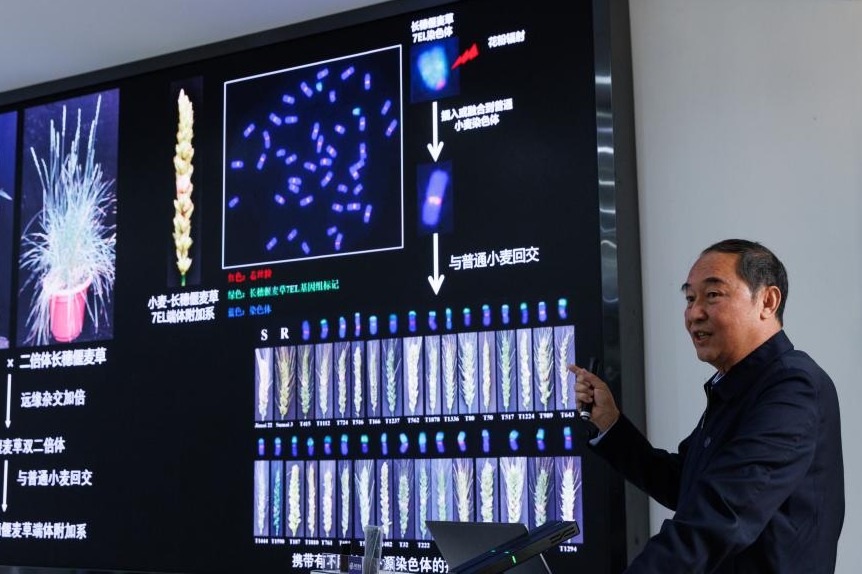
Time to enhance nation's grip on frontier technologies









China has entered an era where the country has been enhancing its innovation capability after issuing guidelines on a national medium- and long-term program for science and technology development (2006-2020) in 2006.
The nation has leapt ahead in some important frontier technologies in such sectors as biology, information industry, material technology, manned space flights and superfast trains.
Chinese scientists have discovered the iron-based high-temperature superconductor system and created live mice from induced pluripotent stem (iPS) cells, answering a lingering question about the developmental potential of the cells.
With 51 million people working in science and technology, the world's largest, expenditure on China's research and development hit 580.2 billion yuan (66 billion euros) last year. The number of patents granted to Chinese nationals ranks fourth in the world, with the market in exchange for transfer of Chinese technology reaching 303.9 billion yuan.
The introduction of Chinese scholars' academic essays is expected to rank 9th throughout the world.
However, China urgently needs to change its development strategy. With rapid advances in urbanization, an aging population, a huge annual increase in population and changing patterns of consumption, what is desperately needed is new technology to further improve people's lives.
To further improve people's lives is the starting point for science and technology. China should strengthen efforts in the development of science and technology in areas of population and public health, public security, and green city development, significantly expanding the development of technologies that can bring benefits to the people.
First, improving the quality and health of the population depends on powerful support from science and technology. Priorities have to be given to developing key technologies for early warning and diagnosis of major diseases, and for early intervention in disease-risk factors while developing key technologies and solutions for standardized, individualized and integrated treatment.
China should also encourage innovation in traditional Chinese medicine (TCM), and inheriting and tapping on the TCM experience, studying the diagnosis and therapy and associated assessment techniques and standards, carrying out research on development and manufacturing technologies.
Second, public security is facing severe challenges, which in turn raises major strategic demands for scientific and technological support.
There should be priority to develop technologies for all-round and obstacle-free risk source detection and monitoring, precision positioning and acquiring information for national public security emergency platforms.
China has to develop warnings and control technologies to monitor possible gas leaks, water bursts, power failures and major industrial accidents.
The nation has to work on key technologies concerning food safety and entry-exit quarantine-related risk assessment, pollutants tracking, safety standard formulation and quarantine monitoring and testing, and develop intelligent technologies to prevent food contamination and improve quarantine monitoring.
Third, with China entering a phase of rapid urbanization, the processes and coordinated urban development need science and technology.
Priorities need to be given to develop green architecture design technologies, energy-saving technology and equipment and renewable energy devices. As well, the government needs to set up standards to regulate the green industry. Besides, China needs to also give priority to technological development in several sectors such as energy and water resources over the coming 10 years, to resolve some outstanding problems bottlenecks in the country's economic and social development.
The program lists key industries that include mining resources, environment, agriculture, manufacturing, communications and transport, information and modern service industries, population and health, urbanization and urban development, public security, and national defense.
The author is a researcher with the Chinese Academy of Science and Technology for Development in Beijing.



Today's Top News
- Effective use of investment emphasized
- China's shuttle diplomacy strives to reach ceasefire
- Nanjing Museum's handling of donated art, relics being probed
- Key role of central SOEs emphasized
- New travel program hailed as 'milestone'
- Animated films top draw at box office