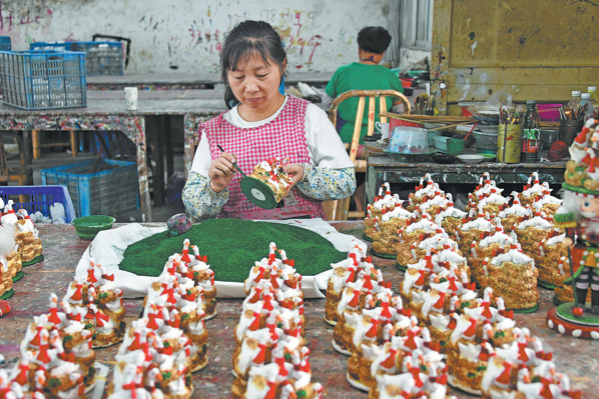
China faces new challenges from battle of the bulge









Don't eat your vegetables.
They're not the typical words of wisdom handed out by parents at the dinner table, but a new report claims it's the precise advice that Chinese mothers should be giving to their children.
|
|

The report, Correlates of Overweight Status in Chinese Youth: an East-West Paradox, published last month in the American Journal of Health Behavior, found that while children in the United States are growing obese because of unhealthy foods, the waistbands of children in China are swelling because of excess veggies, fruits, meat and other normally healthy foods.
As the wallets of well-to-do Chinese continue to expand, so do their children, with higher percentages of wealthy and educated families showing an increase in obesity, according to the report by researchers from Keck School of Medicine of the University of Southern California.
"If you have a society that's getting more money, and more people urbanizing, you're going to have more people getting fat," says Paul French, who in 2010 co-wrote Fat China: How Expanding Waistlines Are Changing a Nation.
The study, which surveyed more than 9,000 high-, middle- and low-income students in seven of China's most populated urban areas, reveals a vital polarity between what's making children fat in China versus the rest of the world.
While it's the Chinese nouveau riche seeing waistbands wander, studies in the US and Europe show its low-income families that fight the fiercest battle of the bulge.
The most recent statistics from the UK's National Health Service Information Center show children from low-income families in England were more than 10 percent more likely to be obese than those from wealthier backgrounds. The results were similar in the US with the most recent statistics from the US Center for Disease Control finding every one in seven low-income pre-school aged children are obese.
The US report found that lower-income children were more likely to be obese in the US because of a lack of affordable healthy food and little access to green spaces, such as parks.
In China, it is the increased consumption of traditionally healthy food - now affordable by the country's prospering middle class - that is the cause.
"It's certainly true McDonald's and KFC don't help the problem, but the Chinese are simply eating more and more of everything," French says. "They're eating more veggies, they're eating more fruit and they're eating more meat - it's just greater consumption."
Excessive doting on sons and daughters, often only children because of China's family planning policy, is another unique cause for the nation's obesity levels.
"Although obesity in children can be caused by genetics, many are caused by postnatal factors from their family," says He Zhenbai, a senior consultant at Aimin Fat Reduction Hospital in Tianjin, a health clinic that helps adolescents lose weight.
The senior consultant at Tianjin's first fat reduction clinic says the number of clinics in China geared toward losing weight has grown considerably over the past few years.
There used to be only one facility in Tianjin, but now there are four or five, He says.
"Chinese families nowadays tend to spoil their kid.... Excessive love from parents and grandparents is allowing children to get whatever they want to eat."
In addition to feeding their children more, parents are reducing the amount and types of exercise their children is allowed to do for fear that they may get hurt, He from Aimin says.
"Many parents think their kids are too fragile to exercise, making it difficult to burn energy," he says.
While obesity in the West is recognized as a major health threat and a financial burden on healthcare, many families have yet to be educated about the dangers of excessive eating or are too focused on other problems to pay attention to the issue, French says.
Some view having a large child as a status symbol.
"It's also a sign of success. A fat child is almost like having a BMW, it's a display of your wealth," French says. "China has gone from famine to gluttony in two generations."
China also differs from its Western counterparts in that the problem is acute to large cities, with many rural areas still struggling to get a proper variety of nutrients.
Gao Huiying, a professor for the Chinese Nutrition Society, says the most recent statistics for obesity in China date back to 2002 when 22.8 percent of the average population was overweight, and 7 percent obese. But the numbers in large cities have since skyrocketed.
"In terms of residents living in big cities, percentages of people who are overweight are now more than 30 percent," Gao says.
The study also finds that boys in China are more likely to be obese than girls, whereas in the US the rates are roughly equal.
Though there are stark differences in the diets between China and the West, increasingly inactive lifestyles and not getting enough exercise are common factor for all modern societies.
"People seldom do physical work, as more mental work is required in modern society. This gives people fewer chances to reduce calories." says He.
And in China where people are earning more than ever, Little Emperors, the only children of their families, will continue to grow.



Today's Top News
- Xi's diplomacy in 2025: Shedding light on a world at crossroads
- China to apply lower import tariff rates to unleash market potential
- China proves to be active and reliable mediator
- Three-party talks help to restore peace
- Huangyan coral reefs healthy, says report
- PLA conducts major drill near Taiwan