Seeing red









|
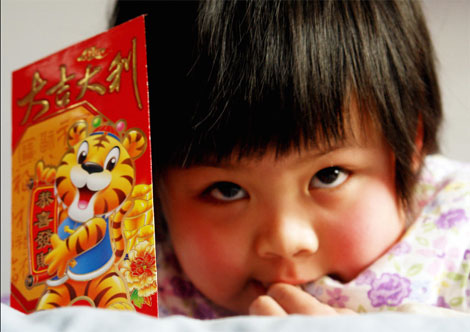
Chinese children receive hongbao from their parents and relatives during the Spring Festival. [Provided to China Daily] |
New Year custom of money gifts becomes burden for many
Unlike the millions of other migrant workers in Beijing, Liu Rubin will not be going home to Gansu province during this year's Spring Festival. The Lunar New Year is considered one of the most important times for family reunions, but the 22-year-old owner of an eatery in Beijing is giving the celebration a miss because of one thing - red packet money gifts, or hongbao.
Liu has been working in Beijing for about half a year and earns 2,000 yuan ($317, 247 euros) a month. "I cannot afford the New Year obligations, let alone hongbao, with what I have saved in the last six months," he says.
Hongbao are gifts of cash in red envelopes. They are given to children by older family members on Chinese New Year, which starts on Jan 23 this year, as lucky gifts for the year ahead. The gifts can range from 100 yuan to 1,000 yuan for a child.
For many of those who have many relatives like Liu Rubin, hongbao has turned from a cherished tradition to an annual ritual that brings mixed feelings.
Xiao Fang, a professor of Chinese folklore at Beijing Normal University, says it was not until the Song Dynasty (960-1279) that people began to use real money instead of metal plates inscribed with lucky words.
"It was supposed to be a way of showing love and care to younger people. Now it is more about the amount of money inside," Xiao says.
In ancient times parents on the eve of the New Year gave their children strings of copper coins that symbolized longevity. In the 19th century people began using money in red envelopes, or hongbao, as symbols of good luck and happiness.
There are numerous rituals with hongbao. Children receiving the gifts are not supposed to show that they are eager to receive the gifts. Instead, they are expected to refuse the hongbao many times before finally accepting it to show a good upbringing. The recipients should also wish the hongbao givers "gongxifacai", or "Wish you a prosperous new year."
The youngsters are expected to open the envelopes much later after receiving them, away from the eyes of the givers, to avoid showing any eagerness to know the amount of money inside the packets.
The amount of money in hongbao usually come in even numbers like 600 and 800, as even numbers are supposed to be lucky in Chinese culture.
In Guangdong province people give hongbao in pairs, in line with the Chinese saying "Good things come in pairs."
Similar to how their Western counterparts sleep next to Christmas stockings that hold their precious presents, Chinese children spend the night with hongbao under their pillows.
Based on Chinese folklore, a little devil called Sui always comes out on the eve of the New Year to touch children's heads, making them sick. A couple in their 50s were so terrified for their baby that they decided to stay up all night to protect their infant from Sui.
The baby played with his hongbao until he fell asleep with the money under his pillow. When Sui came to the house, it was so scared by the golden light emitted by the coins under the pillow that it fled. The couple told the story to their neighbors and people began to imitate their actions. It soon became a custom across the country.
But the tradition has greatly changed. The amount of hongbao alone has risen from a few yuan in the 1970s to thousands of yuan in recent years.
"When I was a kid, I usually got less than 10 yuan. Now, the amount my son gets can range from 100 yuan to more than 1,000 yuan," says Zhang Qiulin, father of a 5-year-old boy.
"I have to keep it for him as he's still too young to manage the money."
Many people even see hongbao as a sugarcoated way of socializing. Such gifts target parents, not their young recipients, Xiao Fang says.
"It is not all about fun and blessing as it used to be. As a parent of a receiver, I have to pay back equally. As a giver, I have to consider the amounts very carefully so that it won't pressure or embarrass the (parents of the) receivers," Zhang Qiulin says.
Hongbao can also be a huge burden for the elderly, especially those who have several grandchildren, Xiao says.
"I usually give 500 yuan for each of my grandchildren. I cannot afford too much with my retirement funds. At my age, I think it's time for the kids to take care of me financially," says Xu Jingjie, a 72-year-old retired public servant in Beijing.
For Liu Rubin the tradition has become an obligation.
"Hongbao is a burden," Liu says. "Yes, I received it as a child, with much of the expected jostling. But now I have to give it out."


Today's Top News
- China reports 20% rise in inter-regional trips on first day of New Year holiday
- China rebuffs criticism over drills around Taiwan
- Mainland pledges deeper cross-Strait integration in 2026
- Lai's 'separatist fallacy' speech rightly slammed
- Xi's message for New Year widely lauded
- Swiss bar fire kills around 40, injures more than 110