Grappling with issue of fixed investment









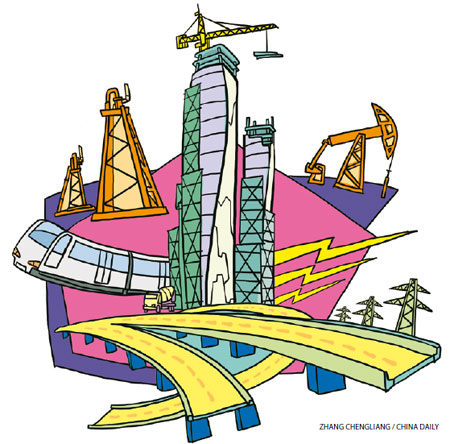
China's fixed-asset investment rose to 26.95 trillion yuan ($4.27 trillion; 3.38 trillion euros) up 24.5 percent year-on-year in the first 11 months last year, but the growth rate was down 0.4 percentage points compared with that of the first 10 months of last year, according to figures from the National Bureau of Statistics.
This trend is highly likely to continue in the Year of the Dragon. That is, China's fixed-asset investment will continue to grow but the growth rate will decrease. The real growth rate of China's fixed-asset investment is expected to increase about 17 percent this year. However, this trend may change if the State Council, the country's cabinet, decides to further loosen monetary policy. On Nov 30 the People's Bank of China announced a lowering in banks' reserve requirements ratio by 50 basis points, for the first time in three years, and put forward new measures for a stimulus fiscal plan. A full and complete economic policy relaxation is generally considered unlikely this year.
I believe two major factors contribute to this trend: government regulatory policy and investment decisions in the private sector.
In China most fixed-asset investment spending is done by the government sector, although there has been a sizeable increase in private investment since its economic reform. Over the past few years China has used fixed-asset investment as a fiscal policy tool and put its economic stimulus plan in place specifically to deal with the global financial crisis. It has primarily focused on pumping more public investment into infrastructure development, such as the rail network, roads and ports; easing credit restrictions for mortgage and small- and medium-sized enterprises; and lower taxes such as those on real estate sales and commodities. China is now rife with over-investment in physical capital, infrastructure, and industrial capacity.
Meanwhile, China's inflation, measured by the consumer price index, hit a 37-month high of 6.5 percent in July of 2011, and the producers' price index, a main gauge of inflation at the wholesale level, climbed 6.4 percent year-on-year. The producer purchase price rose 9.7 percent from a year earlier. These indicate that an increase in fixed asset investment as a fiscal tool has reached its limit.
With regard to the private sector, it plays an increasing role in fixed investment in China. Economic theory suggests that fixed investment is determined by the relationship between the expected returns from investment and the expected cost of financing the investment. In other words, profit-seeking businesses in the private sector proceed with an investment if they believe that the project will deliver a return that exceeds the outlay and that it is better than any other alternative.
Recently the price of real estate in China has dropped, the renminbi has appreciated, and export orders have slumped. In this business environment the returns expected for private fixed investment have greatly fallen. In addition, the central bank has been trying to squeeze the country's banking so as to restrain inflation, increasing the reserve requirements ratio six times a year until Nov 30, when it announced a ratio cut from Dec 5.
China's fixed asset investment is a statistical measure of "fixed investment" similar to those used by the Bureau of Economic Analysis in the US, Eurostat in Europe, the International Monetary Fund and others, which includes investment in physical assets such as machinery, land, building and installations vehicles. It measures capital formation, often used by economists to study long-term economic growth including growth of output and employment and potential productivity. In the past few decades the growth rate of fixed investment in China has been higher that in the US, Europe and Japan. China's amazing long economic growth has been powered by its strong capital formation.
A slower growth of its fixed asset investment will affect the economy this year in several ways.
First, inflationary pressure will ease. China's inflation has been high, as discussed before. Fixed-asset investment has a generally high employment multiplier effect. An increase in fixed-asset investment, on one hand, can increase employment, national disposable income and domestic demand, and on the other hand can anchor another new round of economic expansion by directly driving the current economy, which will result in high aggregate demand.
Therefore, lower fixed-asset investment will help reduce excessive aggregate demand, which will not only lower the producer price index but the consumer price index as well. I expect inflation to continue to fall, from 5.4 percent last year to about 4 percent this year.
Second, China's GDP growth rate will slow. Economic principles dictate that the more fixed capital is used per worker, the more productive the worker can be, other things being equal. That is, the same labor force can produce more GDP in the same time. It is generally believed that investment in fixed assets is positively related to economic growth, so is used as a tool to stimulate economy in times of economic gloom. In China, investment in fixed assets accounts for as much as 45 percent of GDP, and the influence and contribution of investments in economic growth are bigger than that of consumption. Statistics show that among the many factors affecting China's economic growth, fixed asset investment is always considered the main one. Slower fixed-asset investment will affect China's productivity and the total output level. I expect GDP growth to fall to 8.5 percent this year.
Third, China's export growth rate will decrease. Fixed-asset investment can energize manufacturing activities, and manufactured goods are the major components of China's exports. With low fixed-asset investment, manufacturing is expected to contract, as will exports.
I expect exports will slide several percentage points this year. The growth rate could be between 10 percent and 15 percent, depending on the impact of the European debt crisis. Europe is China's most important market for export.
A slowdown in China's fixed-asset investment will also have a global impact. As the second-largest economy, China could influence other countries' growth and the global economy through a number of channels. First, China's imports of investment goods, either raw materials or final products, have a direct impact on its partners' exports and GDP; second, China's relative low-cost export goods could affect exporting countries' inflation rates, and thus monetary policy; third, the slowdown of China's fixed-asset investment could affect global demand of capital, and thus long-term interest rates; fourth, the changing amount of capital inputs to China will have an impact on the prices of capital goods, such as steel, oil and other commodities.
After more than 30 years of high economic growth, China is gradually reaching mature economy status. It is now in a transition from an investment- and export-driven economy to a balanced growth economy. Such a transition may be time-consuming and painful, with high risks. However, with its successful experience in transforming from a central planning economy to a market economy, and with other countries' lessons, China has a good chance to transform itself, without major crisis, setbacks and difficulties, to a more sustainable growth model.
The author is an associate professor with the University of Maryland. The views do not necessarily reflect those of China Daily.





Today's Top News
- China's postal delivery volume hits 216.5b items in 2025
- 2025 in review: A year of shifting horizons
- Decade-plus high for key A-share index
- Spirit of the Long March guides nation for socialist modernization
- China curbs dual-use item exports to Japan
- UN members denounce US attack