Profile: Xi Jinping: Man of the people, statesman of vision









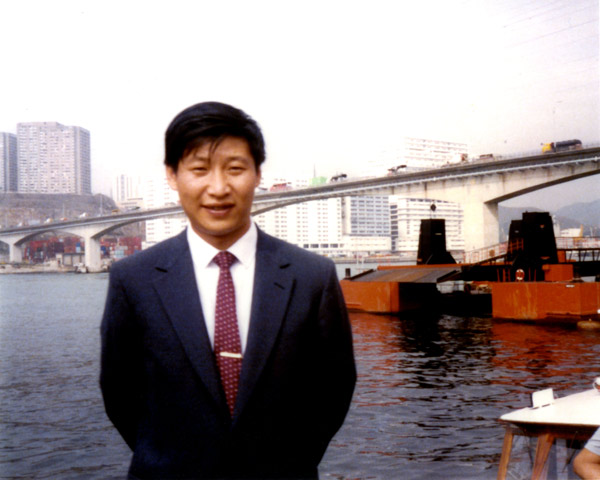 |
| File photo shows Xi Jinping, then vice-mayor of Xiamen city of East China's Fujian province, poses for photo during an overseas visit. (Xinhua) |
Leader with foresight
On several recent occasions, Xi showed a strong sense of responsibility towards the future of the nation and declared his determination to push forward reform and opening up.
Throughout his political career, people have seen his foresight and resolve as well as his willingness to sacrifice personal gain and one-time fame for a bigger cause.
When working in Xiamen, a coastal city in Fujian, he took charge of drafting a development plan for the city from 1985 to 2000 and lobbied for preferential policies from the central government, both of which benefited the city long after he left the province.
When working in Zhengding, Hebei province, he saw potential business opportunities when he learned that the crew of "The Dream of Red Mansions," a popular novel-turned-TV drama, was looking for a filming location.
He then proposed building in Zhengding a large residential compound featured within the novel. The compound, which was used by the TV crew, later became a tourist attraction. Tourist income from the compound exceeded 10 million yuan the year it was completed, paying back more than the investment. The compound has been used as the set for more than 170 movies and TV dramas, with up to 1.3 million tourists every year.
In Fuzhou, after intense deliberation and discussion, he and his colleagues devised a strategic development plan for the city for the coming three, eight and 20 years. All the main targets set by the plan were achieved years ago, and a number of enterprises that were set up or brought to Fuzhou when Xi served there remain the industry leaders, playing a significant role in the city's development over the past two decades.
Working as Fujian governor, he was the first in the country to launch a campaign to crack down on food contamination.
In 1999, he first put forward the idea of improving IT infrastructure and introducing information technology to help the public. Fujian had been the only province in China where all hospitals were linked by computer networks and shared digital medical records by 2010.
In 2002, Fujian launched the reform of the collective forest property right system, becoming the first in the country.
During Xi's tenure, Fujian was among the first provinces in China to adopt special policies to restore ecological balance and protect the environment. This has made Fujian the province with the best water and air quality as well as the best ecology and environment in the country.
After his transfer to Zhejiang Province in 2002, Xi put forward numerous development targets for the economy, public security, culture, the environment and the rule of law.
He initiated local industrial restructuring, transforming the province's extensive, less-efficient growth pattern, and encouraged quality enterprises from outside the province to invest in Zhejiang.
In addition, he proposed a development mode that would give equal weight to both manufacturing and commerce, a mode based on Zhejiang's own conditions. He also supported enterprises' efforts to expand overseas and supported start-ups by ordinary citizens.
At the same time, he encouraged more cooperation among Zhejiang, neighboring Shanghai Municipality and Jiangsu province in order to tap their potential as an integrated economic powerhouse.
In 2004, under Xi's leadership, Zhejiang made an attempt to improve grassroots democracy. Villages there set up residents' committees to supervise the village Party committee and administrative committee on public affairs, a move that received a positive response from the public.
Village supervision committees, which sprang from the Zhejiang model, were later introduced in an amendment to the Organic Law of Villagers' Committees in 2010 by the National People's Congress (NPC) Standing Committee, the top Chinese legislature.
Shanghai was Xi's last local post before he was promoted to the central leadership. Despite a relatively short term in the country's financial hub, he left his mark by promoting the economic integration of the Yangtze River Delta and enhancing Shanghai's leading role in the region.
Xi added "enlightened, sagacious, open-minded and modest" to the official wording of the Shanghai Spirit slogan, which previously had just read "inclusive and sublime." The Shanghai Spirit was intended to capture the essence of the city. Media in Shanghai remarked that these emendations helped present Shanghai to the rest of the world in a deeper, more thoughtful way. These changes were also noticed by people outside Shanghai.