Feeling the pinch









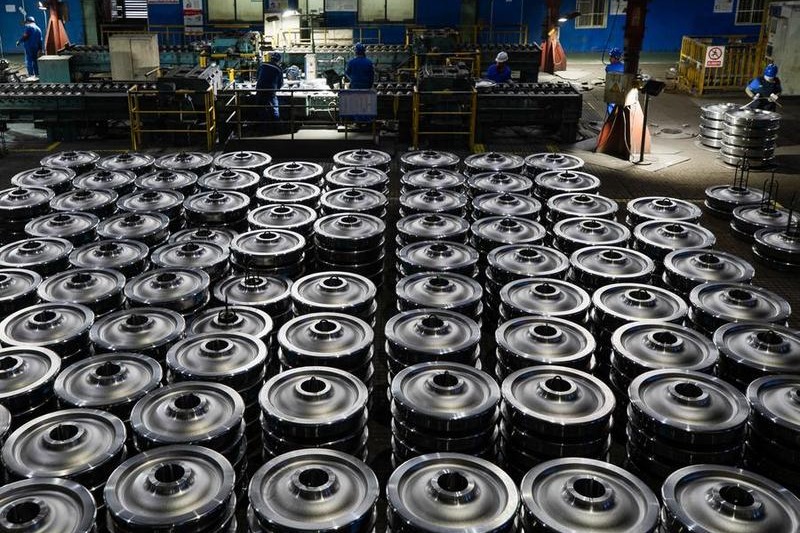
| A worker at a textile company in Huaibei, Anhui province. China's textile exports grew 2.83 percent last year, compared with a 20.05 percent growth in 2011. Xie Zhengyi / for China Daily |

Stiff competition, shrinking demand pose tough challenges for traditional firms
More tough times seem to be in the offing for Chinese exporters associated with traditional manufacturing industries, as the uncertain global economic recovery has triggered increased risks like stiff competition in emerging markets and dwindling demand in developed markets.
According to the China National Textile and Apparel Council, China's textile exports grew by 2.83 percent year-on-year to $25.49 billion last year. The growth was 17.22 percentage points lower than that of 2011.
"The textile industry situation is an indication of the problems ahead for the traditional manufacturing industries in China," says Wang Jian, a professor at the University of International Business and Economics.
"For Chinese traditional manufacturers, the awkward situation is that demand from developed markets is shrinking and competition in emerging ones is becoming fiercer," he says.
He Xihui, director of Zhejiang Phoenix Village Textiles Co in Shaoxing of East China's Zhejiang province, says his company has lost many OEM orders to Vietnamese factories.
"We used to have close relationships with garment companies in Spain and Italy, but from last year, OEM orders have started to decline. One of the European clients told me that they are moving their orders to factories in Vietnam to cut costs," he says.
He says the lost orders of last year accounted for more than one-fourth of the company's total OEM revenue. OEM business accounts for 30 percent of his company's total revenues, which was 2.2 billion yuan ($350 million) in 2012.
Zhang Wenshan, a professor at the China-ASEAN Studies Institute of Guangxi University, says Chinese exporters in traditional manufacturing industries are losing their price advantages to other Southeast Asian countries such as Vietnam, Cambodia and Myanmar.
"Workers get much lower wages in Vietnam than those in China, especially in eastern coastal provinces. In Bangladesh, for example, the average salary for a manufacturing worker is $100 a month. In China, however, it would be at least 3,000 yuan a month. Due to the cheap land rentals and low cotton prices, manufacturers in Southeast Asian countries have better price advantages than Chinese companies," Zhang says.
Although the manufacturing techniques of many Southeast Asian countries are not as advanced as China, it is not that big a problem for traditional manufacturing industries.
"In these industries, the most important factor is how to cut costs," he says.
Moving westward might be a solution for China's traditional manufacturers to stay competitive in terms of relatively low prices, experts say.
According to the Asia Footwear Association, more than 50 percent of the shoe-making companies in Dongguan, South China's Guangdong province, are planning to move their production lines to cities in central and western China.
However, experts warn that moving the whole industrial chain is not an easy mission.
Wang says that moving industrial chains are essentially responses to the change in market demand, especially in light of the competition from Southeast Asian countries and foreign clients' market anticipation.
"Labor costs in central and western China can be 15 percent lower than in eastern coastal provinces. However, before the companies spend a lot of money and efforts to move their production lines westward, they should also think and research carefully whether their Western clients can really help shift the orders away from other Southeast Asian countries," he says.
Some exporters want permanent solutions and are hence planning to shift production lines entirely to other Southeast Asian countries.
Zhang Xiaoling, president of BBL Floor, China's leading floor exporter in terms of volume, says that his company is considering investing in Thailand to build a larger base for exports.
"They have low labor costs and we have advanced techniques and capital. This would be a perfect combination," she says.
yanyiqi@chinadaily.com.cn
(China Daily 02/01/2013 page5)





Today's Top News
- Andy Palmer: West can learn from China's long-term planning
- Mainland spokesman reiterates stand on Taiwan
- Xi to attend opening ceremony of National Games, declare Games open
- Xi urges deepening reform, opening-up during Guangdong inspection tour
- China releases white paper on low-carbon development
- What use are the humanities in the age of AI?