A new way to learn Chinese goes back to pictographic roots









The much ballyhooed Chinese language barrier may not be all it's cracked up to be.
Just ask Taiwan-born ShaoLan, who has invented a new way around it, one that is beyond the rigors of rote memorization and instead explores the ancient artful roots of Chinese calligraphy. It's called Chineasy and the book is just out.
"Chinese is not the easiest language, for sure," she said. "But at the same time it's not as hard as people think."
She insists that the language barrier is "overrated".
"How many languages are there in the world whose ancient forms are similar to their modern forms?" ShaoLan asked during an interview over tea in New York recently. Chinese seems to be the only one (not counting Greek and Sanskrit, of course).
"Why can it last for such a long time and why can 1.3 billion people learn it and the rest of the world can't? I don't believe it," she insisted. Any language with that kind of legs and staying power "has to be so easy that it can be carried on and used and modified", she argued.
ShaoLan, who studied chemistry and business in Taiwan, international studies at Cambridge and now lives in London, said Chineasy all started when she realized that her British-born children were not all that enthused about learning Chinese. She tried several established methods, found them all wanting, so she decided to do it herself.
ShaoLan's mother was a calligrapher and as a child growing up ShaoLan had always found the characters beautiful and mysterious. Analytical by nature, she was also deeply interested Chinese culture - history, language, literature and art - so it was only natural for her to sleuth out why the intriguing characters came to look as they do.
"When I see things I see patterns," she said. "When I see Chinese characters, I try to identify the patterns."
In London, she started to break down the characters - which are composed of one to four or five "building block" components - by the thousands, first on paper and eventually on a computer as the task grew geometrically.
What evolved was a kind of three-dimensional interactive matrix that looks like something out of a science fiction movie. Key in on one element - like the character for "person" - and radiating from it are dozens of other characters where it is also appears.
"So you can see that each character is made of many other components," she explained. "Once you understand the correlation, it is actually much easier."
If you take a complicated Leggo construction like a fire engine and take it apart, it could be made of only 10 kinds of bricks. "It's the same with Chinese characters," she said. "That's how I see it."
For example, the character for "burning" is made of one "fire" and two "trees". Put "fire" before "mountain" and you get "volcano".
The characters "woman" and "mouth" together means "obey". "Again it says a lot about Chinese history and historical reference," ShaoLan said.
"Person" and "mountain" together means "immortal", because in ancient China it was a very Taoist thing for people to go to the mountains for their spiritual or religious practice. Combine that character with "woman" and you have "fairy".
The origins of most characters are well established, but several are still a matter of scholarly controversy, which Chineasy avoids. "We just try to take a view, because even the scholars don't agree with each other."
Given the constraints of the book's simple and direct format, it is wise not to get into it.
Chineasy's website and Facebook page go into great detail on the origin of each character, but not all of origins can be authenticated. The character for "idiot" is a good example. "I simply could not find why a 'mouth' on top of a 'tree' means 'idiot'," she said.
When this happens, ShaoLan offers lighthearted suggestions that are plainly jokes - maybe a talking tree sounds very idiotic, or if you open your mouth wide to try and swallow a tree, that looks very idiotic.
Character origins can also betray cultural heritage. The character for "woman" traditionally is the outline of a figure kneeling on the floor, showing subservience. "I am very frustrated by the origin of this character!" she comments in the book, but in an interview added that it was "not so much a Chinese thing as a global thing - gender inequality. In ancient Europe it was the same".
Put two "woman" characters together and it means "argument". "By Chinese tradition, even nowadays, a lot of families have three or four generations living under the same roof. And because only sons are important, daughters are not, every family wants to preserve their lineage and the mother-in-law will always consider the daughter-in-law someone who wants to steal their children away from them. So inevitably there's always a little conflict in the family."
"My great-great grandfather had four wives, and every wife had their own children, and they all lived together under the same roof," she said. "It is always something interesting to see the domestic politics."
ShaoLan said she recently held a press conference in Taiwan where all of the reporters were native Chinese speakers and when she explained the origin of the character - "Traditionally two women were believed to be unable to be in the same room without arguing" - "they were fascinated," she said, "because this is not how we were taught".
Two "women" for argument is not used very often, but practical utility is not Chineasy's goal. "I'm trying to put something together that is literature, culture, social, history, art. I'm not here to serve the purpose of like Sesame Street or Rosetta Stone. They have done a great job if people want to learn how to say all the usual day to day conversation, they should go to them. I'm not here to serve that purpose."
Contact the writer at chrisdavis@chinadailyusa.com.
chrisdavis@chinadailyusa.com
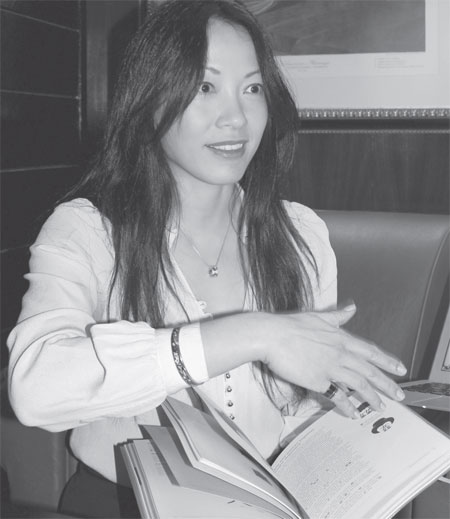
| Taiwan-born London resident ShaoLan in New York City recently talking about her new book Chineasy: The New Way to Read Chinese, which teaches the language by deconstructing its calligraphic characters. Lian Liu / China Daily |
(China Daily USA 03/28/2014 page3)



Today's Top News
- Xi congratulates Ouattara on re-election as president of Cote d'Ivoire
- Supercarrier to be put through paces
- Game changers for China's sports industry
- EU should not give platform to 'Taiwan independence' separatists
- Nation drives global energy transition
- Tariff-troubled US fears not-so-happy holidays