Jay Xu: Museum head practices art of giving









| Shanghai native Jay Xu, director and CEO of the Asian Art Museum, in his San Francisco office. "Giving is itself a gift for all of us to cherish," he said. Qidong Zhang / China Daily |
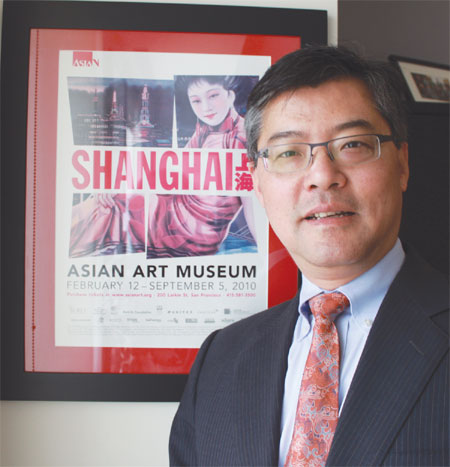
Jay Xu, a native of Shanghai, had just begun his work as the assistant to the director of the Shanghai Museum when the museum collaborated with the Asian Art Museum for a loan of art to honor the sister-city relationship between Shanghai and San Francisco.
Not in his wildest dreams did Xu see himself becoming the director of San Francisco's Asian Art Museum 25 years later, and becoming the first Chinese American to direct the largest Asian art museum in the US, handling more than 250,000 visitors every year.
"Life seems to be full of surprises and accidents on the surface, but everything is actually connected if you look back," Xu said.
Xu was to study science in college but instead majored in Chinese literature by accident, which led him to the job of assistant to the director of Shanghai Museum in 1983, who was an expert on ancient oracle bone inscriptions. ater he worked for Director Ma Chengyuan, a famous scholar of ancient Chinese bronzes and a renowned museum director in China, who taught Xu how to appreciate ancient bronzes and methods of studying them.
Then in 1988, another famous scholar of ancient Chinese bronzes, Professor Robert Bagley at the Department of Art and Archaeology of Princeton University, came to the Shanghai Museum as a visiting scholar. Xu served as an interpreter between Ma and Bagley during his visit. Six months later, Xu received a letter from Professor Bagley inviting him to study in Princeton as his PHD student.
"I had only heard of Harvard and Yale at that time and had never heard of Princeton, then I learned that (Albert) Einstein worked at Princeton, so I went ahead," Xu laughed. "Looking back, my director at the Shanghai Museum may have seen potential in me and maybe he has sensed that one day I could play a meaningful role in US-China relations. I didn't know what it meant to get a degree, but they (Ma and Bagley) did, which changed my life forever."
His study at Princeton gave him rigorous training as a scholar in art history and archaeology, specializing in ancient Chinese bronzes, and his working experience at Shanghai Museum helped make him a bi-cultural expert on an international scope.
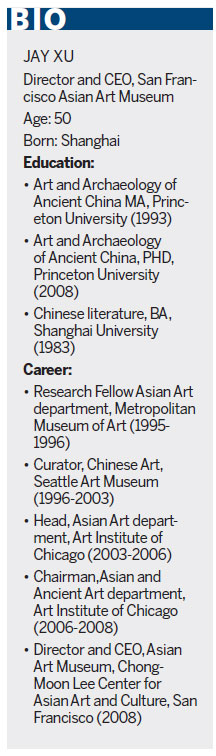
After Princeton, Xu spent two years of research fellowship in the department of Asian Art at Metropolitan Museum of Art in New York, and he became a curator of Chinese art at Seattle Art Museum in 1996 and worked there till 2003. He became head of the Department of Asian Art at the Art Institute of Chicago and later chairman of a department covering not only Asian art but also ancient Egyptian, Greek and Roman civilizations, before he came to Asian Art Museum of San Francisco in 2008.
"A friend of mine once said I am in charge of the largest territory of longest history, which is practically true," said Xu, "our museum has the very best collection in the western world on Asian arts, even comparing to museums in Asia. It is incomparable because there is not a single museum in Asia that is so pan-Asia. So in the sense of culture and geography, we cover much larger territory and diversity of cultures."
Describing San Francisco as a gateway to Asia and managing 150 staff members from curators, designers, artists, researchers, educators, security, marketing and public relations, Xu believes in leadership and enhancing on culture diplomacy at the museum: "True leadership is inspiration, you have to inspire your troops and getting the right staff is getting the job done with double efficiency."
"I am a beneficiary of the Ping Pong diplomacy between US and China," Xu said. "Before normalization of our two countries, there were culture exchange and sports. Art and cultural understanding can help nations reduce conflict or ease tension with each other - when you understand and appreciate each other, it's easier to communicate. Museum not only helps to appreciate the arts, but also understand each other's culture, tradition and history, which is really the root of mutual understanding. Our museum brings Asia and US closer, and enhances the culture diplomacy."
The Asian Art Museum presented Shanghai in 2010, a special exhibition that features more than 130 works of paintings, furniture, posters, fashion, movie clips and contemporary installations. Xu said the exhibition explores the tumultuous history that has resulted in one of the world's most dynamic and cosmopolitan cities.
"I am a Shanghainese myself, and was so proud of putting this fantastic art show together to coincide with China's World Expo in 2010, which showcased great support from both Shanghai and San Francisco mayors," said Xu.
Xu said that approximately 50 programs were created to enrich visitors' experience and provide additional context to Shanghai, including performances, evening events, discussions and lectures, Asia Alive demonstrations and film screenings throughout the exhibition's seven months to honor relationship with Shanghai.
"We arranged a large Chinese contemporary sculpture given by people of San Francisco to Shanghai people, presented by then-San Francisco Mayor Gavin Newsom (now California's lieutenant governor). The sculpture was placed in a public park next to the expo and received a lot of attention; now years have passed but I am still emotionally connected with that program."
Being the only and first Chinese American who became the director of a major US museum, Xu attributes his success to "giving 120 percent or more" at everything he does.
And because he learned the importance of mentoring from his own experience, Xu is an active member of the Committee of 100, which he was invited in 2010 for his achievement as a Chinese American.
In a recent Committee 100 annual meeting, Xu called on fellow members and community leaders to "think about giving early, giving more, giving often".
"Giving is itself a gift for all of us to cherish," he said.
kellyzhang@chindailyusa.com
(China Daily USA 03/28/2014 page11)


Today's Top News
- Supercarrier to be put through paces
- Game changers for China's sports industry
- EU should not give platform to 'Taiwan independence' separatists
- Nation drives global energy transition
- Tariff-troubled US fears not-so-happy holidays
- 'Looking China' brings American youth closer to Chinese culture