



Comfort and nostalgia on the shelves









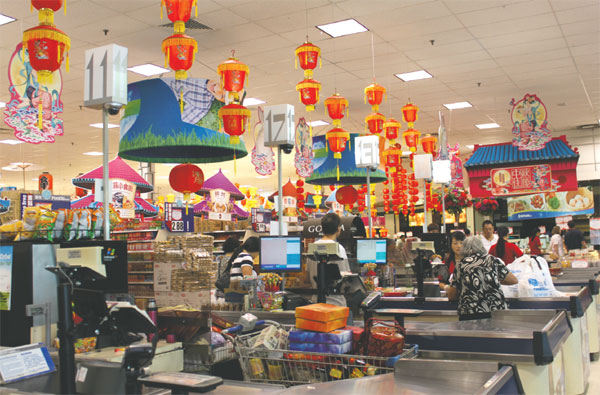
| Chinese supermarket Foody Mart is decorated with Chinese red lanterns to celebrate the Mid-Autumn Festival. Li Na / China Daily |
The growth of the Chinese immigrant population in Toronto also has seen an increase in Chinese supermarkets. Some are concerned that immigrants who shop only at the stores will not integrate into society, but others believe that will not happen as the ethnic stores move closer to the mainstream and represent the embodiment of multiculturalism in Canada, reports Li Na in Toronto.
Zhang Chunyan, a resident in Richmond Hill, a town located north of Toronto, drives 30 minutes every Saturday to a supermarket in the capital city with a shopping list that includes chicken paws and marinated pork feet.
He's not alone.
Along with the growth of the Chinese Canadian community have come Chinese supermarkets. Since the mid-1980s, more and larger Chinese supermarkets have opened in Toronto's suburbs. Now, more than 200 Chinese grocery stores of various sizes are in the greater Toronto area to serve the Chinese and Asian population.
That population has become the fastest growing ethnic group in the country with 537,060 Chinese living in the area, according to the 2011 census, the latest available data.
Whether they are newcomers or well-established immigrants in Canada, ethnic Chinese prefer to shop for food at a Chinese supermarket not only because some items may not be available elsewhere, but also because they feel more comfortable speaking their own language and getting service like at home, according to Lucia Lo, a professor of geography at York University in Toronto.
Lo did a study of ethnic identity and the cultural translation of the marketplace a couple of years ago that consisted of surveying more than 500 Chinese and non-Chinese families.
Critical factors
Apart from price, which is regarded as one of the most important factors in a purchasing decision, culture is another critical factor that affects the ethnic shoppers' decisions, Lo said.
"Not only Chinese customers, all the people here prefer to shop in a supermarket which reflects their own cultural background," she told China Daily. "The shopping environment is distinct between Chinese and non-Chinese."
Dr Ken Ng, president of the Federation of Chinese Canadians in Markham, believes that there is a tendency for immigrants, especially new ones, to find a place where they can be comfortable and which feeds their nostalgia for home.
"This is especially so with immigrants who do not know the English language well," he said. "Chinese supermarkets are therefore places where they can gather and exchange news or talk about things at home. This is not just so with Chinese immigrants but with other ethnic groups too."
While the growth of ethnic supermarkets has been a welcoming signal to the Canadian economy, some say the expansion may reduce the need and desire of immigrants to integrate with mainstream society.
"On the one hand, the Chinese have created an ethnic economy away from their home country. This is an important step toward achieving economic integration," said Wang Shuguang, a professor of geography at Ryerson University. "However, Chinese-owned and operated supermarkets should not be too narrowly focused on consumers within the Chinese group. A broader customer orientation not only helps with business success, but also enhances social integration."
For Zhang, who came from Hubei province in China three years ago, driving to the Foodymart Warden Branch in Toronto means it's easier to not only find Chinese food for his family, but "buy various vegetables there which are cheaper than anywhere else".
A two-minute drive from Foodymart is the T&T supermarket Warden & Steeles branch in Markham, where Zhang can buy Asian snacks and daily food supplies.
Like many Chinese residents in the greater Toronto area, Zhang and his family will split their food shopping between a Chinese grocery store and a local supermarket, such as Costco or Nofrills.
Founded in 2001 by a group of Chinese immigrants from Fujian province, China, Foodymart has grown into a chain of eight large-scale Chinese supermarkets. In its Warden branch with 60,000 square meters of store space, the daily number of customers often reaches 10,000, according to Wei Chengyi, president of Foodymart Corp.
Although Chinese supermarkets also carry non-ethnic food, the shopping environment is very Chinese not only in decorations, but also among the workers, with most of them of Chinese background.
Right after Christmas Day last year, the Warden store was fully decorated for the upcoming Chinese New Year and the food aisles were full of special items in celebration of the big day.




Today's Top News
- Xi's message for New Year widely lauded
- New Year's address inspiring for all
- Xi congratulates Science and Technology Daily on its 40th anniversary
- Xi congratulates Guy Parmelin on assuming Swiss presidency
- China Daily launches 'China Bound'
- Manufacturing rebounds in December








