



China has changed discourse on Africa









Africa Programme head at Chatham House keen to forge links with Chinese institutions
Alex Vines believes China has shaken up a Western approach to Africa that was stuck in a time warp.
The head of the Africa Programme at Chatham House, Europe's largest foreign policy think tank, says the world's second-largest economy has proved over the past decade that the continent is a business opportunity and not just a donor recipient.
|
|
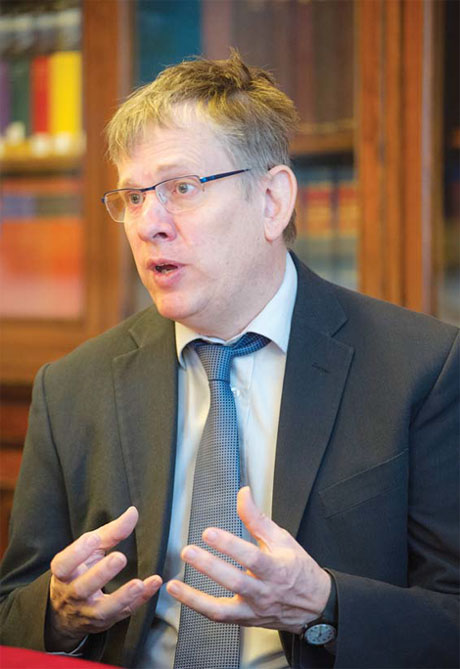
"There was mostly a humanitarian discourse that was more about aid than trade. It was looking at the continent not as an opportunity but as a risk. China has completely changed that discourse."
Vines, 50, was speaking at a conference room at the think tank's headquarters in St James in London among the din of construction noise next door at Lancaster House, where both Mauritius and Zimbabwe negotiated their independence.
"China has forced complacent European countries - which as ex-colonial powers thought they understood Africa very well - to rethink their strategy for the continent."
China's economic engagement with Africa has grown exponentially since the turn of the century and the government expects the stock of outward direct investment to quadruple to $100 billion with trade also doubling by 2020.
Vines believes China has been successful because it has had a grand strategy for Africa, forcing its companies to go out and set up business operations there.
"The going-out process was one that was pushed by the state and that is why it differs from that of India and other countries that have been engaged in Africa. It is a state plan and not driven by the private sector."
He says it is no longer possible for European and other countries to follow such a strategy.
"Grand strategies are probably better for big countries like China since it is rich enough and such big undertakings tend to be quite messy.
"Imperial Britain had a grand strategy that worked since you had an overriding guiding principle that if you stumbled on Country X, you were going to colonize it."
The wealth generated by that once successful imperial strategy is evident in the splendor of Chatham House's Grade One listed 18th century headquarters, once the home of prime minister William Pitt, 1st Earl of Chatham. The organization is famously the originator of Chatham House Rules, under which discussions should always remain anonymous and private.
Vines, who has headed the Africa Programme for more than a decade, oversees a team of nine full-time staff as well as affiliates.
"Last year we had more than 140 meetings on Africa," says Vines. "We are a charity not-for-profit organization and the majority of our work is in the public domain. We provide a comprehensive analysis of African politics. We host meetings with heads of state, government ministers, opposition and civil society leaders.
"In terms of an independent think tank we have more people working on Africa than many other comparable institutions. If you take our counterparts in the US, the Council on Foreign Relations or Brookings (Institution), they tend to only have one or two people working on Africa."
The Africa Programme is increasingly keen to forge links with Chinese institutions, including recent discussions with the Beijing Foreign Studies University.
"We have just had a delegation from a Chinese think tank. I think you have in China quite a lot of Africa centers appearing in Chinese universities but they tend to be quite small. It is from a low base but is growing."
Vines, although British, was born in Canberra, and had a peripatetic childhood with his parents moving round the world, including Mexico, where he did some of his primary school education.
He later went to a private school in the UK, moving on to study archaeology at York University, followed by a master's in Southern African studies.
His first position was as with the British Institute in Eastern Africa in Nairobi followed by a series of roles which involved living in Africa.
He went on to work in a number of United Nations roles, including being a weapons inspector in war-torn Liberia.
Vines says there has seen a major shift of emphasis in terms of how Africa is viewed over a generation.
"It used to be seen just through the lens of Cold War politics and it was all about strategic minerals. If you understood what Soviet policy was and what Western policy was, then you also understood Africa."
One of the most contentious issues among European countries - themselves enduring austerity - is whether they should still set aside 0.7 percent of their GNI for overseas development aid.
The goal was originally set in 1970 and reaffirmed at the Gleneagles G8 summit in 2005 but last year only six countries - Sweden, Luxembourg, Norway, Denmark, the Netherlands and the UK - met the target.
At the recent UK general election, having such a target was vehemently opposed by the UK Independence Party among others.
"I am not against the 0.7 percent target, in particular. I do think the way it is used and targeted at has to be thought about. You have the scandals in the Daily Mail here when they report on the number of consultants, etc," Vines says.
"If the whole thing is front-end loaded and you have to just hit this figure, that is no good. The quality of the spending matters. Sometimes it is the small amounts of money given to specific projects that can have the greatest effect."
Vines says another external impact on African countries is often sanctions imposed upon them by the United Nations.
"It is not by coincidence that there are more sanctions imposed on Africa than any other part of the world because it is easier. There are fewer strategic interests in Africa. You cannot get a UN Security Council resolution on Syria, for example, or anywhere in the Middle East, whereas with many African countries it is much more straightforward."
One of the major African security fears is that the so-called Islamic State, having got a foothold in Libya, will push southwards into Nigeria.
"I think that is the single biggest fear that policymakers have," says Vines. "I think Boko Haram are on a weakening trajectory at present and now with the election and swearing in of General Buhari (as Nigerian president), he will focus on the security situation in the north."
"Will IS find a foothold in that environment? I think it will be difficult for them, given that their supply lines would become very long and that they would stick out very visibly in a Nigerian context."
Vines is not uncritical of China's economic involvement in Africa, and he believes Chinese companies need to use more African workers.
"There needs to be more local content generally. There are about a million Chinese working on construction projects in Africa at the moment. In Angola the single largest import is cement from China. That is bonkers. Angola should be producing its own cement."
Vines insists, however, that it is up to African governments how they handle their relationship with China and other rising Asian powers.
"Some of the political elites see it as a way to extract short-term value, others have a long-term developmental vision and there are others who are very clever at playing off China against India."
Vines is encouraged, however, by the renewed debate about Africa. He lectures at Coventry University, which has 3,000 African students, more than anywhere else in the UK.
"Many of them come from middle class families, especially Nigeria, and we have some very interesting discussions. Some are classic youngsters who prefer to play Candy Crush on their phones but once you get them into a discussion on African politics, you get to the real issues.
"I took some Chinese think tank people up there and they got a harder time about China's Africa policy there than at Oxford or at Chatham House when we did a round-table event."
andrewmoody@chinadaily.com.cn




Today's Top News
- Maduro has declared national emergency
- Tesla overtaken by BYD in global EV sales in 2025
- Trade-in subsidy aims to drive more consumption
- Cooperation can boost cross-Strait integration
- State-owned firms register stable performance
- Global experts hail Xi's people-centered message








