Make the world great – part three: traditional Chinese thinking and modern physics









|
|
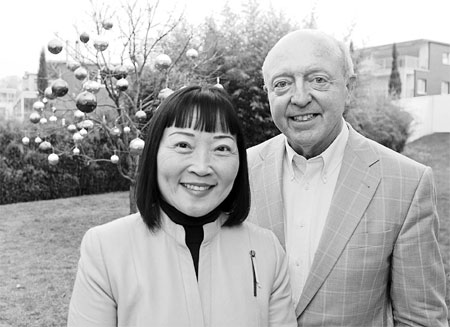
| Hans Boller-Wu, vice-president of the Swiss-Chinese Chamber of Commerce, and his wife Amy Wu are seen in this file photo. [Photo by Xie Songxin/chinadaily.com.cn] |
So far we have argued that only intensified cooperation promises sustainable solutions for the bigger problems of the world, and we have referred to the millennium old Chinese "Book of Political Documents" (Shang-shu) where the "compatibility of all peoples" has been claimed. In the old Chinese political thinking coexistence precedes existence, obviously true for individuals as well as for nation-states, and consequently, from this viewpoint, the new world concept would require that global leaders behave as such by transcending their national borders in their concern for the wellbeing of both their own people and the peoples of the world.
Making the world great – not again, but for the first time – therefore means building a global community of common destiny in which the aspirations of the peoples for peace and prosperity are met through joint efforts of all nations, especially the big ones.
It might be of interest to note here that in a completely different field, namely the one of medicine, the traditional Chinese thinking assumes that the parts of the human body represent the whole, and that the whole precedes the parts. The ear for instance has representations, clearly defined areas, of the liver, the lung, the heart etc. Of course, these assumptions by the Traditional Chinese Medicine (TCM) are approximations, somewhat raw, but they anticipate, as we will see, modern perceptions quite well.
"Opposites are complementary and form a unity". This wisdom is shared by both antique Greek and Chinese philosophers with the latter teaching it in the form of Yin and Yang in TCM to this day. Outstanding personalities such as Heraclitus, Parmenides and Laozi stand for similar concepts emphasizing an indivisible dynamic relationship of parts and the whole. But while the Chinese civilization basically remained on this path, Western thinking moved away over centuries only to find itself in a fragmented world, not only in thinking but also in real terms – until the epochal discoveries of Einstein's relativity theory and Heisenberg's quantum physics reversed the movement again.
Today, old Greeks and Chinese agree with modern physics that fragmentation is no longer an adequate description of reality and has to be overcome. Eminent physicists like Niels Bohr and David Bohm bring it to the point: "It will be ultimately misleading and indeed wrong to suppose, for example, that each human being is an independent actuality who interacts with other human beings and with nature. Rather, all these are projections of a single totality" (Bohm). Or "The opposite of a profound truth may very well be another profound truth" (Bohr).
Let's welcome these new partners in thinking: Europe is a profound truth, America is a profound truth, India is a profound truth, and Russia is a profound truth and China as well. Together all of them and all others form a unity, but they have to recognize and work on it.
The author is Director of the Boller-Wu foundation in Switzerland.