Standing out among the hard shells









Shanghainese entrepreneur Chen Xi founded luggage brand ITO in 2007, the same year German luxury luggage manufacturer Rimowa entered China.
Ten years later, Rimowa, best known for its grooved aluminum suitcases, sold 80 percent of its stake to LVMH for 640 million euros ($680 million). Despite the fact that analysts said the deal was undervalued because of market saturation, Chen is nevertheless soldiering on with his colorful hard shell luggages that cost about one-fifth the price of a Rimowa. He is even aiming to become a bestseller in China within the next three to five years.
"When it comes to choosing suitcases, the millennial generation is not looking for a box to stuff their belongings, but an accessory to go with their styles," said Chen.
"On the other hand, they are not as brand-sensitive as their predecessors and are more open-minded to whatever they find appealing."
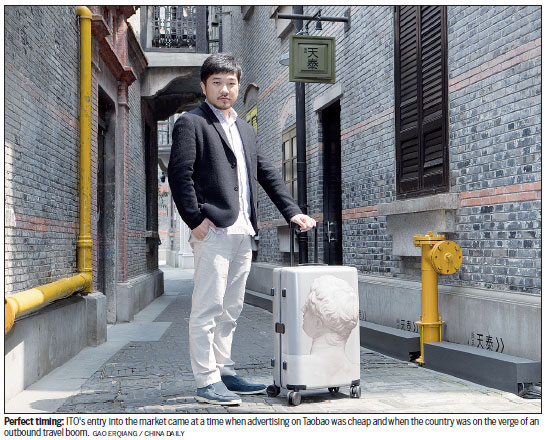
The 33-year-old said he was inspired to start his own luggage brand after realizing that there was a very limited selection in the market a decade ago. Labelling Samsonite as "too formal" and Rimowa as "too expensive", he used to travel exclusively with backpacks before creating ITO, which stands for Independent Traveling Original.
With help from his father who was a senior executive at a luggage factory, a 10,000-yuan ($1,453) investment and a computer, Chen started his business on Taobao, the retail platform of e-commerce giant Alibaba, during his fourth year in college.
Despite having to handle customer service, place orders with the factory and scout for designers, Chen hit the ground running and sold an average of 300 cases a month for the first year.
Within less than five years, his store had sold more than 500,000 suitcases. In 2016 alone, he made 65 million yuan, up 40 percent from the previous year, from the sale of 60,000 suitcases.
Chen said that his products are popular among consumers around his age who like the bright colors. He added that overseas sales currently account for 8 percent of his business.
"ITO is a homegrown brand that is designed in China and made in China. More than that, it proves that Chinese brands can be sold globally as well," he said.
Looking back, Chen said he picked the perfect time to start the business. He recalled how Taobao was still in its infancy a decade ago and online retailers only needed to pay a measly 3 yuan to advertise their products on the prime frontpage banner.
Another factor was that Chinese outbound travel was on the cusp of exploding. He pointed out that Chinese travelers made an average of just one domestic trip a year, with outbound travel still considered a luxury for the majority before the 2008 Beijing Olympic Games. By 2016, China had risen to become the world's largest market for outbound travel, with overseas trips growing three-fold since 2008 to 120 million, according to the China National Tourism Administration.
This in turn spawned the world's largest luggage market. Euromonitor International estimated that retail sales of luggages in China in 2016 surpassed 30 billion yuan, up 80 percent year-on-year. However, market research has found that the per capita expenditure on luggage in China is still many times lower than in Japan and North America.
Well aware that luggages were not products that people purchase on a regular basis, Chen decided to invest his money in product design instead of opening brick and mortar stores that could reinforce the brand's presence.
In 2011, he collaborated with the designers of Shang Xia, a Chinese luxury brand backed by Hermes, and launched a premium luggage collection called Ginko. The collection won the prestigious Red Dot Design Award and attracted the attention of retailers like Lane Crawford department stores, which now stock the Ginko line of luggages.
For the brand's 10-year anniversary this year, a new collection of five limited edition cases featuring authorized prints of the British Museum's signature pieces like the Discobolus was launched.
ITO's success has attracted copycat brands which Chen said are the biggest threat to his company of 40 staff in Shanghai. Last year, he was involved in 10 copyright infringement cases after taking action against those who copied his designs and logo.
This problem is one that major players such as Rimowa face as well. In October 2016, the German brand won a precedent-setting court case in South China's Guangdong province.
Rimowa had taken legal action against a brand called Aimowa that sold similar-looking bags. According to a news release by Rimowa, "the court prohibited further marketing and sales of the 'Aimowa' suitcase in order to protect consumers from the risk of confusion".
He Qi in Shanghai contributed to this story.
xujunqian@chinadaily.com.cn
(China Daily USA 04/14/2017 page7)




Today's Top News
- Drills demonstrate China's resolve to defend sovereignty against external interference: Editorial flash
- Trump says 'a lot closer' to Ukraine peace deal following talks with Zelensky
- China pilots L3 vehicles on roads
- PLA conducts 'Justice Mission 2025' drills around Taiwan
- Partnership becomes pressure for Europe
- China bids to cement Cambodian-Thai truce