Revival of creativity









Acclaimed architect Wang Shu completes a decade at the helm of an experimental school
Over the past decade, Wang Shu has been nurturing Chinese architects on idyllic land at the outskirts of Hangzhou, the capital of Zhejiang province.
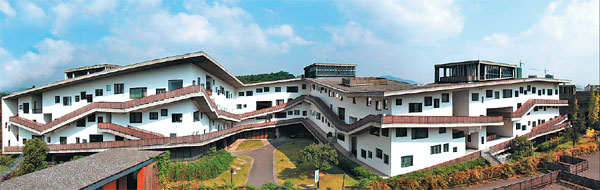
Wang, 54, designed the China Academy of Art's Xiangshan campus in 2007, in the fashion of jiangnan, a term used to describe the scenery along the southern banks of the Yangtze River.
He became the dean of the School of Architecture that opened there that year.
| CHINA ACADEMY OF ART'S Xiangshan campus designed in the fashion of an elegant garden. Photos by Wang Kaihao / China Daily |
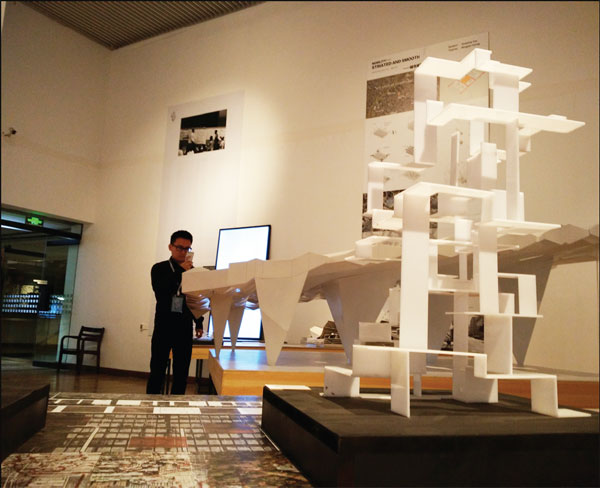
| WORKS of architecture students on display at the school. |
Xu Jiang, the academy's director, describes Wang's design of the campus as an "elegant garden".
Wang says that in Chinese tradition, "elegance lies not only in high taste but also in being able to criticize what is vulgar".
Since it is the country's first architecture school inside an art academy, few people knew that what was being taught there, as architecture used to be seen as part of engineering rather than fine art.
Wang, who is probably the country's bestknown contemporary architect, says the only "interlude" in the past decade's experiment at Xiangshan was his winning the Pritzker Prize, the world's top architecture award. In 2012, he became the first, and so far the only, architect of Chinese nationality to do so, despite years of real estate boom in China.
"I guess the reason I got the prize was that what we were doing was accidentally discovered by the world," Wang says.
"In a country with the largest number of ongoing construction projects in the world, there are few creative projects with Chinese characteristics," he says, adding that Chinese-style architecture has become lost in the frenzy of real estate development.
"Chinese architects have mimicked Western formats. ... We need a blank sheet of paper to start all over again."
Now, an exhibition titled Re-Experiment: Live Exhibition of CAA School of Architecture, which began at the academy in April, is showcasing the school's architectural strides with models and drawings inspired by construction materials and public spaces. The works from students of the school are displayed under different themes. Some exhibits are even half-done.
"We don't want to review all of our best work in a decade," Wang says. "This is more like a biennale."
The school views architecture as a form of contemporary experimental art.
"Architecture education is not just knowledge-based, and we don't just draw, but work with hands-on understanding of construction," he says.
Consequently, the beginners' syllabus reads more like a training manual for carpenters and bricklayers rather than architects.
For freshman students, lesson one is to make a chair, a course taught by Wang's wife, Lu Wenyu. The students also have to deal with mud, rocks and bricks almost daily in later semesters. In the first two years at the school, nobody is allowed to use a computer for homework.
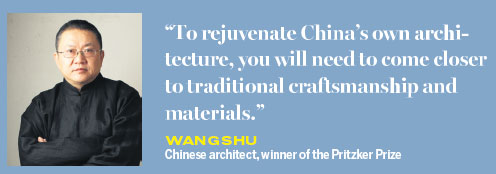
"Computers make architects lazy. Computers are connected with the brain, but hands are connected with the heart," he says. "To rejuvenate China's own architecture, you will need to come closer to traditional craftsmanship and materials."
The school has an unorthodox approach compared with other places that teach architecture in China. While some student projects are stage plays that promote an understanding of the sociological meaning of architecture, others focus on writing novels to nurture their imagination and storytelling skills.
"An architecture school should inspire creative thoughts among its students and go beyond techniques," he says.
The results of Wang's experiment have been mixed. At first, no one else wanted to take up a job in such an unusual institute, and Wang had to lecture every course himself. But today, there are about 40 teachers at the school, including foreigners. Some students come from other countries, too.
Ryan McCaffrey, once Wang's student and now a teacher at the school, shares his thoughts on the attempts to revive Chinese traditional architecture.
He says people at CAA share the belief that the environment is as important as the architecture, while in the West, people pay more attention to the building.
"Environment, material and technique are not new concepts, yet the work here is rich because it studies the specific aspects of those universal problems," says McCaffrey, who is from the United States.
Perhaps the Xiangshan campus, claimed by Wang as "a combo of construction and environment", explains that philosophy.
"How to keep the gist of architecture in a world dominated by the pursuit for money is what we try to answer," Wang says, adding that he hopes at least some of his students will carry the school's spirit to the job market after they graduate.
People often complain that it is hard to find one's way on his mazelike campus, Wang jokes. It can be an education for the students on handling the situation when they get lost in real life.
Wang Jianguo, an academic at the Chinese Academy of Engineering and Wang Shu's friend from their days together at Southeast University in Nanjing, capital of Jiangsu province, says, "It is important to understand his criticism of the problems in architecture in today's China, caused by rapid urbanization, as well as to see his efforts to re-establish the system.
"The architectural diversity advocated by him has gone beyond small circles and has won public praise."
Wang Shu says, "It is just the beginning, and I cannot say what the future trend will be, but it will keep changing.
"Our experiment would be good enough if it could last for the next decade. If so, we will beat Bauhaus (a once influential German art school that taught crafts and architecture), which only existed for 14 years but made a lasting impression."
wangkaihao@chinadaily.com.cn
(China Daily European Weekly 04/21/2017 page21)



Today's Top News
- Xi says major countries should take lead in abiding by intl law, UN Charter
- Xi meets Taoiseach of Ireland
- New Year holiday drives travel peak
- ROK leader begins state visit to China
- AI must serve humanity, not endanger it
- Initiative sets clear course for Yangtze