Craftsmanship puts archery on target









'Whistling' leisure activity with a history of 1,500 years making a mark in modern day
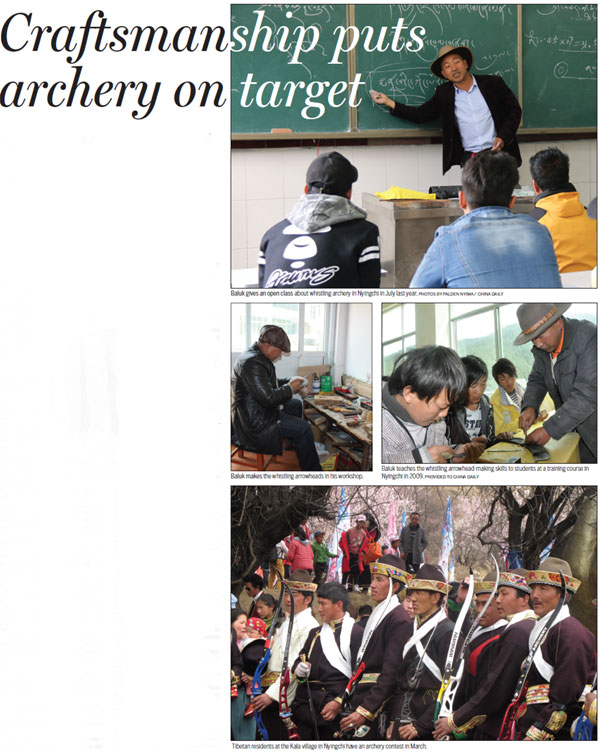
While most of the shops in the Tibet autonomous region's eastern tourism hot spot of Nyingchi sell small souvenirs, one store in the city targets a different kind of customers through the sale of archery supplies.
The owner of the shop, Baluk, who comes from the city's Manling county, prides his store on its locally produced arrowheads used for whistling archery.
According to a local legend, whistling archery has a more than 1,500-year history and was invented by a local king called Agyal King to amaze and confuse his enemy in battle.
Whistling archery is therefore regarded by locals as homage to their heroic king and a joyous traditional sport.
It is widely practiced in the city's rural areas, but there are few people who are able or willing to make the whistling arrowheads themselves.

Baluk has gone to great lengths to learn the skill and preserve the culture, with whistling archery having become a symbol of the city.
"All families in Nyingchi have bows and arrows in their homes," the 58-year-old Baluk said. "Local men pride themselves on their archery ability."
According to residents of Nyingchi, the bigger the inside of an arrowhead, the deeper the sound it makes, representing a man's voice, while thinner arrows create a higher-pitched noise and represent a woman's voice.
In the old days, most arrows had a man's voice, but arrows these days mostly have a woman's voice as people prefer small-sized bows and arrows, said Baluk.
He added that the tradition disappeared for a period of time, and that he only saw archery equipment for the first time in 1982.
Half a century ago, archery became a sport of the upper classes, and when people had picnics, archery was a key feature, Buluk said.
"Archery disappeared again during the 'cultural revolution' (1966-76), but since the introduction of reform and opening-up in 1978, archery has seen a revival," he said.
Whistling archery became popular in rural areas of Nyingchi after the 1980s, and it was included as a competition event at the second National Ethnic Games in 1982.
An archery association was established in Nyingchi in 2007, and archery was listed as an intangible culture heritage the same year.
Baluk was accredited as a regional intangible culture inheritor in 2010, and he receives 5,000 yuan ($730) each year from the local government for his contribution to the preservation of whistling archery culture.
He spent six months learning the skill of producing whistling arrowheads, and a workshop for producing and selling archery parts was established in Nyingchi in 2015.
"The culture of whistling archery is an important intangible heritage passed down by our ancestors, and the preservation of the art of making such equipment is essential," he said.
In September 2016, Tibet's sports administration included whistling archery in the list of the region's common sports.
Baluk has been invited to teach others about whistling archery at community centers in the regional capital of Lhasa and at schools for many years.
Archery contests are held during the Tibetan New Year as well as local festivals and holidays, with people of all ages able to take part.
The sport often takes place as part of other activities, such as family gatherings, community unions, picnics or singing and dancing performances.
Highland barley wine is prepared for archery events, with females offering wine to archers. Both males and females sing archery songs to each other, and they practice circle dancing around a bonfire when night falls.
While the whistling arrowheads are made locally, all other equipment for the sport, including the bull's-eye, target pads, bows, arrows, finger shields, bowstrings, chest protectors and armbands, are imported from foreign countries, such as South Korea and the United States.
A US-made bow costs about 10,000 yuan ($1,452) in Baluk's shop - expensive bows and arrows are a sign of a family's wealth.
Producing whistling arrowheads requires patience and skill. It takes two days to make a pair of arrowheads, according to Baluk, who has an annual income of about 60,000 yuan.
Nyingchi's education bureau plans to popularize the sport in the city's schools in the near future.
According to the city's culture bureau, the city has four national-level intangible cultural heritages and 203 regional-, city- and county-level intangible cultural heritages.
"The bureau has invested 1.5 million yuan in the construction of a workshop to exhibit the city's intangible culture heritages and other products," said Wang Peng, head of the bureau.
"It is not only for tourists to learn more about ethnic culture, but a great opportunity to encourage locals to benefit financially by becoming involved in tourism."
palden_nyima@chinadaily.com.cn
(China Daily USA 05/05/2017 page5)





Today's Top News
- Trump says 'a lot closer' to Ukraine peace deal following talks with Zelensky
- China pilots L3 vehicles on roads
- PLA conducts 'Justice Mission 2025' drills around Taiwan islands
- Partnership becomes pressure for Europe
- China bids to cement Cambodian-Thai truce
- Fiscal policy for 2026 to be more proactive