China's electrified sector leads world









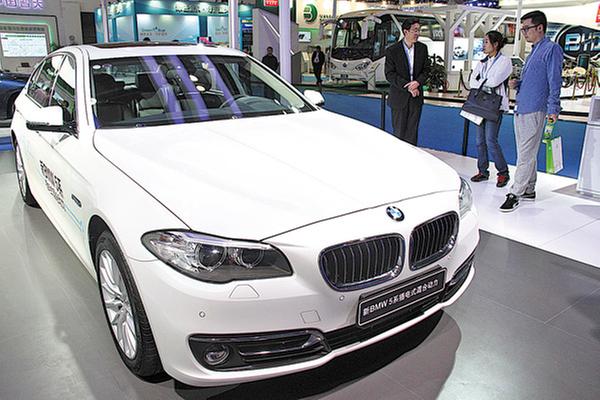 |
| A BMW 530Le catches visitors' eyes at a new energy expo in Beijing. NAN FENG / FOR CHINA DAILY |
China has taken the throne of the world's new energy vehicle sector, due to booming domestic demand for such cars and its evident expansion in battery production.
As demonstrated by its rapid market growth, China is taking the lead in developing the industry, ahead of Germany, France, Italy, the United States, Japan and South Korea. Stricter emission regulations in major Chinese cities are injecting new impetus into the e-mobility sector.
"All first-tier cities will move toward e-mobility, pushing the whole market to shift toward new energy vehicles in the long run," said Ron Zheng, principal of Roland Berger Greater China.
He said China would become the nation with the strictest emission regulations, as it is presenting a radical amendment to emissions legislation to boost sales of electric vehicles.
The authorities have put forward a comprehensive framework to force manufacturers to meet aggressive sales targets for electric vehicles and plugin hybrid electric vehicles of 7 percent in 2020 and 19 percent in 2025.
The new framework also sets an average fuel consumption target of 4 liters per 100 kilometers for new passenger vehicles by 2025, and 3.2 liters per 100 km by 2030.
Another major driver behind China's pole position is its advantages in battery cell production, according to German consulting firm Roland Berger, which conducted the study in partnership with German automotive research institute Forschungsgesellschaft Kraftfahrwesen Aachen.
One example is the Fujianprovince-based battery maker, Contemporary Amperex Technology, which is now supplying cells to BMW Group's joint venture BMW Brilliance Automotive. It launched cooperative projects with Hyundai's Chinese venture Beijing Hyundai Motor this month.
Locally produced lithium-ion cells contributed more than 90 percent of the total to the Chinese e-mobility market thanks to State subsidies, according to Roland Berger Greater China.
The consultancy expects a much faster drop in the price of lithium-ion cells in the near future.
Nielsen Holdings, a global measurement and research company, concurred that the government has fueled the clean energy vehicle sector and that policies promoting full electric vehicles are taking effect in China. Nielsen's survey shows that the popularity of clean energy vehicles is rising among Chinese consumers, with 27 percent of car-buyers willing to consider purchasing fully electric vehicles this year, while 25 percent are interested in plug-in hybrid electric vehicles.
About a quarter of consumers went to see and test-drive the new energy vehicles.
"Chinese consumers are taking note of the benefits of owning an electric vehicle. Today we're seeing a massive opportunity emerging for hybrid vehicles and fully electric vehicles are also growing in popularity," said Olive Zhang, vice-president of Nielsen China.
Nielsen's report finds that demand for longer battery life is particularly strong among fully electric vehicle buyers.
The average expected driving range rose to 374 km in 2017, while the actual distance was extended to 252 km this year, close to the expectation of 265 km reported last year.
The average expected range among mid-range vehicle buyers is 309 km, while high-end customers look for 462 km on average in 2017, according to Nielsen.
There has been little progress in terms of driving range among the majority of Chinese manufacturers, who mainly position themselves in lower-priced segments, despite various plans to launch large fleets of new models over the next several years.
Roland Berger expects carmakers to add longer-range vehicles to their offerings from 2018 after the rapid integration of a new generation of cells.