Learning from a master calligrapher









To teach Chinese calligraphy to beginners, it's best to have a painter as the teacher. At least that was the case for learners at Western Kentucky University in Bowling Green.
In a classroom on the first floor of the university's library, which has been designated as the Confucius Institute since 2010, Liu Shuling, a renowned artist from China, used a brush, some ink and stacks of paper to teach a small class of avid calligraphy learners how to write Chinese characters last Wednesday.
A video of Liu teaching the Americans how to draw Chinese characters with a brush went viral on the internet. By Sunday it had generated nearly 1 million views and 13,000 likes on Miaopai, a Chinese video sharing and live streaming service.
"America," the 76-year-old said, "is transliterated into two characters - mei guo, meaning 'beautiful land' in Chinese."

As he wrote the first character, mei, on a whiteboard, his students watched a shape looking like a sheep with two long, sharp horns appear above a graphic representing "big".
"It has long been believed in China that a big sheep is beautiful, hence the meaning of the word mei," Liu said. "But I'd rather believe it represents a man wearing sheep-horned headgear that makes him look great."
He further pointed out mei is a type of character called huiyi - characters formed by a combination of elements thought to be logically associated. As for guo, the second character in mei guo, or America, Liu drew a circle representing a walled land to be defended by a dagger-axe.
This character belongs to the most common type of Chinese character, called xingsheng, which is created by combining a semantic with a phonetic element intended to remind the reader of the word's pronunciation, according to Liu.
The Chinese traditionally divide the characters into six types, which also include xiangxing, characters that were originally pictographs, Liu said. He painted an animal standing on its rear feet, with hair fluttering on its mane.
"It is a horse," several American students yelled. "Yes, this is the Chinese character for horse," the teacher said, giving them a gleeful thumbs-up.
Liu's brush moved like magic: he drew simple lines and shapes to form different characters for man, woman, fish, river, sun and moon, which his students had no difficulty recognizing. In fact, Liu said the Chinese script is logographic and the basic stock of characters are simple graphs.
As the great Confucius said: "Isn't it a pleasure to study and practice what you have learned?" Liu asked the students to write their country name mei guo in brush.
Elizabeth Harlow, a first-year student in the Chinese department, seemed to be relating Liu's calligraphy to his paintings, which are on show at the library. "His pictures are beautiful," Harlow said. "He is an amazing artist very different from what I've seen before."
As some students were gingerly holding brushes, Liu adjusted their grips.
Shaden Melky, a library technology consultant at the university, said she had always wanted to do Chinese calligraphy, and her first try was "fascinating".
"This is my first opportunity and it's wonderful," Melky said. "It is also nice to learn the history of calligraphy as well."
The classroom is just a part of the 700 square meters of space on the first floor of the university's library allocated for permanent use by the institute.
huanxinzhao@chinadailyusa.com
|
Liu Shuling (left), an established Chinese fine arts painter, displays his paintings to faculty members and students at the Confucius Institute at Western Kentucky University last Wednesday after giving a lecture on Chinese calligraphy, in which American enthusiasts of Chinese culture learn to write "America" in Chinese with a brush. Zhao Huanxin / China Daily |

(China Daily USA 05/08/2017 page2)




Today's Top News
- Drills demonstrate China's resolve to defend sovereignty against external interference: Editorial flash
- Trump says 'a lot closer' to Ukraine peace deal following talks with Zelensky
- China pilots L3 vehicles on roads
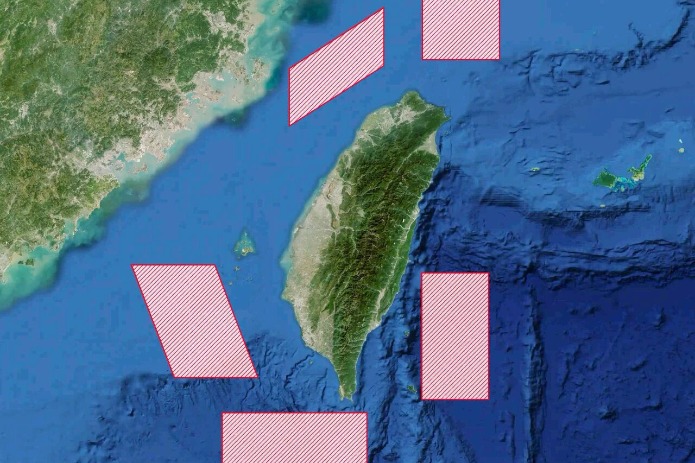
- PLA conducts 'Justice Mission 2025' drills around Taiwan
- Partnership becomes pressure for Europe
- China bids to cement Cambodian-Thai truce