Belt and Road offers tangible benefits










Onus on Sichuan to seize opportunity
CHINA DAILY
Dai Yonghong, a professor at the Institute of South Asian Studies, Sichuan University
Southwest China's Sichuan province does not share borders with any country nor does it have a seacoast. Notwithstanding its unfavorable geographical location, the province, particularly the provincial capital of Chengdu, has all it takes to play the leading role in helping China realize the goals of the Belt and Road Initiative.
The westbound Chengdu-Europe Express Railway is expected to include three major routes-one to the Polish city of Lodz, one to Istanbul in Turkey, and one to Russia. It is still the most used express railway route to trade with Europe, and transporting goods by railways takes less time than by ships. Also, neighboring Yunnan province and the Guangxi Zhuang autonomous region can help Sichuan reach the Southeast Asian market through their land and sea routes, respectively.
On the economic front, Sichuan's GDP reached about 3.27 trillion yuan in 2016, and Chengdu Financial City has the potential to become a regional financial hub. Instead of transferring its production overcapacity to the economies along the Belt and Road routes, Sichuan aims to export its flagship products such as machinery and electronics as well as its infrastructural expertise to Central Asian and Southeast Asian economies, which are exactly what many of the regions' economies want.
From a historic and realistic point of view, Sichuan has a responsibility to help western China seize the development opportunity arising out of the Belt and Road Initiative. A priority for Sichuan is to establish an effective communication mechanism among the 12 western provincial-level regions, which sometimes struggle to make the best use of their advantages and developmental focuses despite their diverse yet generally complementary nature.

For Guangxi, maritime routes must be priority
Li Hao, an associate professor at the China-ASEAN Research Institute, Guangxi University
During a recent inspection tour of South China's Guangxi Zhuang autonomous region, President Xi Jinping said he expected the coastal region to play a bigger role in the implementation of the Belt and Road projects by exploiting its advantages in shipping. For that to happen, Guangxi has to deepen its economic relations with the member states of the Association of Southeast Asian Nations while optimizing its "opening-up" strategy.
In the past year alone, the trade between Guangxi and the Belt and Road economies was worth 200 billion yuan ($29 billion), or more than 63 percent of the region's cross-border trade. Guangxi enterprises also invested more than $871 million in the economies along the two routes during the same period, which was about 54 percent of its total overseas investment.
The success is laudable, but there is still huge potential to be untapped. About 70 percent of Guangxi's trade exchanges with ASEAN economies are with Vietnam, which shares a land border with the autonomous region. It is thus clear Guangxi has not realized the full potential of its maritime connectivity with Southeast Asia.
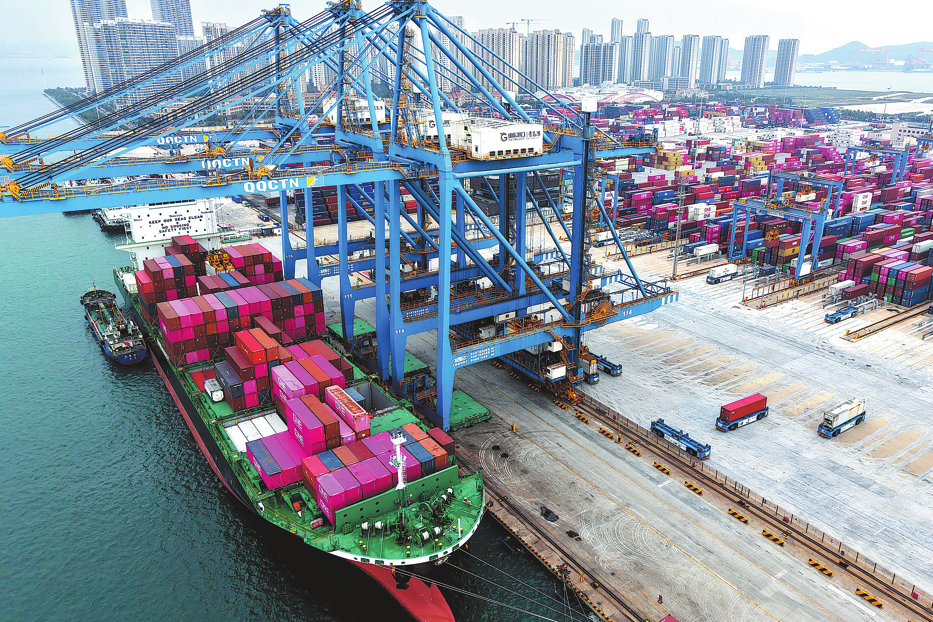
Measures should be taken to ensure that Qinzhou, Guangxi's largest container port that now has 15 international trade routes, opens up new sea routes connecting more destinations in Southeast Asia. The China-Malaysia Qinzhou Industrial Park and the Malaysia-China Kuantan Industrial Park mark a key step toward diversified, deepened cooperation between Guangxi and the ASEAN community. And increasing the "soft" connectivity-through the use of big data, concerted policymaking and cultural exchanges-should top Guangxi's future development agenda.