Firm maps out key role in initiative









Engineering company that has business in 24 countries set to refocus on Africa
The walls of Yin Dewen's office in Zhengzhou, Henan province, are almost entirely covered with world maps.
One shows the major rivers, while another much smaller map highlights the biggest hydropower stations around the globe. A third focuses on hydropower stations across Africa.
As director general of Yellow River Engineering Consulting Co's Overseas Project Engineering Institute, Yin can instantly name the length and flow of any major river he touches on a map, as well as the height of most mountains.
After China proposed the Belt and Road Initiative in 2013, aiming to build a trade and infrastructure network connecting Asia with Europe and Africa along the ancient trade routes of the Silk Road, many Chinese companies like Yin's have been making an effort to answer the call.
"No matter where I go, I always look for maps. When I see a good one, I will try to find where it can be bought," Yin said, adding that maps are important to him for judging potential water conservancy and hydropower projects.
Since 2013, he has traveled to Beijing more than 40 times a year for business and spends more than two months a year abroad, he said.
With a glimpse into Yin's office, articles with exotic charm quickly fall into sight. There are sculptures from Kenya and Laos, and a bank note from the Republic of Guinea on his desk.
"We have had business in 24 countries on five continents and have been following the goings-on in more than 40 countries. Our main markets are in Africa and South America, and we're going to pay more attention to Africa and Southeast Asia," he said.
Yellow River Engineering entered the international market before 2002, said Zhang Jinliang, the company's chairman. "We entered the international market more out of concern for the company's development. Now, we do international business mainly to serve the country's Belt and Road Initiative."
Since it was established in 1956, the company has been working on management of the Yellow River, and the two starting points of the Silk Road - Xi'an, capital of Shaanxi province, and Luoyang in Henan province - are located in the Yellow River basin, so the company has strong advantages in integrating its business with the Belt and Road Initiative, Zhang said.
The Yellow River is China's second-longest river. It originates on the Qinghai-Tibet Plateau and winds its way through eight provincial regions for 5,464 kilometers before reaching the Bohai Sea in the eastern province of Shandong.
Yellow River Engineering has drawn up hundreds of comprehensive plans for developing the river and designed more than 30 large and mid-sized reservoirs in its main channel and tributaries.
One of the major projects was the Xiaolangdi Dam, which is 160 meters high and 1,667 meters wide. With six 30-megawatt turbines, the hydroelectric facility has a total installed capacity of 1,800MW.
With rich experience in surveys, planning and design, Yellow River Engineering is also involved in the engineering, procurement and construction sectors and public-private partnerships, Zhang said.
In addition to water conservancy and hydropower projects, the company has expanded its business to ecological and environmental improvement, buildings, highways, thermal power plants, public utilities and associated facilities.
Zhang said the company has been making efforts in overcoming two obstacles that hinder internationalization of its business: language barriers, and differences in codes and standards.
"Since 2002, we have sent our senior workers abroad for study to make them experts on water resources and hydropower with proficient language skills," he said, adding that more employees with good language skills have been recruited.
China uses different project codes and standards than Western countries. For example, the nation uses flood frequency as a reference for designing water conservancy projects. Western countries, however, uses the record-high flood. This has caused trouble, the chairman said.
While promoting Chinese codes and standards in project negotiation, the company has also cooperated with the Ministry of Water Resources to translate Chinese codes and standards into foreign languages, he said.
"We now have about 500 employees with knowledge of both Chinese and Western codes and standards and who speak foreign languages. They could be dispatched to overseas projects at any time. At peak times, we have up to 200 employees working abroad," Zhang said.
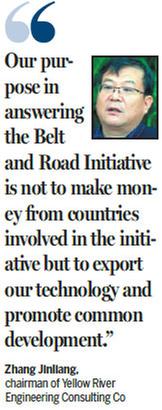
"Our purpose in answering the Belt and Road Initiative is not to make money from countries involved in the initiative but to export our technology and promote common development," he said.
Technology exports also help the company gain technology breakthroughs, he added.
Contact the writer at houliqiang@chinadaily.com.cn