



Butterfly effect and donkey glue









Editor's Note: China is divided into as many culinary regions as there are different ethnic groups. Its geographical diversity and kaleidoscopic cultural profiles contribute to the unending banquet of flavors.
It's the butterfly effect, where demand for donkey glue in China has affected communities halfway across the globe. The issue is sensitive, simply because some of these countries depend on the donkey as a working beast in both agriculture and transportation.
But this is also the reality of a tightening global network of supply and demand, and the fearsome power of being one of the largest consumer markets on Earth.
Donkey glue, or ejiao, is not everyday food. It is used more as a medicine and as a health and beauty tonic. As China becomes more urbanized, its own donkey population is naturally diminishing, and so it is the imported meat and hide that is perpetuating the myths.
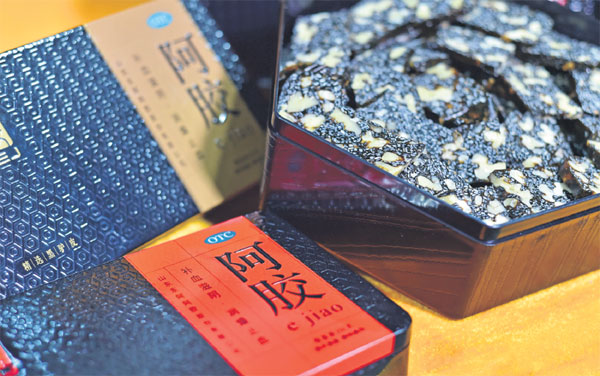
| Ejiao was used as far back as 2,000 years ago. Photos Provided to China Daily |
Let's start at the beginning.
Visitors to Beijing eagerly reach for their camera phones whenever they pass a restaurant advertising lyurou huoshao, the infamous donkey burger that is the highlight of so many travel blogs.
Yes, this is a regional specialty from Hebei province, and the best donkey meat comes from Baoding and Hejian. These neighborhoods are where they firmly believe in the saying, "in Heaven, they have dragon meat; on Earth, we have donkey meat".
Beijing, of course, is right smack in the middle of Hebei, slightly off center to the north. It is also crowded with migrant workers looking for an affordable taste of home.
Donkey burgers are more like sandwiches, with the salty braised meat minced and tucked into sliced-open unleavened flat bread or shaobing. Sliced green peppers are stuffed by the side.
We had a young English colleague once who survived on donkey burgers from a neighborhood shop near our newsroom for most of the two years she was with us. She told us it was a satisfying, nutritious meal with all of the necessary food groups.
But then, she was almost completely acclimatized, taste-wise, when she finished her internship and returned to London. The first article she wrote from home was all about Chinese dumplings.
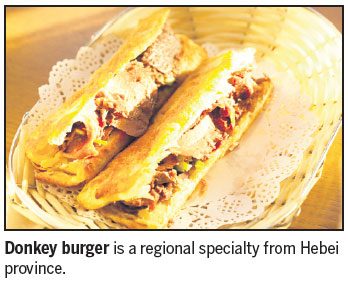
According to those who know, a good donkey burger must have well-braised meat that is expertly seasoned and juicy fresh green peppers, and the flatbread must be soft and tender on the inside and very crisp on the outside so there is crunch in every bite.
Apart from this famous sandwich, donkey meat is also eaten in the Inner Mongolia autonomous region and in Shanxi, Shaanxi, Henan and Shandong provinces, where it appears in various forms, just like pork or beef.
It is a lean meat, with not much fat, and aficionados claim it tastes even better than beef.
All along the lower reaches of the Yellow River, donkey is a rare but traditional meat, often enjoyed in the past when the beasts could no longer work int he fields. It has mostly been truly popular only in rural areas.
My own experience with this meat is limited to a meal in Hohhot, when we were invited for my husband's college reunion. The claypot stew on the table was very fragrant and redolent of spices, its brown gravy shiny and tempting.
Pork ribs, my husband said with a gleam in his eye. I tasted a piece. It was indeed delicious, but I knew it had nothing to do with a pig.
I no longer willingly eat donkey, not after a close encounter with a docile animal at a highway rest stop. As I fed it a carrot, it nudged me with its muzzle and looked at me with eyes that had inch-long lashes, and I knew the meaning of "don't make friends with your food".
Although most Chinese may not sympathize with animal activism attitudes, donkey meat is not easily available, and you have to look pretty hard for restaurants that serve this speciality. In a China that now has access to the best meat products from all over the world, this traditional treat is fading into the background. Which is good.
The flip side of the coin is, most Chinese are now affluent enough to afford tonics, health and beauty supplements that they could not before. This is where donkey glue comes in.
Where as meat is just meat, ejiao takes a lot of donkey hides to produce, and it commands a very good market price.
It is hard to believe that an extract distilled from the hide of donkeys can have any curative properties, but stranger things are found in the pharmacopeia of traditional Chinese medicine.
Ejiao was used as far back as 2,000 years ago. Apart from the ancient scripts that document the complicated process of turning hide into medicinal tonic, archaeologists have excavated evidence that it was a precious burial gift of the time.
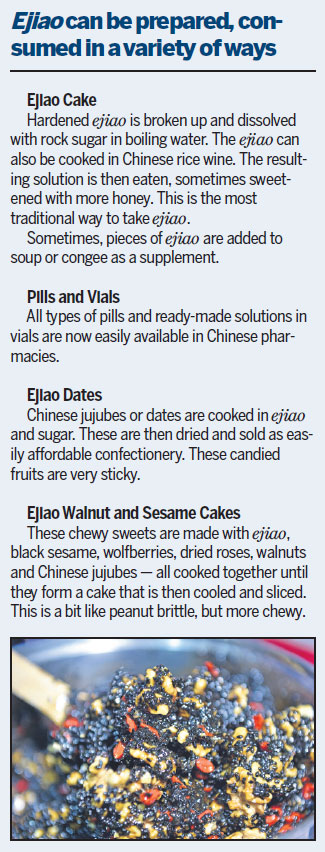
Two thousand years is a long time to perfect a technique, and ejiao is now available in vials, in tablets, as chewy sweets and as thick black cakes that can be slowly dissolved in the best rice wine.
The Chinese firmly believe in the benefits of ejiao, and it is said that a little bit taken each morning will guarantee a long and healthy life. Ejiao promotes blood circulation, according to traditional Chinese medicine, and regular consumption is believed to help all the aches and pains that come with age.
For men, it is a tonic for those who drink regularly and, yes, it is an aphrodisiac.
It is also marketed as an excellent source of collagen to young and older ladies eager to add a glow to their complexion and suppleness to the skin.
paulined@chinadaily.com.cn
(China Daily European Weekly 05/26/2017 page18)


Today's Top News
- New Year's address inspiring for all
- Xi congratulates Science and Technology Daily on its 40th anniversary
- Xi congratulates Guy Parmelin on assuming Swiss presidency
- China Daily launches 'China Bound'
- Manufacturing rebounds in December
- PLA wraps up military drills around Taiwan








