A call for generosity, universal values









China's initiatives must be more than utilitarian, Swiss academic says
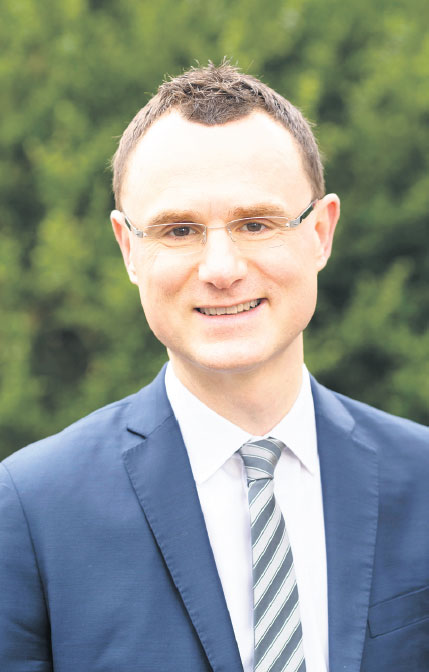
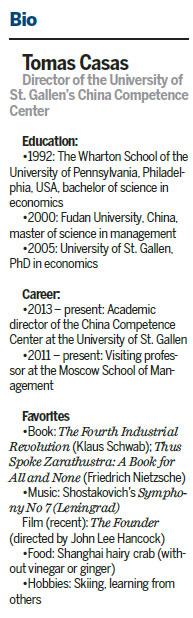
Generosity and a strong set of universally recognized values are the key to China becoming the new leader of multilateral collaboration, says Tomas Casas, director of the China Competence Center at the University of St. Gallen in Switzerland.
Casas says that, at a time when the United States is retreating from its former leadership in multilateral collaboration, China-led policies such as the creation of the Asian Infrastructure Investment Bank and the Belt and Road Initiative are becoming key drivers that defend globalization at what Casas calls "an historical turning point".
| Tomas Casas says that China-led policies are becoming key drivers that defend globalization at an historical turning point. Photo Provided to China Daily |
To gain further support and momentum for these initiatives, Casas suggests generosity by China and a new, coherent narrative with which other nations can identify.
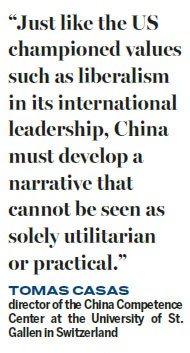
"Just like the US championed values such as liberalism in its international leadership, China must develop a narrative that cannot be seen as solely utilitarian or practical. A commitment to openness must be a value that underpins its initiatives," says Casas.
In his role at the university's China Competence Center, he works to help Chinese and Swiss companies conduct business with each other, and to inform policy within the framework of the Sino-Swiss FreeTrade Agreement, signed in 2013. He also conducts research and has seen China increasingly engage in international trade and development initiatives.
Casas says China's "no-strings attached" approach to international development projects demonstrates a noninterventionist attitude toward other countries' internal affairs, but he says that might not be sufficient.
"This approach can lead to developing countries seeing China as giving free funding to local elites, while the local people ultimately feel no sense of accountability."
Instead, values such as the AIIB's proposal to be "lean, clean and green" could become a central message, championing energy efficiency and sustainable projects as the way forward for international development, Casas says.
"The world needs alternatives to Western values, which have become tired, and are even challenged in Western countries themselves," he says, adding that effective narratives translate into associated values that are "not imposed; they are wanted".
In addition, Casas says he believes China could gain leadership legitimacy and support by being generous to international partners, in the same way the US was generous when it led post-World War II multilateral collaboration.
"Yes, the US was at the center of it all, but these were very generous policies. America benefits while its allies in Europe and Asia benefited even more and became advanced economies, under the institutional umbrella of the US. Generosity might be related to strength."
China can demonstrate its generosity through opening up its market further, especially for low-income countries, and by giving more international aid to emerging economies, Casas says.
By the end of last year, China had provided approximately 400 billion yuan ($58.2 billion; 51.8 billion euros, £44.8 billion) in development aid to 166 countries and international organizations during the past 60 years, according to government figures. It has absorbed about 23 percent of exports from the world's least-developed countries since 2008. And it will set up a South-South Cooperation Fund to improve economic growth and standards of living in developing countries.
"China is already generous, but going forward, it is important that China's international aid should not be seen as a way for China to export its overcapacity, because otherwise that generosity still has a domestic focus and will not be perceived as sincere," Casas says.
China's further opening up of its own domestic market for other economies will be key to building the momentum of multilateral collaboration and demonstrating generosity befitting a global leader, he says.
"Much of the future of humanity depends on what position China takes. If China closes up, it will be one type of world. If China opens up, it will be a very different type of world," he adds.
In his view, multilateral collaboration is key to "increasing mutual dependency on the global economy, hence increasing the cost of conflict in other areas".
During the past year, the push for globalization has seen setbacks, including Britain's choosing to leave the European Union and the United States' withdrawal from the Trans-Pacific Partnership Agreement. In addition, the US has agreed to renegotiate the North American Free Trade Agreement with Canada and Mexico.
Casas says that, even if the US stays with NAFTA, it is unlikely to push forward international multilateral collaboration. Within this context, new multilateral organizations such as the AIIB "will provide fresh impetus for global arrangements conducive to free trade and increased cross-border investment".
The AIIB, established little more than a year ago with 57 founding members, has already approved a lending program of $1.73 billion and invested in nine projects across Europe, Asia and the Middle East.
Casas says such initiatives "reflect a long-term commitment and provide new ideas and resources", and offer more representation to emerging economies than such institutions such as the World Bank and the International Monetary Fund.
Meanwhile, he says, newly emerging economies are better represented in newer institutions such as the AIIB and the New Development Bank, which was established by Brazil, Russia, India, China and South Africa, collectively known as the BRICS countries.
For instance, the New Development Bank's method of funding in local currencies is cited by Casas as an example of fresh institutions' innovation. Although local currency loans increase the risk for lenders, there are benefits for the borrowing countries; hence the system more efficiently achieves its ultimate purpose, he says.
Casas adds that China's new leadership role in multilateral development also helps the country resolve two important challenges of its own: the middle-income trap, in which development stagnates after a country reaches middle-income levels, and the Thucydides trap, which sees conflict as likely between a rising power and a dominant one.
Casas says opening its domestic market allows China to experience more domestic competition - which leads to a structural shift of domestic productivity toward advanced manufacturing - while establishing international partners supports its international authority.
"China needs to enter advanced economy territory, and in doing so, it needs to be a strong partner of existing powers. The only way to do so is with an enlightened, generous narrative embodying a set of universal values that other nations will wish to share."
cecily.liu@mail.chinadailyuk.com
(China Daily Africa Weekly 05/26/2017 page32)



Today's Top News
- Full text: Chinese President Xi Jinping's 2026 New Year message
- Poll findings indicate Taiwan people's 'strong dissatisfaction' with DPP authorities
- Xi emphasizes strong start for 15th Five-Year Plan period
- PLA drills a stern warning to 'Taiwan independence' separatist forces, external interference: spokesperson
- Xi, Putin exchange New Year greetings
- ROK leader's visit to help boost bilateral ties