Makin' Zongzi









Ubiquitous rice-filled triangle represents culture more than food
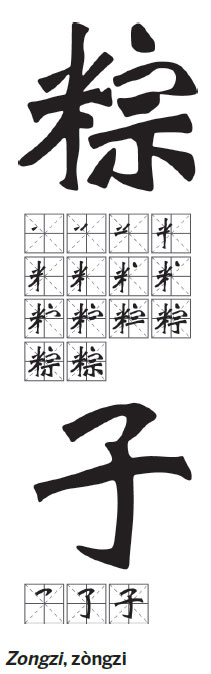
Zongzi (粽子), the classic triangle of rice and stuffing wrapped in leaves, isn't so much popular in China as a food. It's more than that.
In northern China, zongzi might be filled with a few jujubes, a little red bean paste, or some other dried fruit. Even with sumptuous fillings, like the pork or seafood you'll find in southern China's zongzi, the main ingredient remains unchanged: rice.
"It's just rice," most will say. What's so special about the dish, especially for southern Chinese, who already eat rice every day? But they're everywhere for Dragon Boat Festival (端午節 duānwǔjié) - almost inescapably so.
| Zongzi, associated with the Dragon Boat Festival, have become a cultural token for Chinese people. Hao Qunying / For China Daily |
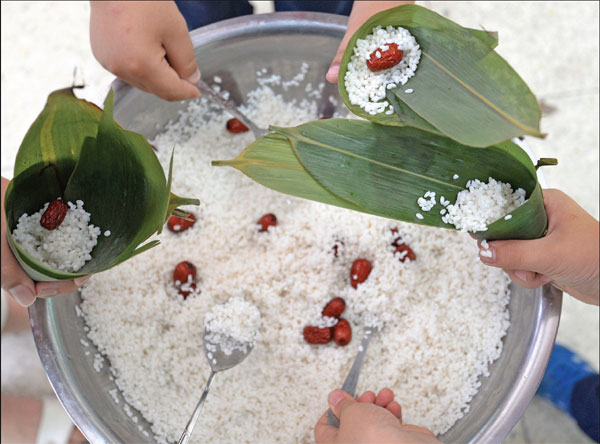
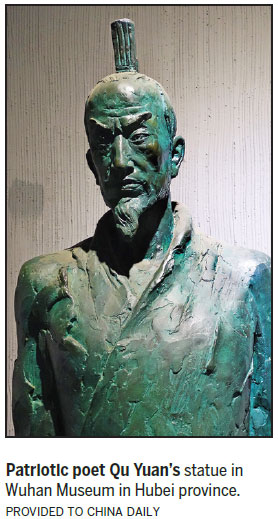
Everything has a reason. People are not eating zongzi, but culture. Even though the Chinese don't care about eating zongzi, they still love them deeply. Everyone loves talking about them, making them and passing them out as gifts, or receiving them. Zongzi have become a cultural token, deeply rooted in our consciousness. The association with Dragon Boat Festival, originates from efforts to save the body of the patriotic poet Qu Yuan, who drowned himself on the fifth day of the fifth lunar month, which is when the festival is now held. Qu's body could not be found, so local people dropped balls of sticky rice into the river. They hoped the fish would eat the rice rather than the poet's body.
Zongzi existed long before Qu Yuan did. Five hundred thousand years ago, our ancestors were already wrapping food in leaves and roasting it in the fire. By the time of the Warring States period (475-221BC), it had become a customary version of fast food, especially for farmers, who were too busy in the fields to head home for a meal.
It wasn't until Qu Yuan, though, that the dish became endowed with sacred meaning and lasting popularity. As an official of the Chu state, which was occupied by enemies in 278 BC, he urged his superiors to fight the Qin rule, and he wrote romantic love poems dedicated to his country. His work was full of magnificent imagination and metaphors. He's been called the first true poet in Chinese history, and he created a new pattern of poem called "楚辭" (chǔcí, Song of the Chu).
It's interesting that the ordinary people commemorated him spontaneously for his righteousness, loyalty and talent, by throwing zongzi into rivers - I am always fascinated by such spontaneous acts of passion. That's the reason why I eat at least one zongzi every year for Dragon Boat Festival. It's to commemorate virtuous human beings. It is, in a smallway, so romantic.
So - just like eating zongzi - making zongzi surpasses the act of cooking and becomes an act of culture and romance. Keep that in mind, and you won't find it so difficult to make your first one.
To get the recipe, we visited Chef Zhang Cuiping in her courtyard hotel, Han's Royal Garden Hotel, hidden in the hutong of Beijing. She doesn't talk much, but she looks familiar, just like my Auntie. And starting with the familiar is the right way to make this ordinary, yet sacred, food. I imagine people just like her, silently making zongzi 2,000 years ago, just to throw into a river to save a noble poet's body from the jaws of the water demons.
Chef Zhang explained that although zongzi appear in different shapes, according to different customs across the country, they're usually triangles or rectangles. Either bamboo leaves or reed leaves can be used, although in Guangdong, dried lotus leaves are used. The fresher, the better. If the leaves are not vacuum-packed, make sure to boil them first and then soak them for three or four hours before using. As mentioned above, the southern style usually incorporates salty meat fillings, while northerners prefers their zongzi to be sweet. Some even dip their zongzi in sugar.
Chef Zhang was too shy to give me more stories behind the recipe, instead begging her boss, Master Wang Xifu, to explain it to me. Wang, a man in his 70s, comes from a long line of cooks; his father was a chef for the last emperor of the Qing Dynasty (1644-1911). He told me that for Dragon Boat Festival old Beijingers used to cover raw rice with colorful cloth, and hang these fake zongzi on their doors for happiness and luck. They would drink a special yellow wine to ward off the onslaught of insects that also appear in the hot fifth month. They'd also eat Five Venom Pancakes (五毒餅 wǔdúbǐng), another celebratory food, made in the shape of snakes, scorpions, toads, centipedes and geckos, also believed to keep insects away.
To make eating zongzi more of a ritual, and to show your respect to Qu Yuan, be sure to share them with friends and drink tea alongside. Green tea is the best accompaniment for sweet zongzi, but for greasy zongzi, try pu'er or chrysanthemum tea. For salty zongzi, wulong tea is the best.
Of course, the best way to eat zongzi is to make them yourself, perhaps while meditating on Qu Yuan's best-known poem.
Lùmànmàn qí xiū yuǎnxī, 路漫漫其修遠兮,
Wú jiāng shàngxià ér qiúsuǒ. 吾將上下而求索.
The road ahead is far and long, but I will seek the truth up and down.
Mmmm ... I think I will do that this year.
Ingredients (for five zongzi):
5 fresh bamboo (竹葉 zhúyè) or reed leaves (葦葉 wěiyè)
5 pieces of pratia grass (馬蓮草 mǎliáncǎo), or sewing thread 300g sticky rice (糯米 nuòmǐ) 10 jujubes (棗 zǎo)
Instructions:
Clean the leaves and grass. If the leaves are dried, soak them in water for two hours, then wash them. Soak the sticky rice for three hours.
Fold the leaves into a funnel. Make sure to leave the open side long enough to cover the top completely, and to keep the bottom gap-free.
Place one jujube into the funnel, then add rice until the funnel is full. Place another jujube on the rice.
Fold the open side down, to cover the top of the funnel.
Lower the two edges and roll the longer leaf left outside along the funnel.
Take the grass and wrap it around the funnel two or three times. Tie it into a slip knot.
Place the zongzi in boiling water and boil for three hours.
Courtesy of The World of Chinese, www.theworldofchinese.com
The World of Chinese
(China Daily European Weekly 06/02/2017 page23)



Today's Top News
- New Year's address inspiring for all
- Xi congratulates Science and Technology Daily on its 40th anniversary
- Xi congratulates Guy Parmelin on assuming Swiss presidency
- China Daily launches 'China Bound'
- Manufacturing rebounds in December
- PLA wraps up military drills around Taiwan