The outdoors can protect kids from myopia









 |
| MA XUEJING/CHINA DAILY |
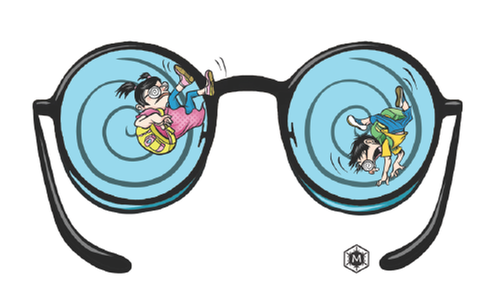
Shortsightedness or myopia, a condition where distant objects appear blurry while close objects appear normal, is a visual defect that is becoming increasingly serious among Chinese children. The estimated myopia rate in China is 31 percent. However, among children and teenagers it is much higher.
Since myopia can have health-damaging consequences if left uncorrected, it must be dealt with more effectively by parents as well as health authorities.
Myopia, however, is not a China-specific issue; it has a global impact. According to researchers, rates of myopia have doubled, even tripled, in most East Asian countries over the past 40 years. Although Singapore is considered to have the highest rate in the world, with about 80 percent of the population affected by it, the prevalence of myopia among Indian people is only 6.9 percent.
The rates of myopia have been rising in Western countries such as Germany and the United States, too. In the US, as well as in some European countries, the rate has almost doubled in the past 50 years. According to some estimates, one-third of the world's population, or 2.5 billion people, could be affected by myopia by 2020. Some experts say we are close to experiencing a myopia epidemic.
A combination of both genetic and environmental factors seems to be responsible for myopia, and the risk factors include doing work that focuses on close objects, spending a lot of time indoors and a family history of this condition. Although for years many people considered genetic factors to be responsible for myopia, studies show environmental factors could also be responsible.
One important factor responsible for myopia could be the amount of time spent studying and doing homework. Some experts say children who spend long hours reading and doing homework are more likely to develop myopia. This theory, however, doesn't hold water. Close work, although it might be a factor, alone is not responsible for the condition.
Researchers at the University of Cambridge in Britain have found that a lack of outdoor activities is linked to myopia. Sunlight seems to have a protective effect on children during their critical years of development, that is, when their eyeballs are still growing. The reasons for this effect, however, are not yet known.
Ian Morgan, a researcher at the Australian National University in Canberra, says children who spend enough time outdoors are less likely to develop myopia even if they study more than those children who almost always stay indoors. Morgan estimates children need to spend about three hours a day under good light conditions to avoid myopia.
The problem with this approach, however, is that in many places and in different seasons children cannot spend much time outdoors. Some experiments are being conducted to allow more children to play and study in better artificial light conditions. No clear-cut results, however, have been achieved yet.
Some researchers say children should spend more time playing outdoors, because it has the additional benefit of improving their mood, increasing their level of physical activity and decreasing the likelihood of obesity, another significant problem among children.
To detect the problem of myopia early, all children should have a comprehensive eye examination by the age of three, with parents paying special attention to any changes in their eyesight.
And, of course, children's eyesight could benefit from less homework and less use of electronic gadgets, though both are difficult propositions in today's competitive societies. As with any other health problem, preventive measures against myopia can be more effective and less costly than a cure.
The author is an international public health consultant.