Space race or cosmic cooperation? China strongly calls for the latter









BEIJING -- China is looking towards increased cooperation with international space leaders, it stressed Tuesday at the Global Space Exploration Conference (GLEX 2017) currently being held in Beijing.
In a letter of congratulations sent to the conference by Chinese President Xi Jinping, he said that China wants to enhance cooperation with the international community in peaceful space exploration and development.
Xi noted that progress in space science and technology will benefit people around the world and China wants to use space exploration achievements to create a better future for mankind.
"China is expanding cooperation with the United Nations (UN) in space exploration, and will disclose projects later this year," said Yang Liwei, China's first astronaut and current deputy director of the China Manned Space Engineering Office.
The country has previously undertaken bilateral cooperation with various countries and institutions and is now looking towards multilateral projects. China will carry out joint projects with the UN Office of Outer Space Affairs (UNOOSA) including astronaut training, space station scientific experiments and multilateral application of such experiments, said Yang.
"Rather than a space race, I think cooperation is always good and worldwide cooperation is even better. I hope we can breach Earth's crises by having worldwide cooperation in space," said Jan Woerner, director general of the European Space Agency (ESA).
"We should not try to duplicate everything, and if we join forces we can do even more with the same amount of money," he added.
The conference, which ends Thursday, was jointly held by the International Astronautical Federation (IAF) and the Chinese Society of Astronautics and follows the GLEX 2012 conference held in Washington D.C.
International space engineers and delegates from leading aerospace companies including Boeing, Lockheed Martin and Airbus attended the conference.
SPACE ODYSSEY
Although China has completed many successful space exploration projects, the country's space expeditions are far from over.
At the conference, Yang said that China plans to use a Long March-5 carrier rocket to launch the core module of the country's manned space station in 2019 and build a space station around 2022.
With the International Space Station set to retire in 2024, the Chinese space station will offer a promising alternative, and China will be the only country with a permanent space station.
China National Space Administration (CNSA) held a ceremony to recognize and thank the ESA and four countries, namely the Netherlands, Germany, Saudi Arabia and Sweden, for their participation in the Chang'e-4 lunar exploration to the far side of the moon which will be launched in 2018.
Liu Jizhong, director of the CNSA's China Lunar Exploration and Space Engineering Center said that later this year China plans to send the Chang'e-5 lunar probe to the moon to collect samples, marking the third step in its lunar program.
He said that China is looking to offer cooperation opportunities in investigating the lunar south pole region, setting up an international moon village and carrying out experiments including energy supply.
Liu added that in accordance with the principle of "openness and cooperation, sharing both risks and achievements," China will create an open platform for cooperation enabling other countries to participate.
COOPERATION UNDERWAY
China has always advocated win-win cooperation between nations and it introduced the notion of building a community of shared destiny in late 2012.
To create peaceful cooperation in outer space, China has signed agreements with over 30 countries and organizations, including Russia, Kazakhstan, Germany, France, the ESA and UNOOSA.
China's contribution to the international space industry has included helping over 20 countries and regions with 50 launches, and exporting satellites to nine countries.
Scientific innovation was a central topic at the recent Belt and Road Forum for International Cooperation, with China proposing a Belt and Road Science, Technology and Innovation Cooperation Action Plan.
China also voiced its willingness to carry out more projects with Belt and Road countries in various fields, including satellite launches, maritime navigation and archaeological studies to enable more countries to benefit.


- China successfully launches new test satellites
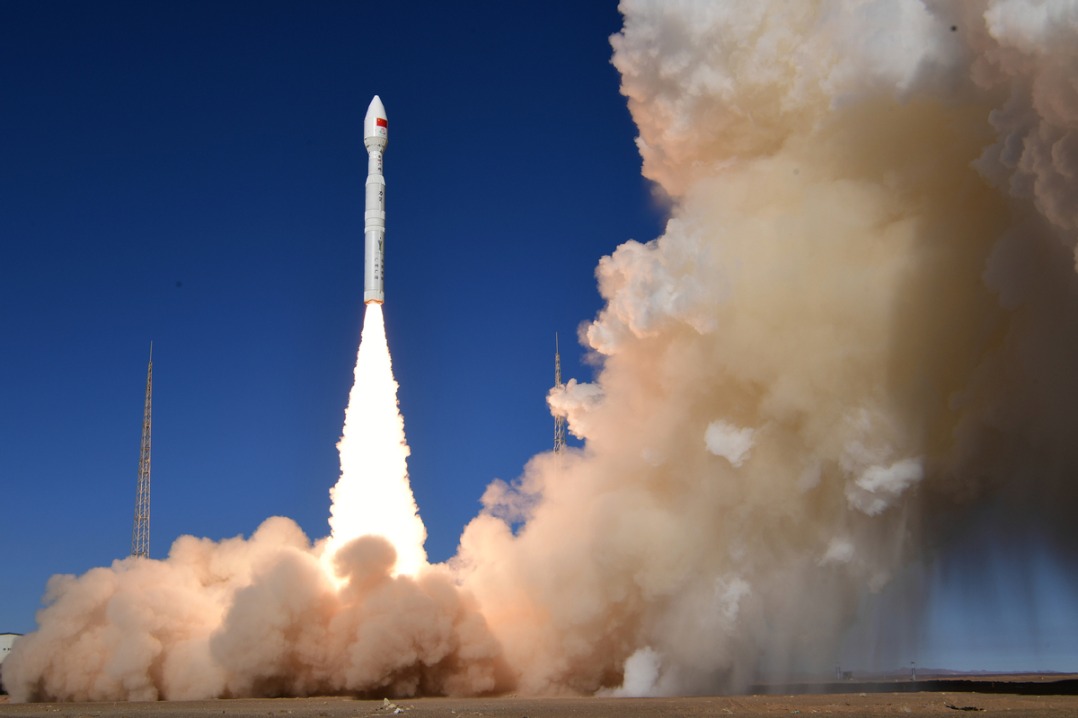
- China launches Lijian 1 Y9 carrier rocket
- First cross-border event debuts at the National Games
- China Focus: National Games enhances coordination under 'one country, two systems'
- China's Fujian aircraft carrier to make regular appearances on high seas: spokesperson
- A decade of dialogues