A bridge that spans time









First structure connecting opposite banks of Yangtze in Wuhan has a respected Russian godfather
A monument at the oldest bridge over the Yangtze River in Wuhan is inscribed with the names of 28 experts from the former Soviet Union. Konstantin Silin's name is first.
On Oct 15, 1957, the 1,670-meter bridge - the first over the river - opened for traffic after 25 months of construction.
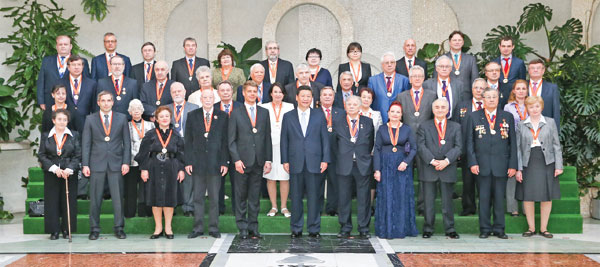
| President Xi Jinping meets with Russian experts and their family members in Moscow in May 2015. Elena Silina (first from right, front row), daughter of the Russian engineer Konstantin Silin. Provided to China Daily |
| The Wuhan Yangtze River Bridge is a witness to the country's rapid development over the past six decades. VCG |
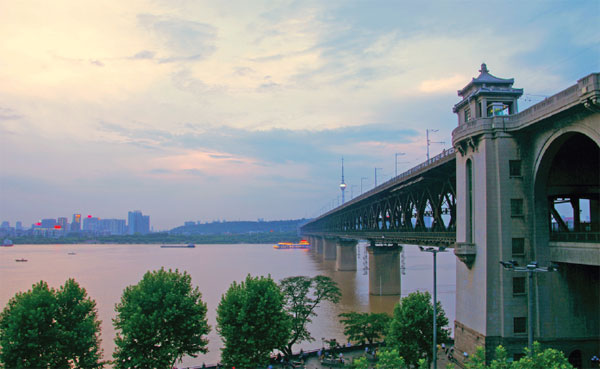
It was completed two years ahead of schedule, thanks to a new method used for the bridge's foundation, which was suggested by Silin, the chief engineer and bridge expert sent by the Soviet Union in the summer of 1954. It was the third time that Silin had been sent to China to help the country to fix crumbling bridges and build new ones.
Chairman Mao Zedong praised the bridge in one of his poems: "A bridge will fly to span the north and south, turning a deep chasm into a thoroughfare."
In 1948, the People's Liberation Army in Northeast China was hampered by damaged bridges when trying to transport supplies. Silin was sent then to help to build the Second Songhua River Bridge. With it was completed, the army crossed and liberated the whole northeastern region.
In 1949, Silin came to China again as a consultant to the Railways Ministry (now the National Railway Administration). He worked on the construction of bridges in Chengdu and Chongqing and the western section of the Longhai and Lanzhou-Xinjiang railways.
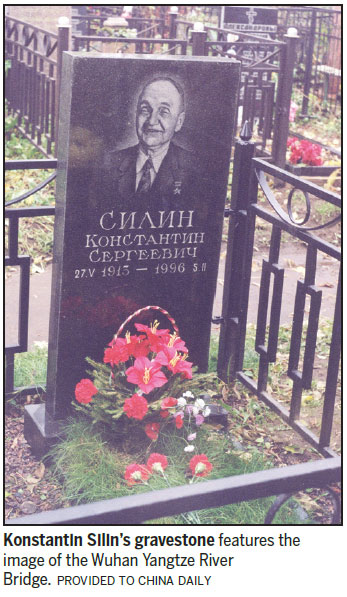
After returning home in November 1957, Silin worked to build and sustain friendship between China and his native land. He died in 1996, and an image of the Wuhan Yangtze River Bridge was carved on his gravestone.
"My parents traveled around China together to fix broken bridges, even when they were expecting me," says Elena Silina, Silin's daughter, who recently came to Beijing to attend the Belt and Road Forum for International Cooperation.
Elena Silina is a professor in the engineering ecology and technological safety department at Moscow State University of Railway Transport.
"My father's participation in the construction of the Wuhan Yangtze River Bridge was a very important thing for ourwhole family," she says.
On the walls of their home were many photos of the bridge, along with Chinese art. Family members used chopsticks.
They'd occasionally go to Chinese restaurants to celebrate an important event. When Elena Silina's daughter, Ekaterina Fortygina, wanted to study a foreign language in college, Silin strongly suggested Chinese. Ekaterina agreed.
"My daughter is in China to study. She knows a lot about China, speaks fluent Chinese and is good at cooking Chinese dishes," Silina says.
While searching for key chains with matryoshka dolls in Beijing as gifts for her Chinese friends, Silina was on the lookout for candied hawthorn for her grandchildren in Russia, who love the sweet-and-sour flavor, she says.
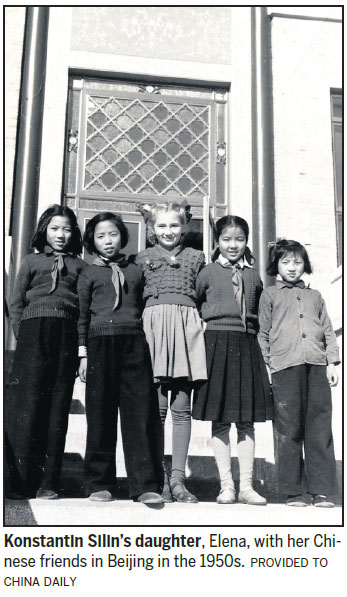
In 1954, 4-year-old Elena came to live in Beijing with her parents for eight years. She returned in the 1980s and again in 2000. Each time, she was surprised to see how much Beijing had changed over the years.
"China has grown fast, and many of its techniques in building roads and railways have been introduced to other countries," she says.
Liu Changyuan, deputy chief engineer of the Wuhan Yangtze River Bridge project, said in an earlier interview: "Konstantin Silin was not only a respected expert but also a very good person." Liu had joined the team building the bridge pillars in 1955 as a fresh university graduate. He recalled that Silin often took a speedboat to examine the pillars and exchanged ideas with construction workers. Liu got to know him during that time.
"He was very modest. He respected us Chinese engineers and workers, and passed on his experience," Liu says.
Silin took great pride in the first bridge over the Yangtze. He often returned to China to visit the bridge.
Once, when he was over 80 years old, he visited the construction site of the Second Wuhan Yangtze River Bridge. After learning about the construction techniques being used, he told Liu and the group of Chinese engineers: "I was your teacher when we built the Wuhan Yangtze River Bridge, but now you have become my teacher."
yangyangs@chinadaily.com.cn
(China Daily European Weekly 06/09/2017 page21)



Today's Top News
- New Year's address inspiring for all
- Xi congratulates Science and Technology Daily on its 40th anniversary
- Xi congratulates Guy Parmelin on assuming Swiss presidency
- China Daily launches 'China Bound'
- Manufacturing rebounds in December
- PLA wraps up military drills around Taiwan