Q&A: Ten facts about China's X-ray probe
Xinhua |
Updated: 2017-06-15 15:47


Share



Share - WeChat




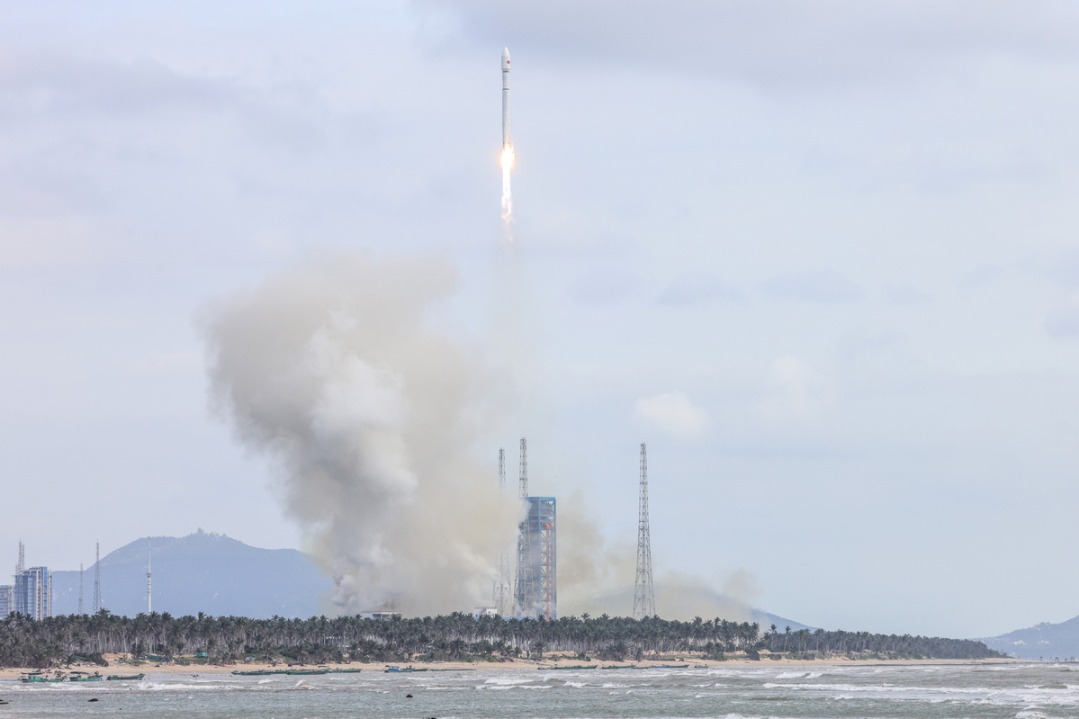
JIUQUAN - China on Thursday launched its first X-ray space telescope, the Hard X-ray Modulation Telescope (HXMT), to study X-rays from mysterious sources, such as black holes and neutron stars. Here are 10 facts about the telescope to help you understand its origins and strengths.
-- What are hard X-rays?
We're all familiar with routine applications of X-rays on Earth, such as body scanning, airport security and so on. Most X-rays have a wavelength ranging from 0.01 to 10 nanometers, much shorter than that of visible light, which is why we cannot see X-rays.
Scientists divide X-rays into different energy bands, resulting in different observation methods. X-rays above 20 keV are called hard, and X-rays below 10 keV soft. X-rays between 10 keV and 20 keV are comparatively less observed in astronomy.
-- How do you detect hard X-rays?
X-rays are absorbed by the Earth's atmosphere, so scientists have to send detectors to high altitude by balloon, sounding rocket and satellite. But with such a small wavelength, X-rays are so energetic that they tend to pass through mirrors directly instead of reflecting off them.
As a traditional optical telescope won't work for X-ray observation, Western scientists developed the coded mask technique and a special focusing technique called "grazing incidence." Both are very complicated and costly, and the focusing technique requires extremely flat mirrors, which China cannot yet manufacture.
-- What method did Chinese scientists develop?
Chinese scientists had to find a new way of imaging X-rays.
Li Tipei, a senior astrophysicist with the Institute of High Energy Physics (IHEP) of the Chinese Academy of Sciences (CAS), and his colleague Wu Mei came up with the direct demodulation method in the 1990s. It can help reconstruct the image of X-ray sources by using data from relatively simple non-imaging detectors, such as a telescope with "collimators" that collects and records X-ray photons parallel to a specified direction. In other words, it doesn't need mirrors.
-- Is HXMT only for hard X-rays?
It should be noted that HXMT, although by name a "hard X-ray" telescope, was expanded to medium and low band with two sets of detectors around 2006. Now it covers a broad energy band from 1 keV to 250 keV.
Li Tipei first proposed making a space telescope based on his demodulation technique in 1993. "At that time, it was a pioneering idea. But for many reasons, it failed to get official approval until 2011, and X-ray astrophysics had moved far ahead in the interim. So we added new scientific instruments to the satellite," said Zhang Shuangnan, lead scientist of HXMT and director of the Key Laboratory of Particle Astrophysics at the CAS.
-- What's the structure of HXMT?
The 2.5-tonne telescope carries a trio of detectors, with the high energy X-ray telescope (HE) covering an energy band from 20 keV to 250 keV, the medium energy X-ray telescope (ME) from 5 keV to 30 keV and the low energy X-ray telescope (LE) from 1 keV to 15 keV.
Though different in many aspects, the three types of telescopes are basically composed of collimators, detectors and readout electronics. Collimators help shield the photons outside the field of view, detectors generate signals containing the energy and arrival information of each photon they "catch," and readout electronics convert the signals into digital ones that can be recorded and stored.
-- Why the larger detection area, the better?
HE has a total detection area of more than 5,000 square centimeters, the world's largest in its energy band, ME 952 square centimeters and LE 384 square centimeters.
The larger the detection area, the more photons and signals the telescope will collect. For example, it's easier for scientists to draw patterns out of signal curves from a detector that can "see" 100 photons per second than one that can "see" only 10 photons per second. "Given it has a larger detection area than other X-ray probes, HXMT can find more features of known sources," said Xiong Shaolin, a scientist with IHEP.
-- Why the broader field of view, the better?
The special focusing technique developed for X-ray observation enhances the detection sensitivity of mirror telescopes, but usually results in a narrow field of view. HXMT, on the other hand, has a very broad field of view and can finish scanning the galactic plane in about two days.
"It's easier to spot transient sources by scanning across large sky areas, which might bring new scientific discoveries," Xiong said.
-- Is HXMT averse to very bright sources?
X-rays of lower energy usually have more photons. Therefore a telescope based on the focusing technique is not fit for observing very bright objects emitting soft X-rays, as too many photons at a time will result in over-exposure.
But HXMT won't have that problem, as its collimators diffuse photons instead of focusing them. "No matter how bright the sources are, our telescope won't be blinded," said Chen Yong, chief designer of LE.
-- How will an X-ray telescope detect gamma-ray bursts?
According to Zhang Shuangnan, scientists found that a set of HXMT high-energy detectors, originally to shield background noises caused by unwanted X-ray photons, especially those from behind the telescope, can be adjusted for the observation of gamma-ray bursts.
The creative new function pushes the satellite's observation band up to 3 MeV and will get a very good energy spectrum, Zhang said.
-- Why does HXMT have a sunshade?
Engineers from China Academy of Space Technology made a sunshade for HXMT low and medium energy telescopes when installing the payloads on the satellite, the first of its kind ever aboard a domestic probe.
"HE works at around 18 degrees Celsius, while ME and LE require very low temperatures, respectively down to 80 degrees below zero and 40 degrees below zero. Therefore, the satellite, just like a coat that can support a person to survive at both the equator and polar regions, needs a sophisticated temperature control system. Our solution is to cool ME and LE with the sunshade, to heat HE and insulate ME and LE from HE," said Zhou Yupeng, deputy chief designer in charge of the satellite temperature control.
-- What are hard X-rays?
We're all familiar with routine applications of X-rays on Earth, such as body scanning, airport security and so on. Most X-rays have a wavelength ranging from 0.01 to 10 nanometers, much shorter than that of visible light, which is why we cannot see X-rays.
Scientists divide X-rays into different energy bands, resulting in different observation methods. X-rays above 20 keV are called hard, and X-rays below 10 keV soft. X-rays between 10 keV and 20 keV are comparatively less observed in astronomy.
-- How do you detect hard X-rays?
X-rays are absorbed by the Earth's atmosphere, so scientists have to send detectors to high altitude by balloon, sounding rocket and satellite. But with such a small wavelength, X-rays are so energetic that they tend to pass through mirrors directly instead of reflecting off them.
As a traditional optical telescope won't work for X-ray observation, Western scientists developed the coded mask technique and a special focusing technique called "grazing incidence." Both are very complicated and costly, and the focusing technique requires extremely flat mirrors, which China cannot yet manufacture.
-- What method did Chinese scientists develop?
Chinese scientists had to find a new way of imaging X-rays.
Li Tipei, a senior astrophysicist with the Institute of High Energy Physics (IHEP) of the Chinese Academy of Sciences (CAS), and his colleague Wu Mei came up with the direct demodulation method in the 1990s. It can help reconstruct the image of X-ray sources by using data from relatively simple non-imaging detectors, such as a telescope with "collimators" that collects and records X-ray photons parallel to a specified direction. In other words, it doesn't need mirrors.
-- Is HXMT only for hard X-rays?
It should be noted that HXMT, although by name a "hard X-ray" telescope, was expanded to medium and low band with two sets of detectors around 2006. Now it covers a broad energy band from 1 keV to 250 keV.
Li Tipei first proposed making a space telescope based on his demodulation technique in 1993. "At that time, it was a pioneering idea. But for many reasons, it failed to get official approval until 2011, and X-ray astrophysics had moved far ahead in the interim. So we added new scientific instruments to the satellite," said Zhang Shuangnan, lead scientist of HXMT and director of the Key Laboratory of Particle Astrophysics at the CAS.
-- What's the structure of HXMT?
The 2.5-tonne telescope carries a trio of detectors, with the high energy X-ray telescope (HE) covering an energy band from 20 keV to 250 keV, the medium energy X-ray telescope (ME) from 5 keV to 30 keV and the low energy X-ray telescope (LE) from 1 keV to 15 keV.
Though different in many aspects, the three types of telescopes are basically composed of collimators, detectors and readout electronics. Collimators help shield the photons outside the field of view, detectors generate signals containing the energy and arrival information of each photon they "catch," and readout electronics convert the signals into digital ones that can be recorded and stored.
-- Why the larger detection area, the better?
HE has a total detection area of more than 5,000 square centimeters, the world's largest in its energy band, ME 952 square centimeters and LE 384 square centimeters.
The larger the detection area, the more photons and signals the telescope will collect. For example, it's easier for scientists to draw patterns out of signal curves from a detector that can "see" 100 photons per second than one that can "see" only 10 photons per second. "Given it has a larger detection area than other X-ray probes, HXMT can find more features of known sources," said Xiong Shaolin, a scientist with IHEP.
-- Why the broader field of view, the better?
The special focusing technique developed for X-ray observation enhances the detection sensitivity of mirror telescopes, but usually results in a narrow field of view. HXMT, on the other hand, has a very broad field of view and can finish scanning the galactic plane in about two days.
"It's easier to spot transient sources by scanning across large sky areas, which might bring new scientific discoveries," Xiong said.
-- Is HXMT averse to very bright sources?
X-rays of lower energy usually have more photons. Therefore a telescope based on the focusing technique is not fit for observing very bright objects emitting soft X-rays, as too many photons at a time will result in over-exposure.
But HXMT won't have that problem, as its collimators diffuse photons instead of focusing them. "No matter how bright the sources are, our telescope won't be blinded," said Chen Yong, chief designer of LE.
-- How will an X-ray telescope detect gamma-ray bursts?
According to Zhang Shuangnan, scientists found that a set of HXMT high-energy detectors, originally to shield background noises caused by unwanted X-ray photons, especially those from behind the telescope, can be adjusted for the observation of gamma-ray bursts.
The creative new function pushes the satellite's observation band up to 3 MeV and will get a very good energy spectrum, Zhang said.
-- Why does HXMT have a sunshade?
Engineers from China Academy of Space Technology made a sunshade for HXMT low and medium energy telescopes when installing the payloads on the satellite, the first of its kind ever aboard a domestic probe.
"HE works at around 18 degrees Celsius, while ME and LE require very low temperatures, respectively down to 80 degrees below zero and 40 degrees below zero. Therefore, the satellite, just like a coat that can support a person to survive at both the equator and polar regions, needs a sophisticated temperature control system. Our solution is to cool ME and LE with the sunshade, to heat HE and insulate ME and LE from HE," said Zhou Yupeng, deputy chief designer in charge of the satellite temperature control.




- Control of precursor chemical exports tightened
- Xi greets Ouattara on reelection as Cote d'Ivoire president
- 'Book of Songs' from Chinese imperial tomb proves oldest complete copy ever found
- Exhibition highlighting the 'Two Airlines Incident' opens in Tianjin
- Average life expectancy in Beijing rises to 83.93 years
- Energy drink overdose sends delivery worker to hospital