Kenya railway a game changer for East Africa









Western speculation about the debt implications of giant infrastructure projects exaggerates the risks and is unjustified
Hailed as a symbol of "Chinese quality and spirit", the Mombasa-Nairobi Standard Gauge Railway, which opened on May 31 in Kenya, ferried more than 7,000 passengers in the first week of its operation, a weekly record for the country.
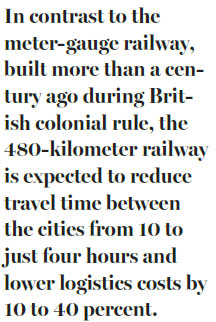
In contrast to the meter-gauge railway, built more than a century ago during British colonial rule, the 480-kilometer railway is expected to reduce travel time between the cities from 10 to just four hours and lower logistics costs by 10 to 40 percent. Built by China Road and Bridge Corp, the railway - the largest infrastructure project since Kenya's independence - cost $3.8 billion (3.46 billion euros; £3.0 billion), with China contributing nearly 90 percent of the amount.
The good news for Kenya, however, has been accompanied by speculation from Western observers that the country will struggle to repay the "monstrous" debt, to the detriment of its taxpayers. A recent report in The New York Times even drew parallels between the China-funded railway and the "Lunatic Express", a term coined over 100 years ago to describe the costly, all-consuming construction of a colonial British railway linking the Kenyan part of Lake Victoria with Mombasa.
Such a far-fetched analogy and misinterpretation of the Kenyan government's motives for building the railway is nothing short of slanderous. The Beijing-backed project provided training opportunities to 45,000 local employees and created more than 46,000 jobs during the four-year construction period, not to mention the proposal to build a technical academy for railways. The Kenyan people were fully involved in the project and stand to greatly benefit from it.
Unlike the 1 billion yuan aid to the Tanzania-Zambia Railway, which was built in the 1970s, Beijing's railway loan to Nairobi has to be repaid. The two countries' partnership to build the Mombasa-Nairobi project has not only helped train some 3,000 local railway technicians and created opportunities for many others to receive such training in the future, it has also kept the cost at a controllable level.
Nairobi is confident that the railway will increase its annual GDP by 1.5 percent and the loan will be paid back in about four years. That is achievable if all the terms agreed to are followed through as designed. China and Kenya have vowed to upgrade the construction of industrial parks along the route while seeking to integrate the Mombasa-Nairobi railway, the Port of Mombasa and the Mombasa Special Economic Zone.
The railway will also stimulate growth and industrialization of neighboring countries, including Uganda and Rwanda, adding fresh impetus to the economic integration of and flow of people and resources in East Africa.
The lack of connectivity in East Africa has greatly limited cross-border trade between the countries in the region, many of which are heavily reliant on the continent's second largest port, Mombasa, keeping prospective investors at bay. The Mombasa-Nairobi railway could well be a game changer for the more than 120 million people in the six East African countries.
China welcomes the idea of enhancing capacity cooperation with Kenya and other African countries, by contributing its railway expertise and strong record of building infrastructure facilities. Its railway cooperation with Kenya and other African countries has not been without challenges, from transnational coordination to the slow long-term returns on the projects. But that should not stop the parties concerned from taking the right path to share development; nor does it justify the West's attempts to exaggerate the risks.
The author is a senior researcher at the Charhar Institute and a researcher at the Institute of West Asian and African Studies of the Chinese Academy of Social Sciences. The article is an excerpt from her interview with China Daily's Cui Shoufeng.
(China Daily European Weekly 06/23/2017 page12)



Today's Top News
- Confidence, resolve mark China's New Year outlook: China Daily editorial
- Key quotes from President Xi's 2026 New Year Address
- Full text: Chinese President Xi Jinping's 2026 New Year message
- Poll findings indicate Taiwan people's 'strong dissatisfaction' with DPP authorities
- Xi emphasizes strong start for 15th Five-Year Plan period
- PLA drills a stern warning to 'Taiwan independence' separatist forces, external interference: spokesperson