Maintaining uniform standards









For a century, school attire has mirrored social and political shifts in China
It's not unusual to hear complaints about the state of school uniforms. In 2015, Chinese media remarked that many Chinese internet users felt their uniforms "could claim the global crown" in ugliness.
Media cited a Weibo survey in which just 10 percent of respondents said they looked good, while 44.6 percent were happy to call school uniforms ugly - slack, shapeless tracksuits with "no aesthetic value at all".
| Clockwise from top left: Chinese architect and cousins in middle-school uniforms in 1916; students wear qipao at Shanghai's first all-female school in 1937; students in Foshan, Guangdong province, in 2008; and in 2001, logos for Beijing's application to host the 2008 Olympic games were printed on students' uniforms. The World of Chinese / For China Daily |
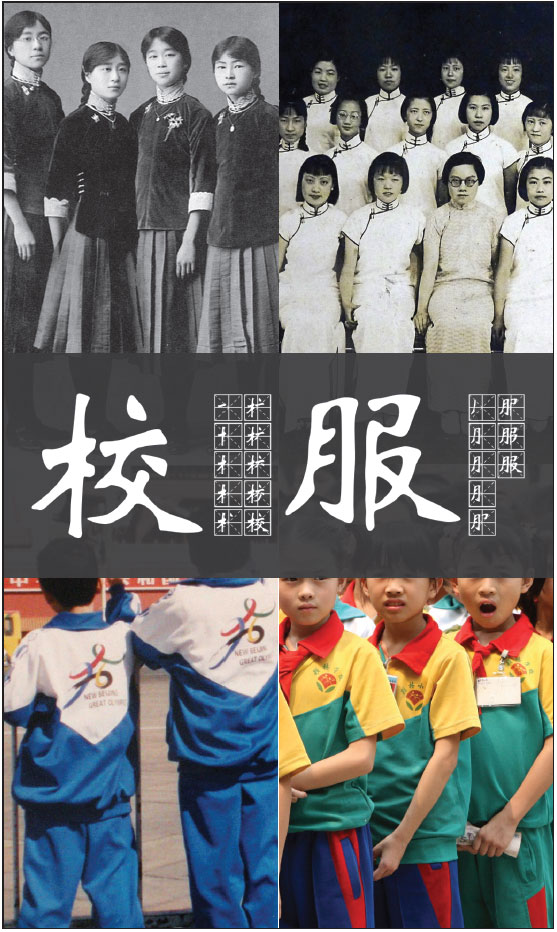
Scrapping uniforms altogether is an unlikely solution, though. While some deplore the homogeneity, others are loath to let personal appearance become a distraction. In March 2017, one school in Fujian had to ban imported sneakers, explaining that students were constantly one-upping each other with expensive footwear.
While schools such as the Zhengzhou Experimental School are beginning to explore clothing more clearly defined by gender, others are importing styles from the United Kingdom and South Korea. Schools have even hosted fashion shows to help improve the aesthetics of mandatory school attire.
But as in equality grows in society, uniforms are becoming yet another form of status symbol - then again, how students dress has always had important social implications in China.
Indeed, uniforms were first introduced in the fallout of the crippling defeat of the Second Opium War (1856-60) as part of an urgent call to learn from the West. Encouraged by missionaries, Qing officials sponsored numerous "new" schools in Beijing, Fuzhou and Shanghai in which foreign languages, science and military knowledge replaced traditional texts. Clad in robes, hats and boots, their students wore uniforms similar to the attire of government officials - albeit without the badges of rank - to show that their education was in the service of government (women were not allowed to enroll).
By the time of the Republic of China (1912-1949), alterations in apparel and customs became critical components of the government's larger reform. Students returning from Japan brought new features, including stand-up collars. Originally based on Prussian military designs, they were called "students' suits" (學(xué)生裝) in China, despite a newfound eagerness to modernize the nation through outside ideas, the Republic was also characterized by strong nationalistic sentiments; regulations said that "school uniforms should be mainly made of plain, strong materials produced in the country".
Although restrictions had been lifted since 1907, schools for females were rare and limited to students from elite families. They wore unembroidered versions of typical female attire, usually a cropped cheongsam top and black skirt, a look known as the "civilized new outfit" (文明新裝) which drew admiring commentary from some in the intellectual class. "Ever since the flourishing of female schools, all students wear light makeup and simple, elegant clothes," noted scholar Xu Ke, who deplored the bound feet, piercings, jewelry and excessive makeup that had long epitomized female beauty standards. "Even women in brothels copy (their) look."
Nevertheless, the May Fourth Movement, in which more than 3,000 students gathered in front of the former Forbidden City to protest the terms of the Treaty of Versailles on May 4, 1919, stunned the establishment. Speaking with patriotic fervor and eloquence, the students demanded a modernizing nation that adopted ideas from Western civilization. The ensuing publicity cemented their attire within the national imagination, and women's uniforms became known as "May Fourth suits" (五四裝).They are now ubiquitous in films and TV shows about the early Republican period.
Surprisingly, traditional Manchurian gowns made a comeback in the 1920s and '30s as women began favoring a single cheongsam over their previous two-piece outfits. "It is not to show loyalty to the Manchurian Qing government, advocating the restoration of the monarch, but because women are intentionally mimicking men," said writer Eileen Chang. "Influenced by Western culture and infatuated with the idea of gender equality…they reject all feminine qualities and would rather exterminate all characteristics of women. The early qipao were squared-shaped and quite stern, bearing the air of the puritans." At schools, qipao were usually plain white or Indanthrene blue, but the newly fashionable cheongsam soon took society by storm, quickly evolving away from its prudish origins into tight fitting, revealing versions.
The new China was founded in 1949. The drab, unadorned aesthetic of the worker and peasant classes became the dominant style, except for the rise of one particularly colorful the red scarf.
Symbolizing a corner of the Communist red flag - itself a symbol of the revolutionary martyrs' blood-the scarf is the symbol of the Young Pioneers, the pre-teen steppingstone to the Communist Youth League. Inspired by Soviet style, Young Pioneers wore white shirts and dark trousers or knee-length skirts for girls. After 1952, girls began to wear floral skirts. Proud schoolboys would aspire to wear a blue-striped sailor shirt, known as "spirit of the sea".
As reform and opening-up gathered steam in the 1980s, individual choices like bright colors and Western fashions returned-indeed, government officials led the way by ditching their military costumes for business suits and ties.
The tracksuit-style uniform so abhorred today first emerged in the 1990s, the culprit a 1993 notice from the Ministry of Education (then known as the China Education Committee) snappily titled "Suggestions Concerning Improving the Management of Urban Primary and Middle School Students 'Uniforms".
According to the notice, uniforms ought to be "frugal, natural, lively and functional", while stressing they are not the same thing as "exercise clothes" and that policies of a particular region ought to be made with support from "students, parents, and all levels of society". It also mentioned that designs should be based on the economic circumstances of the student body; the notice initially addressed only urban areas.
Such expectations continue today, alongside varied other styles more in line with Western standards, such as slacks or pleated skirts. Increasingly, though, elite, independent and boarding schools are adopting fashions that a student in the Republic of China might well recognize: long socks, collared shirts, sweater vests and ties. Meanwhile, May Fourth suits are making a comeback on special occasions, such as graduation photos or assemblies commemorating the end of the war with Japan. Apparently, the school uniform, like history, has away of repeating itself.
Courtesy of The World of Chinese, www.theworldofchinese.com
The World of Chinese
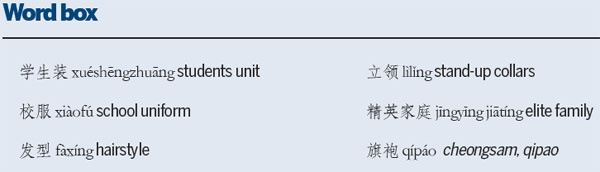
(China Daily Africa Weekly 06/23/2017 page23)




Today's Top News
- China's finance minister pledges expanding fiscal spending in 2026
- CPC leadership meeting urges steadfast implementation of eight-point decision on improving conduct
- Autumn grain purchases exceed 200m tons in China
- Wang to meet foreign ministers of Cambodia, Thailand in Yunnan
- China's top legislature concludes standing committee session
- Thailand and Cambodia agree to temporary ceasefire