Ensuring organic products are authentic









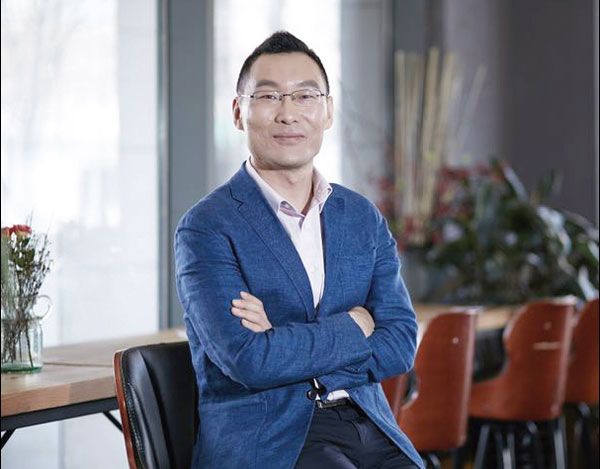
Zhang Youting, deputy CEO of Organic and Beyond, a Beijing company that supplies organic foods, talks to Wang Xiaodong
Self-discipline is very important for organic producers in China. Once an enterprise has attained certification for organic production, the awarding body will conduct inspections once a year, and these last for a couple of days. For most of the year, the enterprise is left alone to manage its production and ensure the products are produced in an organic way, without the use of synthetic fertilizers and pesticides.
We have taken many measures to ensure authenticity of our products. For example, on farmland in Beijing's Shunyi district managed by our company, we employ local farmers to grow vegetables, and all fertilizers and pesticides they use are supplied by our company to ensure only organic ones are used.
| Organic and Beyond, a Beijing company that supplies organic foods, has employed technicians to provide technical guidance to the farmers to help them grow in an organic way. Provided by Organic and Beyond to China Daily |
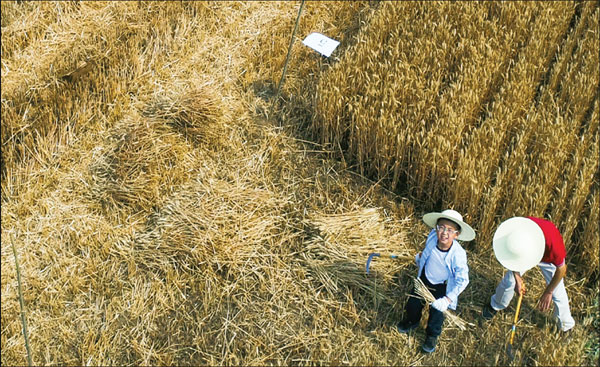
The company has also assigned two technicians to do inspections and provide technical guidance to the farmers to help them grow in an organic way. We also maintain connections with experts from universities and institutes, such as the Chinese Academy of Agricultural Sciences, and employ some of them as our technical advisers.
We keep a record of the whole process of the producting vegetables, including when the seeds are grown, what kinds of fertilizers are used and when weeds are removed. All the information is electronically stored so the whole production process can be tracked, and if any problems arise we can find the causes.
Following requirements and regulations from the Chinese supervision authorities, we also assign an electronic code to every product we produce, so the public can have access to information about the product, such as its name, producer and certificate number.
We began selling organic products in 2007, and sales have been increasing by an annual rate of about 20 percent in recent years. Last year, sales volume reached nearly 100 million yuan ($14.6 million; 13.1 million euros; £11.56 million). We expect the market to keep on expanding, as now more Chinese consumers realize the importance of food safety and environmental protection. As the Chinese become more wealthy, they are also more willing to spend more for healthy food.
Our main products are fruit, vegetables, grain and eggs. We also import organic food such as beef from Australia, wine from France and milk from Denmark, and they sell well in China. Some imported organic food is sold as nonorganic in China because it has not been certified by Chinese authorities.
Most of our products are sold to big cities in developed areas such as the Yangtze River Delta and the Pearl River Delta, as the price is several times that of nonorganic products. But almost all of the products are produced at places far away from these regions, which greatly increases transportation costs.
For example, the production base for organic rice is in Northeast China's Heilongjiang province, but the rice is not sold there. It has to be transported to cities hundreds of miles away, or even farther, such as Beijing and Tianjin, for sale. Loss is also inevitable during transportation, which will add to the price.
A big challenge for the organic industry in China is lack of trust from consumers. In addition, due to lower efficiency in production, the cost of organic food is high, so many consumers find it too expensive. Some producers may also not be able to find the right pesticides, which brings risks of faking.
| Zhang Youting, deputy CEO of Organic and Beyond, says, "We keep a record of the whole process." Provided to China Daily |
(China Daily Africa Weekly 06/23/2017 page7)

Today's Top News
- US?arms sale only a?'bomb' to Taiwan
- China-Cambodia-Thailand foreign ministers' meeting reaches three-point consensus
- Drills demonstrate China's resolve to defend sovereignty against external interference
- Trump says 'a lot closer' to Ukraine peace deal
- China pilots L3 vehicles on roads
- PLA conducts 'Justice Mission 2025' drills around Taiwan