Bringing museums to life









For the last 14 years, a Beijing company has been offering a ticket package that allows people to visit 110 museums in Beijing for free or with a 50 percent discount
China has more than 4,500 museums, including State-owned and private ones, and visiting exhibitions is common for many Chinese. But 50-year-old Cao Wei says that many do not have fun during their visits.
Recalling a scene at the Geological Museum in Beijing, he tells of a couple and their son, who was about 7 years old. There were many beautiful displays there, but the son, after taking a hasty look at some, ran away.
| Cao Wei works as a guide at Capital Museum in Beijing; at China Science and Technology Museum. Photos Provided to China Daily |
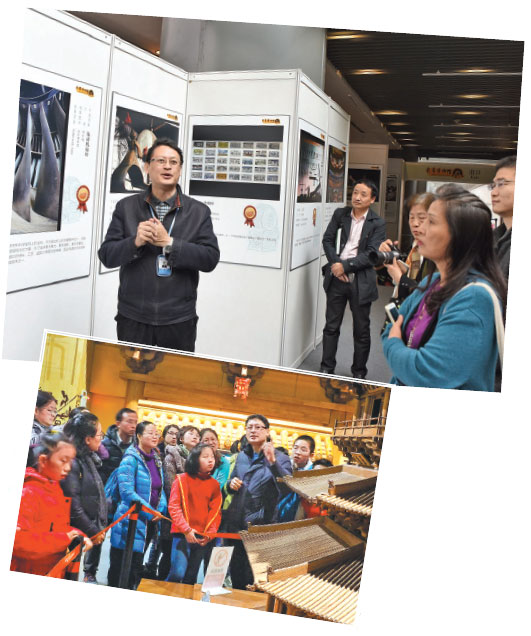
The mother wanted to teach the child about the exhibits, so she started reading the material on displays to him after bringing him back. But the boy fled again.
"The museum is not a place for you to merely learn and accumulate knowledge. It is a place where you can explore the world from different perspectives," he says.
For the past 14 years, Cao, the founder of Borui Zhongtian Culture Development Co, has been offering a ticket package that allows people to visit 110 museums in Beijing for free or with a 50 percent discount.
Very few people can visit all 110 museums in Beijing, but the more important thing for Cao is for them to really enjoy their visits.
"Some people try to use all 110 tickets, but often they find it boring to just see items on display without understanding their value," he says.
"So I think that public education that teaches people to understand the exhibitions is important," he says.
In 2013, Cao started free lectures for museum-goers and organized free tours.
So far his company has given 64 lectures, which include talks on many different perspectives of Chinese people's lives in ancient times.
The company has also organized 190 tours to exhibitions - not only in Beijing, but also in provinces such as Shaanxi and Hubei.
One Friday in April, the company organized a tour to Beijing's Fayuan Temple to learn about the 1,300-year-old temple.
"We told the participants: Today we are here to learn how to see a museum, but our goal is not to make you experts on museums, but to keep your curiosity and the ability to explore the unknown alive," he says.
Then, after they learned about the history of the temple, the participants were told to look for lilac flowers with more than four petals.
"Lilac flowers typically have four petals, so if you can find five-petal lilac flowers, you find happiness. The participants were amazed to find two-, three-, five-, six-, and up to nine-petal flowers in the temple," says Cao.
Cao grew up at the China Science Publishing House, which was previously the mansion of Prince Fu, Emperor Kang Xi's fourteenth son, and as a result has strong feelings about Beijing's heritage.
In the 1970s, Beijing was not as developed as it is today. It had a much smaller population and almost no high-rises. And, once in a while, herdsmen could be seen on Changan Street herding sheep.
Then, young Cao and his friends used to climb the roofs of the mansion on rainy days.
Cao attended a middle school that was located on Donghuamen Street, close to the Forbidden City. In the afternoons, Cao and his classmates would ride their bicycles to the Meridian Gate of the Forbidden City to play soccer beside the moat.
These memories of old Beijing prompted Cao to attempt to share the charm of the ancient capital's history with others.
Additionally, in the 1970s, the China Science Publishing House was populated by people who were well-versed with cutting-edge science and technology.
On summer nights, young Cao would hear the elders talk about these subjects.
"Although I could not understand these things, the chats broadened my view of the world and influenced my life," Cao says, adding, "That's why the popularization of scientific knowledge is so important."
Meanwhile, in 2015, Cao's company started hosting an annual photography contest.
The contest does not focus on photography skills, but Cao takes participants to 10 museums to shoot pictures that showcase the progress of science and technology through the relics.
One of the winners in 2015 took the picture of a pottery cup from early human history.
The red pottery cup was found in Jiangxi province in 1962, and after tests in China and the United States in 2012, it was dated to about 20,000 years ago, marking the turn of human history from the Paleolithic Age to the Neolithic.
Speaking about the contest, Cao says: "What we want to show through discovering science and technology in cultural relics is how humans accumulate wisdom."
yangyangs@chinadaily.com.cn
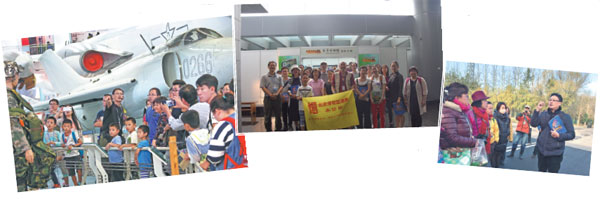
| From left: The Chinese Aviation Museum in Changping district, Beijing, is Asia's largest museum showing aircraft relics; an event organized by Cao Wei at the Capital Museum; Cao works as a guide at China Civil Aviation Museum. |
(China Daily European Weekly 06/30/2017 page19)





Today's Top News
- Poll findings indicate Taiwan people's 'strong dissatisfaction' with DPP authorities
- Xi emphasizes strong start for 15th Five-Year Plan period
- PLA drills a stern warning to 'Taiwan independence' separatist forces, external interference: spokesperson
- Xi, Putin exchange New Year greetings
- ROK leader's visit to help boost bilateral ties
- China's new plan, world's new opportunities