Welcome to hybrid world of shopping









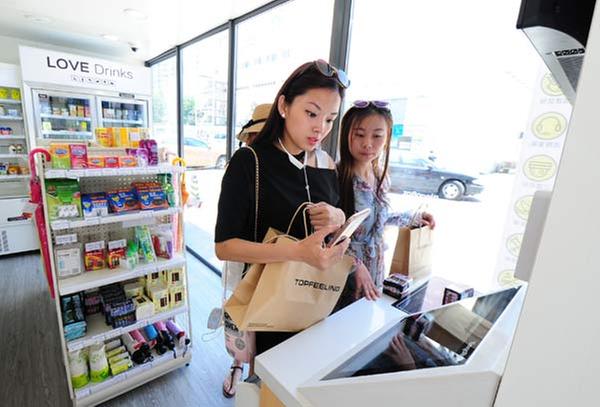 |
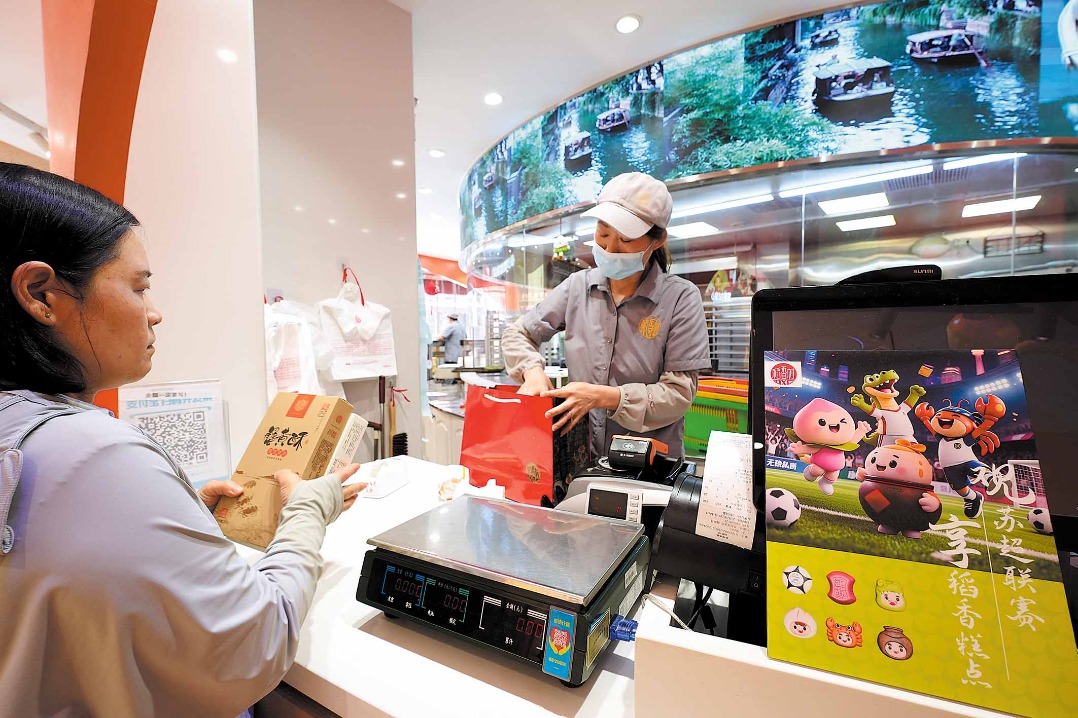
| A shopper pays her bill by scanning a QR code at BingoBox in Shanghai. [Photo by Ji Haixin/For China Daily] |
BingoBox, Hema Xiansheng try new models to entice clients
Artificial intelligence is alive and well, and poised to move into your 24-hour convenience store.
New kid on the block BingoBox opened its first checkout-free outlet in Shanghai last month and now plans to launch thousands of stores in the next two years.
Although that might look rather ambitious, the Chinese startup has a few tricks up its sleeve.
Already it has received 100 million yuan ($14 million) in a series A investment round, spearheaded by venture capital firm GGV Capital, as well as signing a strategic partnership agreement with French retail giant Groupe Auchan SA to strengthen its supply chain.
But it's the technology that has made the difference.
"We have built a team of artificial intelligence experts to research and develop technologies including product recognition and sorting algorithms," Chen Zilin, founder and chief executive officer at Bingobox, told online business website China Money Network.
"This technology has successfully recognized more than 200 types of products," he added. "We are planning to launch AI solutions for retail enterprises starting in August."
Chen appears to be on a winner. He rolled out the company's first 24-hour unattended convenience store in northern Shanghai's Yangpu district last month.
Similar to the Amazon Go's experimental outlet, there is no checkout or cashier.
Instead, BingoBox provides more than 500 products, including snacks, drinks and even fruit.
For shoppers, the process is easy. First, they scan a QR code, via their smartphone, to open the store door.
After that, they pick up their snacks and drinks before scanning them in the "product identification area". Payment is then made through a QR code that pops up on the screen to complete the transaction.
At that point, the door opens to let the customer out. Simple, but very effective.
"We are optimistic about the retail industry's transformation, and especially in Bingobox's team," Eric Xu, a managing partner at GGV Capital, told China Money Network.
The concept was developed by Zhongshan Bingo Internet Technology in Guangdong province, using AI and face recognition technology.
To sort out its supply chain problems, the company put together a partnership deal with Auchan.
"It was a way of testing the waters," said Gu Xiaobei, who is in charge of investor relations at Sun Art Retail Group, which is the parent company of Auchan, in Shanghai.
But Bingobox's approach illustrates what Jack Ma, founder of e-commerce behemoth Alibaba Group Holding Ltd, talked about at a conference in Hanghou last October.
He called for online and offline businesses to be combined with logistics in the next 20 years to nurture a new retail model.
Ma's vision is starting to take shape in Alibaba's $150 million investment in Hema Xiansheng, a platform which combines bricks-and-mortar stores with online services.
Known as online-to-offline, this fresh food startup is racing ahead and has steadily expanded its network of supermarkets since it opened its first outlet last year.
Now, it has nine stores in Shanghai, one in Ningbo and one in Beijing.
Most supermarkets have more than 3,000 kinds of products. In the seafood sector, customers select what they want to buy, pay for it online before having it cooked to order.
Or they can do the same online and have their orders delivered within 30 minutes as long as they are within three kilometers of the store.
"Up to 80 percent of the company's customers are born in the 1980s and 1990s (or Millennials)," said Hou Yi, founder and chief executive officer of Hema Xiansheng. "They are internet natives.
"This generation has grown up in an increasingly affluent China," he added. "Therefore, they care more about quality and are less sensitive to prices."
Still, what is important, is that the food is fresh and delivered on time.
As soon as you walk into a Hema Xiansheng supermarket, you hear a rattling sound above with shoppers and employees rushing around with mobile devices, picking up produce and other products from the shelves.
They then bundle them into shopping bags before some are clipped to hangers. At the touch of a button, they are lifted toward the ceiling on overhead conveyor belts.
By using this business plan, the offline stores double as the warehousing, sorting and delivery centers for its online supermarket.
Last year, shopping online was worth 4.7 trillion yuan, an increase of 24.7 percent compared to 2015, according to iResearch, a market consultancy based in Beijing.
"The keywords for retailers are equality and interaction," said Wu Zhige, associate research director at IDC China. "Retailers should create new shopping models and advance the digital transformation of their distribution channels.