Tanzania's partnership is paying dividends









The relationship between China and Tanzania is growing steadily in terms of business and investment, a report by global consulting firm McKinsey & Co shows.
The report, Dance of the Lions and Dragons, says that, although Tanzania has not yet translated the growing relationship into an explicit China strategy, it has attracted several hundred Chinese companies across a diverse set of sectors as a result of a passive posture relying on large markets and historical ties. Much more would be possible with true strategic engagement, it says.
Contrary to an earlier belief that Chinese companies are only involved in the construction and trading sectors, the report indicates that the bulk of the companies are involved in manufacturing. They have built plants and are manufacturing products.
One such enterprise is the $1.2 billion Tanzania Gas Field Development Project, built in 2015 by a Chinese contractor.
According to the report, by the end of 2013 China had invested more than $2.5 billion in Tanzania, with nearly 500 Chinese companies doing business in the country. This makes China the second-largest investor in Tanzania after the UK.
China's modern ties with the East African country date back to the earliest years of African independence in the 1950s and 1960s, when former Tanzanian president Julius Nyerere turned to China to build "Third World solidarity".
"One concrete expression of that early cooperation was China's 1968-76 construction of the TanZam Railway, which linked landlocked Zambia with the port of Dar es Salaam in Tanzania," says the report, adding that Britain, Japan, then West Germany and the United States, as well as the United Nations and the World Bank, had all declined to fund the project, deeming it financially unviable.
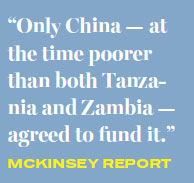
"Only China - at the time poorer than both Tanzania and Zambia - agreed to fund it, to the tune of $3 billion."
The report cites Kariakoo, a low-income market in Tanzania where there are more than 100 small Chinese traders operating and selling everything from clothes and slippers to cheap electronic devices. Its store owners are often poorly educated and speak minimal English or Swahili, yet they operate successful businesses by building relationships with local wholesalers and retailers.
Another example is Sunshine Group, founded in Tanzania in 2012. Initially the group focused on mining but it has since expanded at a rapid rate to build businesses in agriculture, transportation and logistics and manufacturing.
"To date, it has invested around $100 million in Tanzania and neighboring countries, including building a gold-smelting factory, processing plants for agricultural commodities ranging from peanuts to cotton and rice, and a card-printing facility producing bank, credit, and phone cards. Its transportation subsidiary operates more than 200 vehicles," notes the report.
Sunshine Group exports processed agricultural products to China and Southeast Asia.
For China's StarTimes broadcasting company, Africa represented a wideopen market - free from the more constraining regulation common in its home country. But in Africa, Star-Times faced a market with little infrastructure and unformed viewing habits. Taking the long view, the company has invested in low-cost, digital satellite television for its African markets and in 10 years has grown from nothing to become the No 1 pay television provider in Africa by subscriber volume. In Tanzania, for example, it has invested $120 million over the past six years and reduced the price of pay television by 80 to 90 percent.
Omid Kassiri, a McKinsey & Co partner, says that, like other Chinese companies, StarTimes pursues a localization strategy. As it builds its customer base, the company employs locals as technicians and provides them with the necessary training. On the product side, it invests in both international and local programming.
Fatima Acyl, the African Union commissioner for trade and industry, says the impact of China's presence in Africa is mostly positive regarding jobs, foreign direct investment and technology transfer.
"We also believe that, going forward, there is significant space for there to be an increase," says Acyl.
China's total direct investment in Tanzania soared from $700 million in 2011 to $2.1 billion last year, turning the world's second-biggest economy into the biggest foreign investor in the East African country.
For China Daily
(China Daily Africa Weekly 07/14/2017 page29)





Today's Top News
- Wang to meet foreign ministers of Cambodia, Thailand in Yunnan
- China's top legislature concludes standing committee session
- Thailand and Cambodia agree to temporary ceasefire
- NPC's 4th annual session slated for early March
- Civilizational links for a fairer world
- Manufacturing in China spurs global growth