A turning point in growth speed?









Latest forecast on China's GDP is good news - but short-term improvement is not grounds for complacency
The International Monetary Fund recently hiked China's GDP growth forecast to 6.7 percent. This is the third time it has raised its forecast for this year, first from 6.4 to 6.5 percent in January and then from 6.5 to 6.6 percent in April.
Such an upward forecast is undoubtedly welcome news, not just for Chinese policymakers but for state and corporate leaders all over the world. After all, the reinflation - or, at very least, the halt of deflation - in China in 2015 has brought improved corporate earnings and national GDP growth around the globe. If China's economy was to sustain the vibrant growth we have seen over the past 12 months, then it and the United States, the two largest economies in the world, could at last pull global economic growth from the doldrums it has been in since the 2007-08 global financial crisis.
It is well known that short-term economic growth data should be interpreted with great caution, in China or anywhere else. Data revision, seasonal fluctuation and the unique Chinese New Year effect have all brought unexpected complexities to interpreting short-term economic figures.
This is even more relevant when interpreting Chinese statistics, since figures from different sources are sometimes at odds with each other and render it difficult to derive a consistent picture of the short-term economic fluctuation.
Long-term sustainability, rather than speed, should be the center of attention when examining recent upbeat economic figures.
For example, the IMF says "policy support, especially expansionary credit and public investment", is largely responsible for the fund's upward revision of China's economic figures.
The natural next question is, to what extent will the expansionary credit and public investment policy persist going forward? If anything, the recent central finance working conference probably paints a very different picture from the policy orientation of the past year or so.
Ensuring financial stability, stabilizing asset prices, preventing asset bubbles and preventing systenic financial risks have gradually taken over and become the highlight of economic and financial policy guidance.
Such a shift in policy orientation is not only much-needed but also timely. As a matter of fact, much of the focus of the new policy orientation coincided with the market-oriented supply side reform, which has been the main direction of economic and financial reform put forward by the government.
However, economic policy during the past couple of years, especially the reliance on the real estate sector and the ever-strengthening expectation of escalating housing prices in China's first-and second-tier cities, seems to have ensured short-term economic growth at the expense of deviating from the direction of long-term reform, making future reform more difficult to tackle.
It is worth noting that many of the problems that the next stage of economic reform is attempting to solve - such as rapidly growing corporate leverage, ever-increasing housing prices and the real economy's difficulty in accessing the financial markets and switching into investment-related, rather than manufacturing-or service-related areas - were indeed consequences of previous expansionary credit and investment policies.
As I said in my book China's Guaranteed Bubble, contemporary economic policymakers increasingly find themselves flanked by short-term and long-term economic policy goals. It becomes difficult, if not impossible, for a policy to deliver desired objectives both in the short and long term. More often than not, expansionary policies that are instrumental in improving the economy in the short term risk not only generating asset bubbles - and, even worse, misallocation of resources - but, more seriously, the moral hazard and incentive distortions that make further policy more difficult.
In this regard, it is probably naive to conclude that improvement in short-term growth figures is necessarily encouraging for the long term. After all, international policymakers have gradually come to the consensus that the 2007-08 global financial crisis and the lackluster economic recovery afterward are largely the aftermath of expansionary monetary policy and financial regulation during the previous decade.
Many have proposed that active fiscal policies, and the often accompanying developmental finance, can shoulder a lion's share of expansionary policy. Such policies aimed at long-term development would have to overcome the ordinary test of cash flow and financial viability. An even bigger challenge is that different participants in such policies between the public and private sectors have very different objectives and time horizons. If not conducted properly, expansionary policies run the risk of becoming avenues of rent-seeking and risk-transferring.
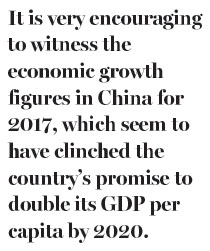
In this sense, it is very encouraging to witness the economic growth figures in China for 2017, which seem to have clinched the country's promise to double its GDP per capita by 2020. On the other hand, such short-term improvement is not grounds for complacency. How to gradually wind down China's national-level leverage, taper off implicit and explicit policy guarantees for economic objective and financial investment and truly let the market play maximal roles in allocating resources, should be the focus of policymaking in the next few years.
The author is the oceanwide professor of finance at Tsinghua University. The views do not necessarily reflect those of China Daily.
(China Daily European Weekly 07/28/2017 page9)






Today's Top News
- UN envoy calls on Japan to retract Taiwan comments
- Innovation to give edge in frontier sectors
- Sanctions on Japan's former senior official announced
- Xi stresses importance of raising minors' moral standards
- Coordinated reform key to country's growth
- Shandong gives new life to traditions