Local workers seen as key to market penetration









African employees help Chinese companies to better understand culture and regulatory environment
In their efforts to penetrate the lucrative African market, Chinese enterprises are keenly focusing on a strategy of staff localization.
Local people understand the market and the regulatory environment better, a challenge enterprises face in foreign markets. Local labour is also cheaper compared to the imported one.
Holley-Cotec Co (EA) is one of such companies that strongly believe in the power of staff localization in market penetration. While very few Chinese pharmaceutical companies have succeeded in the African market, Holley-Cotec is doing well and expanding. The company has subsidiaries in Kenya, Tanzania, Uganda and Nigeria.
| Employees at Twyford Ceramics, a Chinese company based in Kenya that specializes in the manufacture of ceramic tiles. Edith Mutethya / China Daily |
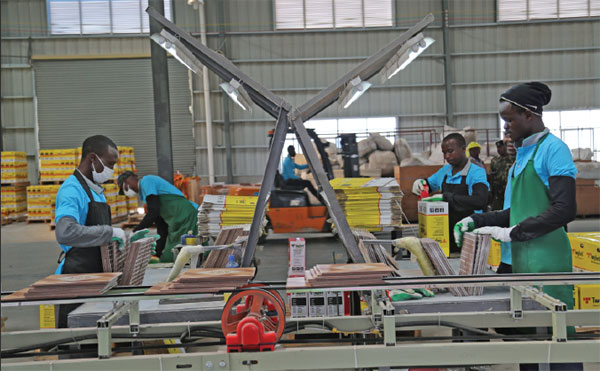
According to Godfrey Wachira, Holley-Cotec Co (EA) Ltd sales and marketing manager, locals run the show in all the countries where the company has operations. In Kenya for instance, out of the 20 employees in the company, only two are Chinese nationals - the managing director and the finance director.
Wachira considers this strategy as one of the company's major strengths. "If you don't have the local expertise, you are poised to fail because this is a foreign market and there is a language barrier - among other challenges," he says. "You must know the culture and where the market wants to go in order to break through."
Huawei Technologies Co Ltd, a Chinese multinational networking and telecommunications equipment and service company, is another firm that keenly focuses on local talent.
According to Adam Lane, the senior public affairs director, Huawei Southern Africa, strong focus on local talent has been an important part of the company's localization strategy, alongside strong partnerships with local customers and suppliers/subcontractors.
"Though we only have a few hundred staff directly employed by Huawei Kenya, we have more than 2000 employees working on our projects through our sub-contractors. These sub-contractors have grown to be major local companies in their own rights," he says.
Lane says Huawei places strong emphasis on recruiting, developing, training and promoting local talent in its operations across Africa. This is in addition to providing a good compensation and benefits package as well as a supportive corporate culture.
The company offers training to its local staff through Huawei East Africa Training Centre in Nairobi, in Chinese universities, online training, and through on-the-job training which includes close mentorship and support from managers and colleagues.
StarTimes, a Chinese broadcasting company is also pursuing a localization strategy. As it builds its customer base, the company employs locals as technicians and provides them with the necessary training.
On the product side, it invests in both international and local programming. This focus on the local market has taken television viewing from an occasional luxury to a daily routine for many Tanzanians.
According to a recent research by McKinsey & Company, out of the 1,000 companies surveyed, 89 percent of the employees were Africans, adding up to more than 300,000 jobs for African workers, scaled up across the more than 10,000 Chinese firms in the continent.
"In trade and manufacturing sectors, the workforce was 82 and 95 percent Africans respectively. Comparing public and private enterprises, SOEs employ an 81 percent African workforce while private companies employ a 92 percent African workforce," the report states.
The report dubbed, Dance of the Lions and Dragons, states that employing Africans leads to lower overall costs. Although China rose to global manufacturing prominence on a large, low-cost labour pool, its payroll costs have been rising and its labour is becoming less price competitive than the Africa's.
"Chinese labour is so expensive these days. Even when we bring some technicians to help set up operations, we try to send them back as soon as possible," a manufacturer told McKinsey & Company.
According to construction firms in Africa, even though Chinese workers tend to be more productive, it is five times more expensive to bring a Chinese worker to Africa compared to hiring a local person. Most of the companies, therefore, prefer employing local people and equipping them with the required skills.
However, the McKinsey & Company report states that only 44 percent of managers at the Chinese-owned companies surveyed were African, hence a challenge to the companies to empower a new generation of African business managers.
edithmutethya@chinadaily.com.cn
(China Daily Africa Weekly 07/28/2017 page29)






Today's Top News
- Thailand and Cambodia agree to temporary ceasefire
- NPC's 4th annual session slated for early March
- Civilizational links for a fairer world
- Manufacturing in China spurs global growth
- Taiwan lawmakers vote to pass motion to impeach Lai
- Xi: Steadfastly implement conduct rules