When the flag is raised, expect fate to take over









Thanks to their overreliance on cliche, screenwriters make it easy to recognize these moments that point toward doom
We've all seen the war movies. Before heading off to battle, the rookie recruit kisses his girlfriend goodbye, promising, "As soon as I come back, I will marry you." Or maybe he keeps a photo of his childhood sweetheart in his wallet to show others what's waiting at home.
It's as bad as someone on Game of Thrones saying, "We'll talk when I get back."
They're dead meat. We all know it.
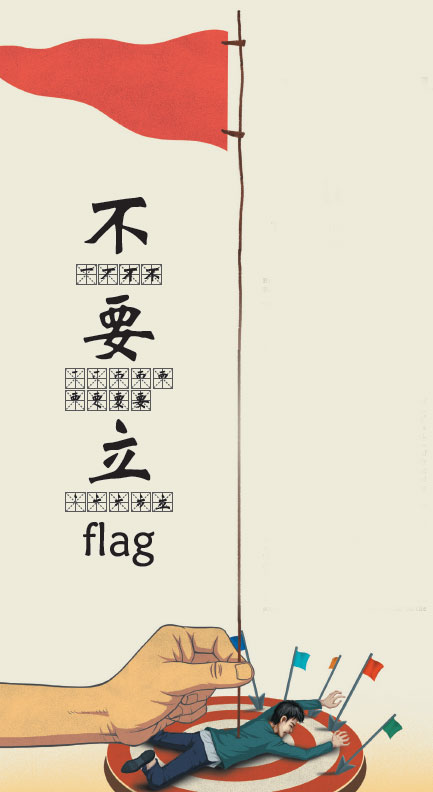
Chinese moviegoers have a term for this sort of signaling: "Don't raise a flag!" (不要立 flag! Bùyào lì flag!) Originally a gaming term, "raise a flag" refers to particular lines or cues that serve as a sure sign of impending death or disaster. It usually exists as a half-Chinese, half-English term - 立 flag, with 立 (lì) meaning "raise" (mixed use of Chinese and English has become increasingly popular both online and in conversation among younger Chinese, even though some scholars and media have criticized the phenomenon, citing "language purity").
The term is often used on social media or in "bullet subtitles" (彈幕 dànmù), viewers' comments that shoot across the screen as chyrons when a video is played. Thanks to their overreliance on cliche, screenwriters make it easy to recognize a flag. When a hitman hero swears "This will be the last time I kill," he is raising a flag (社交媒體 shèjiāo méitǐ) - he's guaranteed to not only kill many times more, but probably also die himself before washing his hands of the business. When a mother calls her child before surgery to reassure the youngster that "Mommy will be back soon," that's a flag saying she's sure to die on the operating table. Even a schoolgirl telling her best friend a secret after school raises a distinct flag that the consequences could be fatal. All the viewer can do is plead, "不要立 flag!" or lament, "Flag 已立 (Flag yǐ lì. The flag has been raised)."
You may have heard another expression - 烏鴉嘴 (wūyā zuǐ, literally "crow mouth") referring to someone who says something ominous. If someone says about a person, "He has been out of contact for 24 hours. I'm afraid something has happened to him," it's crow mouth. When you hear some grim crow-mouth talk, it's not regarded as ominous or unlucky. Instead, people call it "反 (fǎn) flag," or "counter-flag", meaning these phrases indicate that everything will, in all likelihood, turn out all right.
The logic goes that if one's worst fears have already been aired, they are far less likely to transpire. It's akin to jinxing: Just as pride comes before a fall, a declaration of confidence is like a red rag as far as fate is concerned. So better instead to predict one's own impending doom as a way to ensure your own survival - a false-flag operation, if you will.
Not that flags are always life-or-death matters. In daily life, the criteria for what's a flag and what flags mean are fairly loose. Indeed, having faith in just about anything could be interpreted as a flag. For example, your friend may casually predict sunny weather: "明天一定是個好天氣 " (Míngtiān yīdìng shìgè hǎo tiānqì. It must be a good day tomorrow!) And you probably will say: "你最好別立 flag 又霧霾了怎么辦?" (Nǐ zuì hǎo bié lì flag, yòu wù máile zěnme bàn? You'd better not raise a flag! What if there's smog again?)
Another example, after the test, you may said: "這題目真是太簡單了, 我肯定能過. Zhè tímù zhēnshi tài jiǎndānle, wǒ kěndìng néngguò. It was so easy. I am sure I can pass it." and then there is somebody saying: "你最好別立 flag, 當心補考有你一個. Nǐ zuì hǎo bié lì flag, dāngxīn bǔkǎo yǒu nǐ yīgè.)
It doesn't matter how good the going is - even if you pass the day with flying colors, many Chinese think it's safer to wave a white flag than raise a red one.
Courtesy of The World of Chinese, www.theworldofchinese.com.cn
The World of Chinese
(China Daily Africa Weekly 08/04/2017 page23)






Today's Top News
- High-speed rail reaches 50,000 km milestone
- China puts sanctions on US defense firms, execs
- Iconic hall reopens after decade-long renovation
- Sanctions show China's resolve to safeguard its sovereignty and territorial integrity
- China OKs three action plans to build pilot zones for a Beautiful China
- CPC leadership meeting stresses steadfast implementation of eight-point decision on improving conduct