When vacationing abroad, tread carefully









Travel information website has published guidelines aimed at helping Chinese tourists be responsible travelers
Chinese travel information website Qyer recently unveiled guidelines aimed at encouraging tourists to respect cultural differences and protect the environment when traveling.
"As travelers, we're merely guests in a destination. Our travel should be responsible and sustainable," says Zhang Yi, a co-founder of the website.
The guidelines suggest making friends with local residents, and offer insights on customs and taboos in different countries. They also emphasize proper disposal of trash when camping, and the protection of marine life and wildlife.
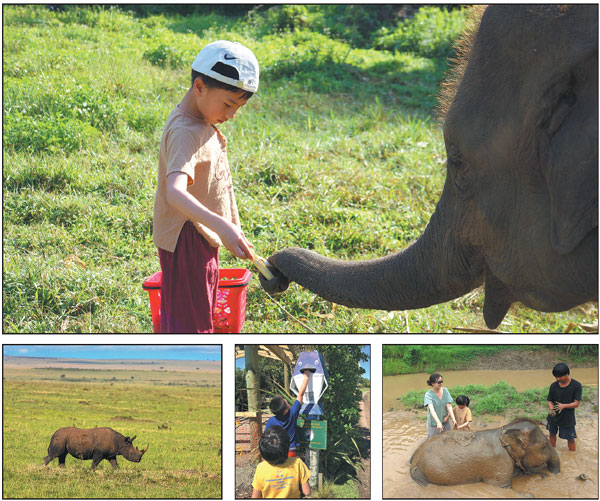
| Clockwise from top: In a trip organized by Qyer, Chinese parents and children can encounter elephants in Ran-Tong Save and Rescue Elephant Center, Chiang Mai; Chinese tourists bathe an elephant; Chinese children donate money for pengu ins in New Zealand during a trip organized by Qyer; a rhinoceros in Masai Mara National Reserve, Kenya. Photos Provided to China Daily |
"They are like a code of conduct to help travelers to avoid improper behavior," says Zhang.
"Don't take anything away except your photos, don't leave anything there except your footprints," is the fundamental principle, he says.
The project is supported by the World Wildlife Fund, Traffic - the wildlife trade monitoring network - and the Forest Stewardship Council.
Wang Lei, forest program manager at WWF's Beijing office, says the conservation organization is working closely with tourism operators on public awareness of forest protection.
Li Chenyang, project manager of Traffic, says: "Sustainable travel is very important. Tourists should be informed which souvenirs or wildlife products violate international laws and contribute to the loss of local species or habitats."
Raising awareness
Traffic has been cooperating with traditional and online travel agencies to raise awareness among inbound and outbound Chinese tourists not to purchase illegal wildlife products such as ivory and rhino horn or to eat protected species.
"Such consumption leads to poaching and fuels the illegal wildlife trade, and these endanger species and can even lead to them becoming extinct," Li says, adding that compared with before, public awareness about the situation has greatly improved.
Zhang cites elephant attractions in Thailand as an example. The common itinerary used to be for tourists who traveled to Chiang Mai to visit elephant camps where they could ride an elephant and watch shows in which the elephants perform tricks.
But last year, the website's bookings for such elephant camps dropped by about 90 percent because the company has been promoting visits to elephant conservation centers as an alternative.
In 2015, Qyer founded an office called Q-home in Chiang Mai and cooperates with several elephant conservation centers such as Elephant Nature Park, where tourists can enjoy encounters with elephants in their natural environment and help to feed them and give them baths.
"For decades, the local mahouts (trainers) have made a living by training elephants to do tricks; many tourists have no idea about the cruelty of teaching an elephant to learn to perform in this way. We try to persuade the mahouts to change their way of operation and attract tourists in a sustainable way that is not abusive to the animals," Zhang says.
"It's not about withdrawing all elephant rides and shows. But we can inform tourists of which elephant attractions are the most friendly to the animals and the local environment."
He says the company indicates on its website where the elephants might be being abused and directs them to the conservation center's activities instead.
This also meets the desires of tourists, since they now want more unique experiences, he adds.
"Chinese travelers used to join group tours for outbound travel, but now more are traveling independently, and they want to experience something different," Zhang says.
Travel guidelines
According to the China Tourism Academy, 122 million Chinese tourists traveled overseas last year, up by 4.3 percent from 2015. Their total expenditure was $109.8 billion (93.6 billion euros; £83.8 billion).
Qyer has printed 2,000 copies of its responsible travel guidelines, using recycled paper, and distributed them to practitioners in the tourism industry. An electronic version can be downloaded for free via its website.
Qyer recently cooperated with Beijing Utour International Travel Service Co to promote the brochure's content among the travel agency's tour guides and tourists. And Qyer has launched the League of Responsible Travel with more than 20 tourism bureaus, airlines and tourism companies from home and abroad.
xulin@chinadaily.com.cn
Tips for responsible traveling
1 Do research before your trip and learn about the local religions, culture, taboos and values.
2 Learn and try to speak a few words in the local language.
3 If you're heading for a destination that is culturally different, learn the meanings of the hand signs and body language in that destination.
4 Support local businesses, eat local food and use public transport.
5 Bear in mind that if you eat protected species or buy souvenirs made from animal products, your actions will speed up their extinction.
6 Purchase local handicrafts if you want to buy souvenirs. Don't bargain too much.
7 Respect local religions and any cultural taboos and dress codes.
8 Ask as person's permission if you want to take a photo of them and do your best to send a copy to him or her later.
9 Think twice about giving gifts or money to beggars. You can use your money to support local schools, clinics or other projects.
10 Protect the local environment like it's your own home (It is).
11 Share your travel experience with others.
12 Smile and be a calm, optimistic and friendly traveler.
(China Daily Africa Weekly 08/04/2017 page22)






Today's Top News
- Civilizational links for a fairer world
- Manufacturing in China spurs global growth
- Taiwan lawmakers vote to pass motion to impeach Lai
- Xi: Steadfastly implement conduct rules
- High-speed rail reaches 50,000 km milestone
- China puts sanctions on US defense firms, execs