Artery at the heart of Chinese culture









Ancient man-made waterway offers a link to country's past - and now efforts are underway to preserve the glory of the Grand Canal
The ancient Chinese built two great engineering wonders: the Great Wall and the Grand Canal. Though the Great Wall's function in military defense has faded over time, the Grand Canal remains a crucial conduit of cultural communication.
Spanning more than 2,000 kilometers between Beijing and Hangzhou, the canal was listed as a UNESCO World Heritage Site in 2014.
Currently, the creation of a Grand Canal cultural belt is being discussed nationwide.
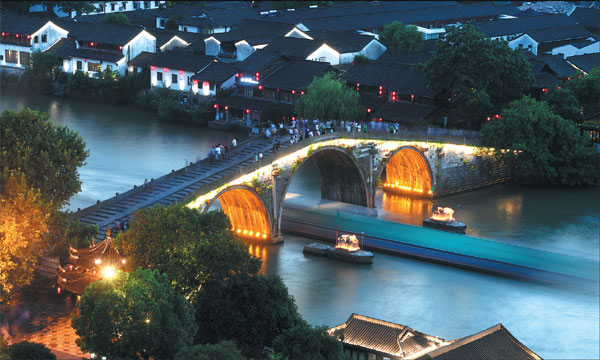
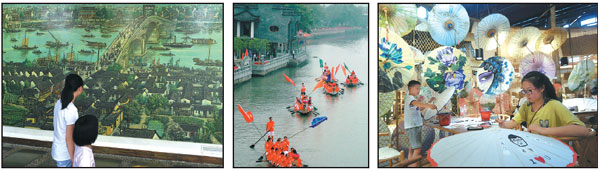
| Top: Gongchen Bridge stretches across the eastern and western banks of the Grand Canal and appears majestic and grand. Above: Local governments along the canal are coming up with all sorts of measures to protect this cultural gem. Photos by Huang Zongzhi and Wang Dingchang / Xinhua |
But why should a man-made waterway be considered a cultural treasure?
Zhang Shuheng, a researcher at an archaeological institute in Zhejiang province, says the canal was a pillar for the economy, social stability and government functions in ancient China.
It also helped the evolution of Chinese culture by enhancing communication between the south and the north.
Hangzhou resident Zhou Zhihua, who grew up beside the canal, says: "Areas around the Gongchen Bridge used to be busy - filled with people from all walks of life, like businessmen, dockers, rickshaw drivers and vagrants."
Zhou, who has been a local folk opera performer for more than 50 years, says that in the early 20th century, opera performers would gather at the bridge to perform, and the boats and teahouses on the dock were the stages.
Like silk and porcelain, tea was once an important cargo transported on the canal. So, tea dealers from different parts of the country gathered at Gongchen Bridge and set up a business association.
Zhou says the association was also a charity that would give food to vagrants and prepare coffins for those who died in poverty.
"People on the dock, no matter where they came from, whether rich or poor, were all willing to give," says Zhou.
Today, the hustle and bustle at Gongchen Bridge is long gone, but its spirit of openness and philanthropy is part of local culture.
Zhou now runs a teahouse that has been offering free Laba porridge to local residents for the Laba Festival for the past six years.
Also on the Grand Canal is the city of Suzhou, sometimes called the "Venice of the East" for its waterways.
Andrew Shaw, once a BBC reporter in Britain, found his spiritual home in the Chinese city.
Nine years ago, Shaw, mesmerized by jade, quit his job and moved to Suzhou to become a jade carver.
Since the Qing Dynasty (1644-1911), Suzhou has been the center of jade carving in China, and local craftsmen would travel to Beijing, using the canal, to serve the emperors.
Shaw went to Xiangwangnong, an area known for jade workshops, looking for a mentor. Finally, he became an apprentice there.
Today, he owns a workshop and his works are a blend of Eastern and Western culture.
"Jade is the heart of Chinese culture, it represents the perfect personality - mild, tolerant and pure," says Shaw.
Also, on the banks of the Grand Canal, Jessica Doolin, 27, from Ireland, is pursuing her dream of being an acrobat.
Wuqiao county of Cangzhou, in Hebei province, is the cradle of acrobatics.
In the past, performers traveled using the Grand Canal to perform around the country and even abroad.
Doolin, a former hairdresser, fell in love with the art and decided to become a performer five years ago after watching an acrobatic performance.
She is now the oldest student at the Wuqiao acrobatics school.
"Being a late starter means I have to work harder," she says.
Meanwhile, local governments along the canal's length are devising measures to protect this cultural gem.
A Grand Canal protection regulation was enacted in Hangzhou in May, and in the city of Yangzhou technologies such as remote sensing and big data are being used to protect the waterway.
Beijing is also working on a blueprint for the protection of the Grand Canal cultural belt.
In the arts and crafts museum under Gongchen Bridge, ancient crafts such as the making of paper umbrellas and silk fans, as well as paper-cutting, are demonstrated.
Paper-cutting master Fang Jianguo has a workshop in the museum and the work he is most proud of is based on the G20 Hangzhou summit, a piece he spent two months working on.
Separately, during the past six years, Shaw has introduced jade artists from different countries to the annual jade carving exhibitions in Suzhou.
Last year, he taught two French apprentices at his workshop.
"Communication and exchange are key to keeping culture alive and evolving," he says.
Xinhua
(China Daily European Weekly 08/11/2017 page18)






Today's Top News
- China holds central rural work conference
- President Xi to deliver New Year's message to ring in 2026
- Xi's diplomacy in 2025: Shedding light on a world at crossroads
- FTP has given Sanya a complete makeover
- China to apply lower import tariff rates to unleash market potential
- China proves to be active and reliable mediator