



Private universities rise to the challenge









They are seen as more sensitive to social and market demands than traditional institutions
The demand for education in China has been rising even faster than the GDP. The number of students at Chinese universities rose from 16 million in 2005 to 26 million in 2015, and the 13th Five-year Plan (2016-20) predicts that these numbers will continue to rise. The plan also emphasizes the need to "cultivate students' entrepreneurship and innovation capabilities" and to improve education in rural areas.
One contribution toward reaching these goals is the huge growth in private universities. Now, private institutions enroll about a fifth of Chinese university students in more than 600 private universities, up from just 20 in 1997. In a statement issued in January, the State Council, China's Cabinet, supported the growth of private education: "The social sector and private companies should be encouraged to set up schools and educational institutions and provide diversified educational products and services."
| Xi'an International University, in Northwest China's Shaanxi province, was set up in 1992 and is one of China's oldest private universities. Provided to China Daily |
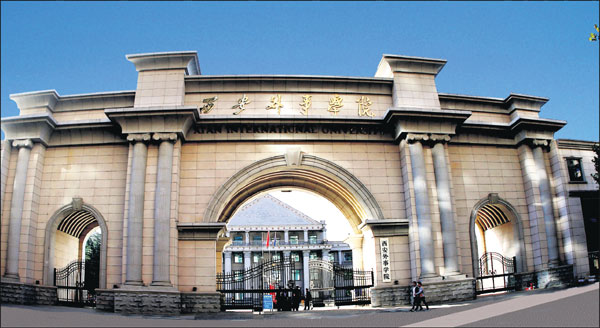
Xi'an International University, in Northwest China's Shaanxi province, was set up in 1992 and is one of China's oldest private universities. It was started by Professor Huang Teng, chair of the board of directors, to provide training in foreign affairs for the provincial government. Now, it is a not-for-profit organization and follows strict governance rules. It has 22,000 students and about 2,000 faculty and staff members.
Chen Aimin, president of XAIU who took the gaokao in 1978, says that private universities now attract students whose gaokao scores are not high enough to get into more established, lower tuition, public universities. "Our goal is to make students of the highest gaokao scores willingly choose us over public universities and their lower tuition. To achieve this, we must become much better in many ways than public universities.
"Private universities are much more sensitive to social and market demand than traditional universities. With their short chains of command and smaller bureaucracy, they can make quick decisions to meet student needs. As a result, private educational institutions are marching forward with typical 'China speed' that can hardly be matched by public universities, just as China's State-owned enterprises can hardly catch up with the growth and expansion of private enterprises."
She also says XAIU implements decisions much faster than those she saw in 22 years studying and teaching at US universities.
For example, she points out that XAIU set up a research institute in Shaanxi's Free Trade Zone less than four months after the zone was approved by the central government. The institute aims to become an important think tank for the economic development of the province, especially on issues related to the Belt and Road Initiative.
In 2009, XAIU set up its College of Entrepreneurship Education, years before the central government launched the "Mass Innovation and Entrepreneurship" program in 2015. The college has been visited by educators from all over China, and in 2016, it received an award from the Ministry of Education as a "National Top 50 University of Outstanding Experience in Creativity and Entrepreneurship Education".
At XAIU, all students take an introductory class in entrepreneurship. Those who want to can go on to second-level classes. After that, the university does psychological testing to determine which students are suitable to be entrepreneurs. They can go on to advanced courses and practical opportunities working with XAIU graduates and with the university's business incubator.
Many of the xinsanjie, who attended the June conference on the 40th anniversary of the gaokao resumption, hosted in Beijing by the Center for China and Globalization, see private universities as a significant part of educational reform.
Zhang Li, president of the education research and development center of the Ministry of Education, says the country needs more diversified students, not just those who do well in the gaokao. And Shao Hong, a member of the Standing Committee of the Chinese People's Political Consultative Conference, says: "The central government should give more resources to nongovernment-funded universities."
Wang Huiyao, chairman of the CCG, concludes: "Competition should be applied to universities, which are now a monopoly. We should have private and foreign-owned universities."
davidblair@chinadaily.com.cn
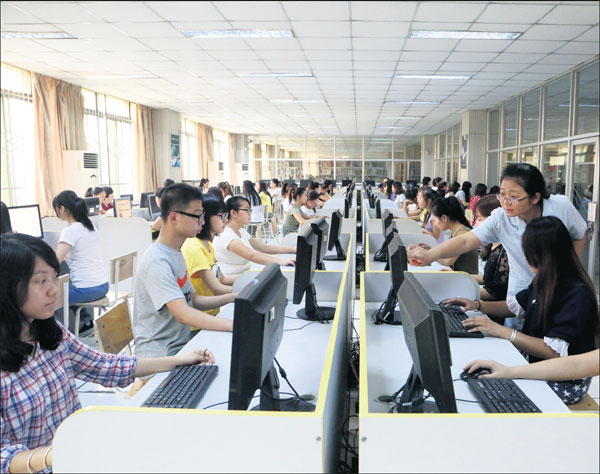
| Students of XAIU at a computer course. At the university, all students also take an introductory class in entrepreneurship. Provided to China Daily |
(China Daily Africa Weekly 08/11/2017 page8)




Today's Top News
- Thailand and Cambodia agree to temporary ceasefire
- NPC's 4th annual session slated for early March
- Civilizational links for a fairer world
- Manufacturing in China spurs global growth
- Taiwan lawmakers vote to pass motion to impeach Lai
- Xi: Steadfastly implement conduct rules








