TCM therapy offers much food for thought









Perhaps ancient medical wisdom can offer some pointers on how China should approach the problem of institutional corruption
I started applying small amounts of medicinal paste to several acupuncture points on my chest and back from day one of the first 10 hottest days of the lunar calendar. The paste is supposed to help cure some chronic diseases if you apply it on the exact acupuncture points during the first, second and third hottest periods, each of which usually lasts for 10 days, from July to early August.
I have no idea whether it works or not. Yet I respect the philosophy of traditional Chinese medicine, which sees the human body as a whole system and considers the unrestricted flow of both blood and qi (the invisible but vital force inherent in all things) throughout the body to be vital to a person's health.
Based on the relationship between the flow of blood and qi in a person's body and his or her health, TCM insists that an illness should never be considered a disorder of a specific part or organ but a disorder of the whole system. Being holistic in nature, TCM works to fix the dysfunctional operation of a person's system even as it treats a specific problem.
The medicinal paste I am using, a mixture of several ground herbs, is supposed to help rid patients of respiratory diseases that "hibernate" in the summer and afflict them in the winter. According to TCM philosophy, some diseases that flare up in the winter can be cured with herbal medicines in the summer and vice-versa, and therefore it is easier to treat people's "inner cold" and cultivate their vital energy in the summer so that they can better resist winter-related ailments.
I don't buy some quacks' claims of TCM therapies having miraculous effects. Yet the holistic philosophy of TCM can be extended to other diseases afflicting humankind. Popping a pill to cure a headache, as a Chinese saying goes, is to treat a symptom without trying to find the real disease. For example, every case of corruption is a symptom of a graver illness and should be aggressively treated. But while using one set of medicines to treat the symptom, the doctors should detect the cause of the symptom (that is, the real disease) and use more powerful medicines to cure it.
The number of corrupt officials serving sentences and the amount of money recovered from them are unprecedented. But successfully plugging the loopholes in the administrative and economic systems, which are exploited by some to make illegal profits, would be a far greater achievement. And for that, we first have to find those loopholes, using methods similar to those employed by TCM practitioners to clinically diagnose a patient's illness.
Governance, rather good governance, is a term officials at all levels frequently use when talking about realizing the Chinese Dream of national rejuvenation. For good governance, too, TCM philosophy can be of great importance. An official's governance capability will greatly improve if he or she approaches the problems in the same way a TCM practitioner diagnoses a physical ailment.
Organizing interviews or surveys to find out what people feel about the policies that have been implemented is similar to a TCM doctor taking a patient's pulse and checking the tongue to diagnose an ailment. Only by finding out whether some policies have compromised the quality of people's lives can the policymakers identify the root of a problem and take measures to solve it.
Making and implementing policies to only deal with a specific ailment, physical or otherwise, without bothering to identify its root cause and treating it properly is like popping a pill to cure a headache without knowing what actually has caused it. The headache will keep returning to nag the person until he or she resorts to holistic treatment to cure the real illness.
The author is a senior writer with China Daily. Contact the writer at zhuyuan@chinadaily.com.cn
(China Daily European Weekly 08/18/2017 page11)


Today's Top News
- US actions fail to match its words on Taiwan question
- China's diplomacy to blaze new trails
- Visits point way to better future for all
- PLA tests joint combat strength for second day
- Xi stresses advancing rural areas' vitalization
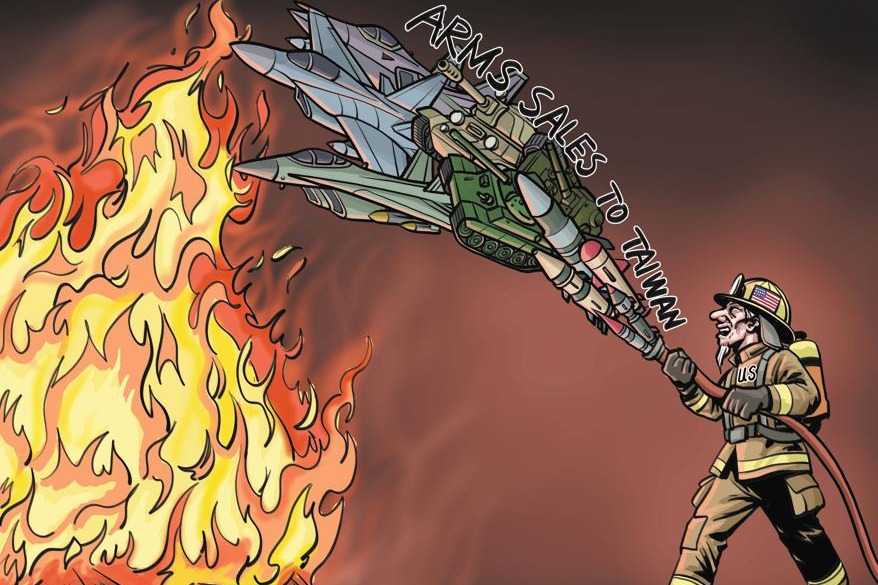
- US arms sale to Taiwan will lead secessionists toward destruction