Cash? What's that?









As the mobile payment trend gathers momentum, the days of coins and banknotes are becoming a memory for more and more people
WeChat and Alipay, two major online payment platforms in China, have been calling for consumers to go cashless and cardless in their daily life through promotions in August. Cashlessness is a new Chinese characteristic. In a recent report by Tencent, the Chongyang Institute for Financial Studies at Renmin University of China and French market research company Ipsos, 84 percent of Chinese were "comfortable" going out with only their mobile phone and no cash.
Gao Jingwen, in her 20s, can hardly recall when she last paid in cash.
| China's lack of "credit card culture" has helped to fuel the popularization of mobile payments, especially in small cities and underdeveloped areas. Photos by Wang Zhao / Agence France-Presse |
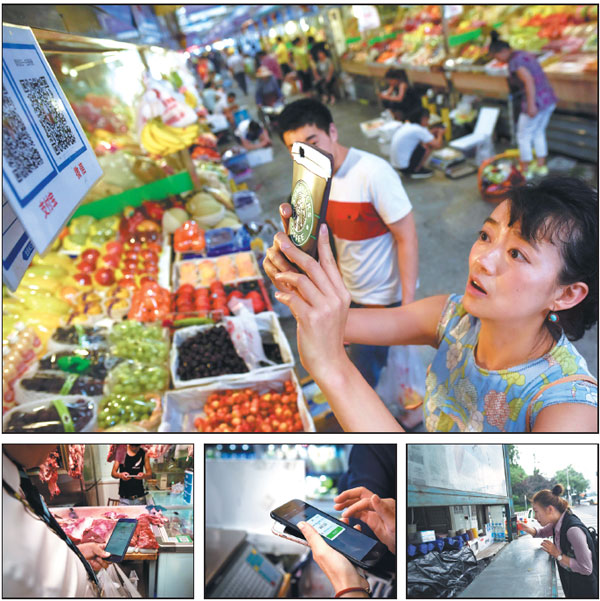
"I do not need cash in a restaurant, seeing a doctor, paying electricity and water bills. I cannot think of any place I cannot pay with my smartphone," she says.
Zhang Shucui, 67, always used to take a large amount of change when going to the wet market near her home in Beijing's Haidian District, but those days are over.
"The QR code replaced the change basket in front of the stalls," she says. "Gone are the days when I had to search all my pockets for a coin."
The report also showed more than 70 percent of the 6,500-plus respondents saying they could live for more than a week with only 100 yuan ($15; 13 euros; £11.50) in cash, and 52 percent only use cash for 20 percent of their total monthly consumption.
Mei Houdui, an electronic products dealer in Shenzhen, shared a recent "awkward" experience - he wanted to borrow some cash as pocket money for his child at a party and failed, as no one had any cash in their pockets.
The new payment pattern has won over Chinese consumers with its convenience and flexibility, squeezing the market share of card and cash payments.
Alipay or WeChat? This is the question posed most often when a purchase is made in China. Cards and cash, the once-dominant purchasing methods, have become a secondary option in less than half a decade.
"Mobile payment companies were worried about their future just four years ago, but the spread of technology has exceeded the imagination of almost everyone," says Li Gang, a professor at the Tencent Research Institute.
Data from the People's Bank of China showed a total of 157 trillion yuan of payments were made on mobile devices in China last year, more than 200 times the total for the United States in the same period. The figure is expected to continue expanding by 50 percent each year, it said.
It is no accident that mobile payment has expanded so fast in China. According to a report by eMarketer, China's lack of "credit card culture" has helped fuel the popularization of mobile payments, especially in small cities and underdeveloped areas.
In a remote mountain village of central China's Hunan province, one can easily buy a hen or groceries by scanning a QR code.
The Payment and Clearing Association of China said in a report that mobile payment users in small towns and the countryside account for half of the total in China. The percentage of mobile payment users in the countryside is even higher than in provincial capitals.
"Mobile payment has become the norm and companies and brands cannot afford to ignore that fact," says Li.
WeChat Pay has recruited several million offline vendors. Alipay announced 10 million brick-and-mortar shops have signed up for its cashless life promotion.
Mobile payment has also helped improve outdated, time-consuming services at government offices and in the public sector.
In Xi'an, nearly 70 percent of the northwestern city's drivers pay their traffic fines via WeChat instead of wasting time lining up in in police departments.
Patients in Guangzhou are used to making appointments with doctors, and paying, by smartphone.
Statistics from WeChat show that more than 300 cities have public service platforms that accept WeChat payments.
Both the internet giants have expanded their services overseas since last year. Alipay can be used in hundreds of thousands of shops in over 70 countries, while WeChat has landed in 19 countries and regions, including Japan, Thailand and South Korea - popular destinations among Chinese tourists.
Xinhua
(China Daily Africa Weekly 08/18/2017 page18)






Today's Top News
- Judicial reform critical for modernizing governance
- Effective use of investment emphasized
- China's shuttle diplomacy strives to reach ceasefire
- Nanjing Museum's handling of donated art, relics being probed
- Key role of central SOEs emphasized
- New travel program hailed as 'milestone'