Challenges await China's economy









Surprises also in store for many industries as global quantitative-easing tightening and nation's credit squeeze alter landscape
China's economy is moderating. It stayed steady, with GDP growth rate at 6.9 percent for the second quarter of the year, which is better than the consensus of 6.8 percent.
Consumption was the largest contributor, which fueled 63.4 percent of GDP growth in the first half. Value-added industrial output was up by 6.9 percent year-on-year, indicating a robust recovery of China's large industrial enterprises. Fixed-asset investment expanded by 8.6 percent in the first half, while property development investment slowed, despite a relatively low base last year. Corporate profits continued to rebound as evidenced by the strong nominal GDP growth.
Despite the expectation-beating economic data, the A-share markets were rattled. The Shanghai Composite fell by 1.4 percent, the Shenzhen Composite was down by 3.6 percent and ChiNext plunged by more than 5 percent on the data release day. Will the growth last? Market sentiment was mixed amid concerns of tougher regulatory environment, as signaled by the speech of President Xi Jinping at the National Financial Work Conference, held in Beijing on July 14 and 15.
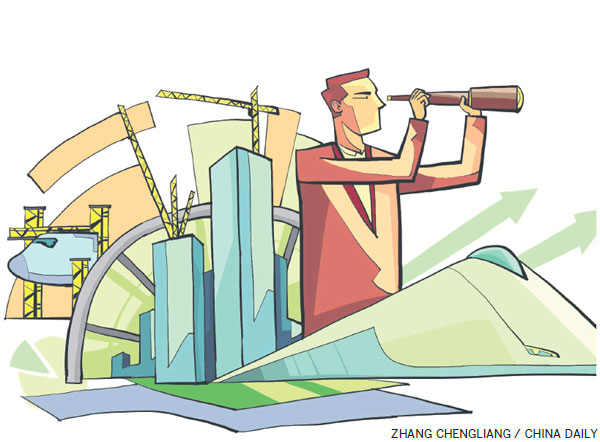
In our view, the second half of 2017 will be challenging in general. But there are indeed sparks to expect from some industries, which may spur the economy.
China's economy is facing challenges. From a global perspective, central banks' tightening of monetary policy is universal. After the two rate hikes in first half of 2017, the market is expecting a balance sheet reduction and one more rate increase from the United States Federal Reserve this year.
Meanwhile, the market expectation of the European Central Bank's quantitative-easing tightening is rising after comments by its President Mario Draghi on a review of monetary policy starting in September. The Bank of Canada raised its interest rate for the first time in seven years. The Bank of England's discussion of rate hike is on the way. If a part of the post-crisis economic recovery and prosperity worldwide was explained by the loose monetary policy, a reverse impact from quantitative-easing tightening on global economic growth should be expected. And the economic slowdown will eventually spread to China via external demand in trade.
It is worth noting that China's credit growth is slowing. Credit growth is an important booster to economic growth for a highly leveraged country like China. According to a Bank for International Settlements report, China's core debt to GDP ratio was 255 percent for 2016, among the highest in the world. A slowdown in credit growth is a result of deleveraging in the financial sector, as mentioned by the People's Bank of China, whereas it is also a warning sign of economic slowdown, no matter whether it's a proper level to support the real economy or not.
The June M2 money supply growth hit a historic low at 9.4 percent, compared with 11.8 percent for June 2016. The credit growth is greater than M2 growth, indicating banks' off-balance-sheet business growth is slowing as well, further evidence of financial deleveraging making progress. The slower credit growth and M2 expansion could become normal, as signaled by President Xi Jinping's speech at the National Financial Work Conference. A tighter regulation is expected going forward.
As credit growth slows and off-balance-sheet risk rolls back, funding costs are rising. These changes in funding costs are most palpable in the interest rate of interbank certificates of deposit, which at times will surge above the benchmark lending rate. Meanwhile, on banks' asset side, bond yields are rising and approaching the benchmark lending rate, lowering banks' appetite to make loans. These changes in banks' funding costs will eventually permeate to the rest of the economy. Higher financing costs for companies will be one of the consequences, and this will inevitably affect corporate profitability extensively.
Supply-side reform brought new growth energy to China's economy. In spite of the headwinds that the economy is facing, we do expect surprises brought by the tailwind - the supply-side reform in particular. After 30 years of rapid economic growth, China's economy has reached a turning point. The path that the economy has traveled since 2012 resembles an L-shaped growth phase. In this transition phase, quality and efficiency improvement becomes the tone of economic growth. This is the goal of de-stocking and reducing excess capacity, as implemented by supply-side reforms.
Supply-side reform contributed to the better-than-expected economic growth of the first half of the year. The profits of large enterprises increased by 22.7 percent year-on-year in the first five months, with the coal mining industry's turnaround in profitability and the steel industry's profit rising more than 80 percent. Both industries are pioneers of supply-side reform.
For the steel industry, according to the China Iron and Steel Industry Association, 84.8 percent of the whole-year capacity-eliminating plan has been completed in the first half, and new increased capacity is under strict control. The effect has even spilled over globally, as US and European steel prices rallied by more than 70 percent in the past 18 months and steel companies' share prices roared upward. As for the coal mining industry, 111 million metric tons of "zombie" capacity has been cut, completing 74 percent of the annual target.
Supply-side reform contributed to the government's efforts to curb China's property market boom. Property inventory has been falling since late 2016, with the June figure showing a decline of 9.6 percent year-on-year. The concrete progress of property de-stocking allowed the growth of the new construction starts to slow gradually without causing collapse or a systemic risk to the economy.
Looking ahead, surprises await China, while it is also aware of risks. In the second half, we do expect surprises to come amid the headwinds, as in the first half. The 70th anniversary of the establishment of the Inner Mongolia autonomous region and the upcoming 19th National Congress of the Communist Party of China could bring foreseeable benefits to some industries. For instance, regional thermal coal producers might be forced to halt production for tightening environmental and safety inspections. Supply-side reforms in the power and agricultural industries were raised, though details were not yet finalized, which could point the way for new momentum.
China should be aware of the macroeconomic risks as well as industry-specific risks. Overall economic growth is moderating, caused by global quantitative-easing tightening and China's credit squeeze. It's a more challenging environment for all industries and companies.
The author is managing director and head of research at BOCOM International, and a senior research fellow at the International Monetary Institute of Renmin University of China. The views do not necessarily reflect those of China Daily.
(China Daily Africa Weekly 08/18/2017 page10)





Today's Top News
- Thailand and Cambodia agree to temporary ceasefire
- NPC's 4th annual session slated for early March
- Civilizational links for a fairer world
- Manufacturing in China spurs global growth
- Taiwan lawmakers vote to pass motion to impeach Lai
- Xi: Steadfastly implement conduct rules