It's all in the stock









Editor's Note: China is divided into as many culinary regions as there are different ethnic groups. Its geographical diversity and kaleidoscopic cultural profiles contribute to the unending banquet of flavors.
Imagine a busy Chinese kitchen with its cooks in front of a row of hot stoves, every one busy working the woks and creating a noisy symphony. Behind that percussion, there is the roar of the cooking fires adding to the rhythmic beat of ladles hitting the cast iron pans, and the constant clacking of cleavers on chopping boards.
Through it all, there is yet another quieter motif - the soft bubbling of the stockpots, a murmur that reflects the heart of the Chinese kitchen.
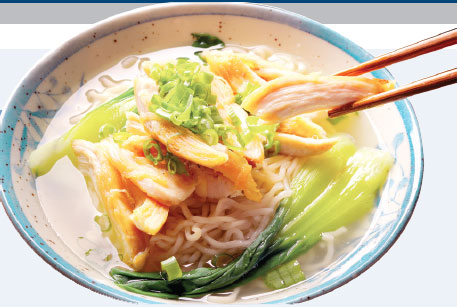
The stockpot is the first thing the chef tends to at the start of his working day before the kitchen gets frenetic. It is this that will decide and define the quality of his cooking.
Good stock will season soups and stews, help add umami to stir-fries and allow braised meats, vegetables and tofu products to develop that essential depth of flavor.
That is why there is a saying in the Chinese kitchen: "A good opera singer develops a flavorful tone, a good cook develops a flavorful stock."
In fact, he develops several different stocks, all of which will be used as his most basic tools of the trade. And like all tools, there are different levels of sophistication, each for a specific purpose.
The most standard stock is a simple one, a clear broth made of chicken or pork bones that can be used to lighten sauces or moisten stir-fries, replacing the use of water. It stays in the background and is never strongly seasoned.
Up one level is the superior stock, which can be either meat-based or vegetarian.
Meat-based stock is subdivided into chicken stock, pork stock, beef stock and fish stock, and there is also vegetarian stock.
Very specific techniques are applied to suit different ingredients. While chicken, pork and beef are subjected to long, slow simmering to breakdown the meat and extract every bit of flavor, fish stock needs a totally different cooking method.
Fish bones are first seared over high heat to get rid of any pungency, often with the addition of thin slices of ginger. The fish is then placed into rapidly boiling water, which quickly breaks down the protein and allows the stock to develop its classic milkiness.
Vegetarian stocks require the chef to have an intimate understanding of his ingredients, in order to slowly create layers of flavor. There are the robust root vegetables such as radishes and carrots to build the body of the stock, or sprouted soybeans to provide a natural sweetness.
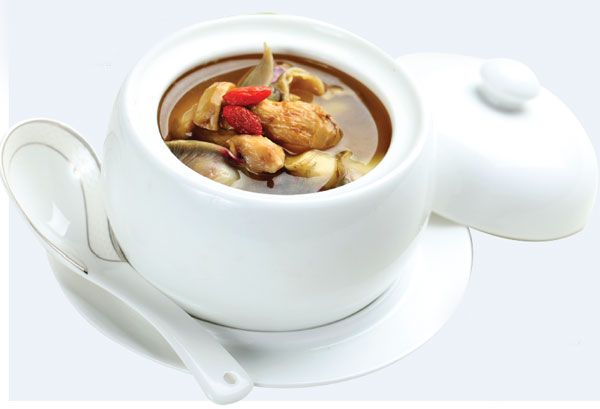
Mushrooms may add more depth, while aromatics such as ginger, garlic, leeks and onions complete the profile.
Chefs may also mix and match ingredients, using combinations of pork and chicken, for example.
The Chinese word xian, which indicates deliciousness, is made up of the characters for fish and lamb, which may give us a hint to how Chinese chefs thinks.
Superior stocks are used for noodles in soup, or as the foundation broth for dumplings. Sometimes, they may be chilled into a jelly, which is then added to moisten minced meat used for filling for buns and dumplings.
At times, they are the canvas for other ingredients such as tofu or greens.
Then there is that Rolls-Royce of all stocks, the supreme stock, the brewing of which is an art in itself.
Every master chef has his own secret recipe, with a list of ingredients as long as his arm and a cooking time that may stretch over several days.
In an old Chinese text on cooking, the ingredients alone take up several scrolls and include an old mother hen, a duck, several chicken carcasses, pigeons, pork ribs, pork marrow bones, dried scallops, kelp, soybeans, beef marrow bones, carrots, turnips, radishes, white of leeks, dried flatfish and a whole medicine chest full of Chinese herbs and roots.
Another equally ancient recipe calls for 10 to 12 chickens, skinned and scrubbed clean of internal organs and blood and slowly simmered until the bones go soft. The stock is then filtered and the liquid reduced until it naturally thickens and turns to liquid gold.
For clear stocks very like the French consomme, eggs are beaten and floated into the broth. As the beaten egg cooks and congeals, it gathers up all the impurities. After the stock is filtered, what is left is a flavorful clear liquid.
Such stock will be used to cook dishes that look deceptively simple.
In Lu or Shandong cuisine, the cooking style of the imperial kitchens of the Forbidden City, there is a tofu dish in which soft beancurd is hand-cut into hair-like shreds and eased into a golden broth.
It looks just like a plain tofu soup until the first mouthful. That is when the full flavor of the golden stock fills the mouth with a richness that betrays its humble appearance.
In Sichuan cuisine, too, chefs like to play this trick of artifice.
The tender shoots of mustard greens are presented in a bowl of liquid in a dish named Clear Water Vegetables. The crystal broth is the result of very long, slow simmering of chicken meat to extract its essence. It may look like water, but it tastes like heaven.
It is not only Lu cuisine that places great importance on the quality of its stocks. In the south, the delicate flavors of Huaiyang cuisine, too, are best represented by the full flavors of its soups and broths.
The Cantonese chefs, of course, would not know how to cook without their stockpots.
paulined@chinadaily.com.cn
Simple chicken stock for noodles
1 whole chicken or two chicken carcasses
1 piece ginger, crushed
1 bunch spring onions, knotted
1 teaspoon quality Chinese wine
2 liters water
First, prepare the chicken by removing skin and all visible fat. Carefully check the insides and remove any blood clots or innards.
Rinse, dry and rub with salt and Chinese wine.
Heat up the water and when it is boiling, slip the chicken in, adding the ginger and knotted spring onions. As soon as the pot comes back to a boil, turn down heat to a gentle simmer.
Skim off bubbles and scum as you watch over the stock. Do not overcook or the proteins will break down too much and lose flavor.
By the end of 45 minutes to an hour, you should have a tasty stock. Pour through a sieve and remove the solids.
Cook noodles and vegetables separately and place in a bowl. Ladle hot broth over.
| Mushrooms add more depth to good stock. Photos Provided to China Daily |
(China Daily European Weekly 08/25/2017 page18)





Today's Top News
- China to apply lower import tariff rates to unleash market potential
- China proves to be active and reliable mediator
- Three-party talks help to restore peace
- Huangyan coral reefs healthy, says report
- PLA conducts major drill near Taiwan
- Washington should realize its interference in Taiwan question is a recipe it won't want to eat: China Daily editorial