Village with a difference









The river that runs through Chengkan is artificially split into several small canals that pass every home, so every one of the 700 houses in the village gets water from the river
Chengkan village has a special layout. It is in the form of eight trigrams derived from the Yijing, a set of books dating back about 2,000 years that are often referred to in fortune-telling and feng shui.
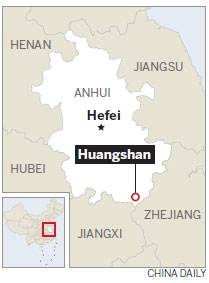
The village, at the foot of Huangshan Mountain in Huangshan, Anhui province, is an innovative combination of buildings and natural elements, such as water.
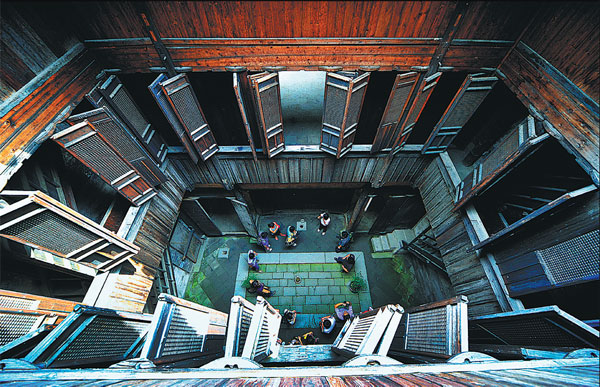
| A feature of Yanyi Hall in Anhui province is that the ceilings of the ground and first floors have three layers. Yu Xianmin / For China Daily |
| A traditional building in Chengkan village, Anhui province . Fang Ping / For China Daily |
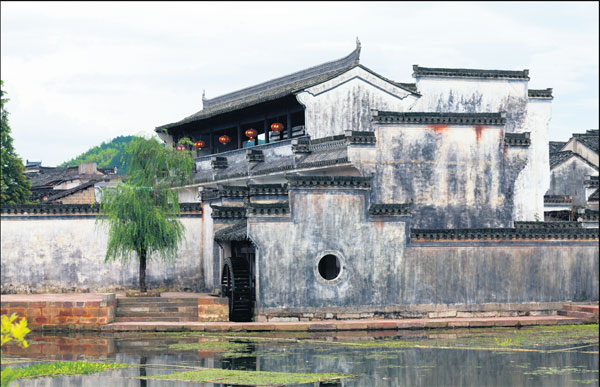
Thanks to planners' use of Yijing theories, it has been known as "the first village south of the Yangtze River" since the Song Dynasty (960-1279).
An S-shaped river runs through Chengkan, separating the eight trigrams, and the river is artificially split into a number of small canals that pass every house. So all of the 2,000 villagers get water from the river.
All of the canals merge into Yongxing Lake at the other end of the village.
The villagers say there used to be a timetable and rules on water use before the village had running water.
Earlier, the water was used for drinking before 8 am, and for washing and laundry later.
Although most residents use tap water nowadays, some old people still use water from the canal.
Eight hills surround the village. If you take any of its three main roads or 99 alleys, most of which are curved, it is hard to find your way out of this labyrinthine community.
Only the locals know their way around their complicated yet organized neighborhood.
So if you want to get to the center of the village, you walk against the water flow in the canal, and if you want to get out of the village, you follow the direction of the water.
There are more than 100 villages in Huangshan, all beside rivers that value the shuikou, or the water mouth, located at the entrance of the village.
It is believed that the effort taken to design the shuikou is time well spent, since feng shui gives a lot of importance to water, which signifies fortune.
Thus, making water an integral part of a structure is considered key to good luck.
The shuikou is also regarded as a prototype of an ancient public garden in Chinese villages.
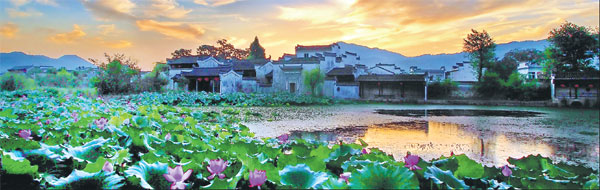
Yongxing Lake, to the west of Chengkan, is believed to be auspicious for the village, together with its river and hills.
Chengkan has produced a galaxy of talented people in various fields because of that.
Beside the lake there are ancient buildings that are used as training sites for local craftsmanship, such as bamboo carving, wood carving, ink stone carving, ink making and paper-tearing, all of which are listed as intangible cultural heritage.
There, visitors can interact with the artists.
The door culture, another unique tradition, is where villagers teach you how to cross a threshold.
According to tradition, a man must always cross a threshold with his left foot first, while a woman must use her right foot.
Also, it is hard to ignore the delicate stone sculptures of the mythical creature tun on either side of the door.
Touching their tongues will rid you of bad luck, and touching their heads could win you a work promotion, locals say.
Chengkan's architecture, mostly dating back to the Ming Dynasty (1368-1644), is also a big draw, with five public buildings and 15 residential houses listed as cultural relics under State protection.
The two most impressive buildings are Xiawu and Yanyi Hall.
Xiawu, which covers about 2,000 square meters, was considered one of the largest private residences during that time.
It used to be the residence of Luo Xiaohua (1516-1565), a renowned ink maker, whose work is preserved in the Palace Museum in Beijing.
The buildings are a magnificent representation of the Hui style, an influential school of culture.
Now the building houses the Yijing Museum, and tourists can experience Yijing culture there while enjoying the beauty of its original brick and wood carvings.
Yanyi Hall is a three-story house. Its design has a unique feature in that the ceilings of the ground and first floors have three layers - wood, sand and stone - to combat fire.
So if the wood catches fire, sand helps extinguish the blaze, and if it is not enough, the stone bricks prevent the fire from spreading.
Luckily, the system has not had to be used.
peipei@chinadaily.com.cn
| Yongxing Lake, which is situated to the west of Chengkan, is regarded as auspicious for the village. Zhang Guochun / For China Daily |
(China Daily Africa Weekly 08/25/2017 page22)





Today's Top News
- Militarism revival efforts criticized
- Leadership highlights Party conduct
- Forging a human-centered future in era of smart machines
- Land-sea trade corridor key to regional progress
- Local rules to be reviewed to help disabled
- Stronger RMB points to resilience